Dangerous goods transport: the team
 Prolog 6 min read
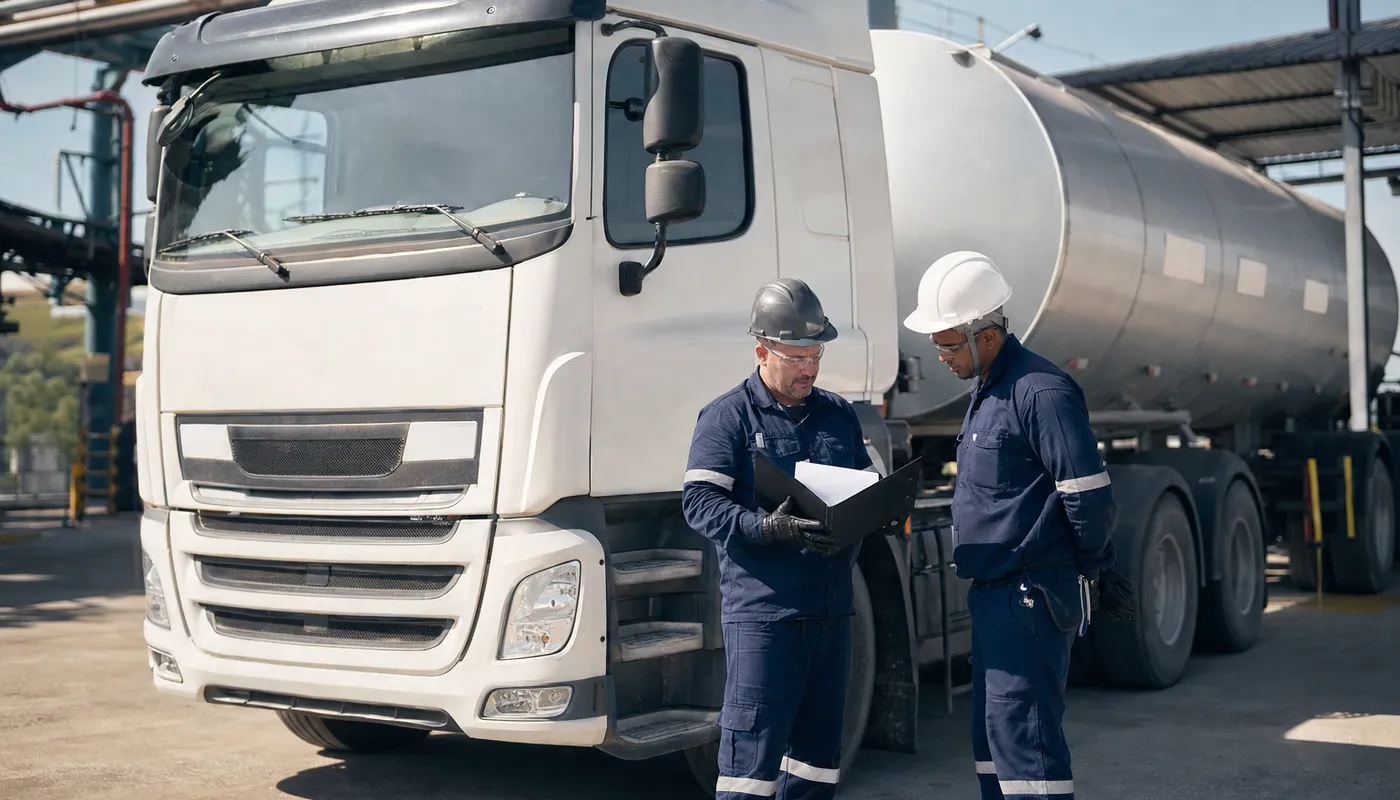
Operating with products classified as dangerous requires more than fitting a vehicle into the schedule. Fleet management needs to treat people, documents, responsibilities, vehicles and equipment as parts of the same operational control.
In dangerous goods transport, professional training and renewal must be handled carefully because, in Brazil, the activity itself is subject to specific rules and procedures. When the available dossier does not provide expiration deadlines, fines or detailed course requirements, the safest approach is to organize what is substantiated: which rules exist, who regulates the activity, which documents are part of the process and which certificates need to be kept track of.
Dangerous goods transport has its own rules
In Brazil, ANTT, the National Land Transport Agency, states that the transport of products classified as dangerous is subject to the rules and procedures of Resolution No. 5.998/2022. The agency also states that it has authority to regulate dangerous goods transport by road and rail.
This changes how the team is managed. The fleet is not simply assigning people to trips: it is organizing an operation that needs to align with transport conditions, documentation, duties, obligations, responsibilities and applicable violations, topics ANTT describes when presenting dangerous goods regulations.
For management, this calls for a checking routine before the operation. The company can organize controls by the people responsible, documents, vehicles, equipment and the status of each item. This organization does not create a new legal obligation; it simply helps the team clearly see what needs to be checked under the applicable rules.
Driver training is part of operational control
In Brazil, Resolution No. 789/2020 from Contran, the National Traffic Council, consolidates standards on the training process for drivers of motor and electric vehicles. For a fleet working in dangerous goods transport, this reinforces the need for driver training to appear on the same management dashboard used to keep track of operational availability.
The main concern is to avoid treating training as an issue separate from the rest of the routine. If the schedule shows who drives, training control shows which drivers have their documentation status reviewed by the company. If the operation requires document checks, management needs to know who consults, updates and validates that information before authorizing an activity.
A simple way to structure this management is to maintain a list of drivers, associated documents, the person responsible for checking them and the date of the last internal check. This type of control is administrative: it does not replace the regulation, create an official deadline or remove the need to read the applicable rules. Its purpose is to give the team visibility into what has already been checked and what still needs review.
Renewal without inventing deadlines or fines
The topic concerns professional renewal, but the dossier used for this post does not provide specific renewal deadlines, expiration dates or fine amounts related to training for dangerous goods transport. The correct approach is therefore to discuss an internal review calendar without asserting expiration dates that have not been confirmed by an official source.
This calendar can bring together the items the operation needs to keep track of: driver training, activity documents, the people responsible for checks, vehicle and equipment status and applicable certificates. Each fleet can set its review frequency according to its own routine, as long as it does not treat that internal frequency as a legal deadline.
Renewal, in this context, becomes a management discipline. Instead of depending on individual memory, the company maintains a repeatable process to review information, update outstanding issues and record who checked each item. The value lies in consistent control, rather than creating rules that do not appear in the dossier's sources.
Documentation is also part of team availability
ANTT describes how Brazilian regulations address documentation, duties, obligations, responsibilities and applicable violations. This puts documents at the center of the routine of anyone managing the team: knowing who is scheduled is not enough; it is necessary to know which documents have been checked, who is responsible for the check and which issues remain open.
Controls can separate documents related to the person, the operation, the vehicle and the equipment. This division helps the team avoid mixing different matters in a single list. A driver may be associated with certain supporting documents; a vehicle may have its own requirements; equipment may require certification or inspection when the operation involves dangerous goods in bulk.
In Brazil, ANTT itself states that vehicles and equipment used to transport dangerous goods in bulk must be certified and/or inspected. The agency also states that OCPs (product certification bodies) and OIAs (accredited inspection bodies) are still required to issue physical certificates. Document management therefore needs to cover people as well as the physical items that are part of the operation.
Responsibilities need to be clear
Since the regulations involve duties, obligations and responsibilities, the fleet benefits from explicitly assigning checks. One person can keep track of driver documentation; another can validate vehicle status; another can confirm that physical certificates are organized when applicable. What matters is that each step has a person responsible whom the team recognizes.
This division also reduces ambiguity in the routine. When everyone knows who checks each item, discussions move from generalities to a concrete list: professional, document, vehicle, equipment, certificate, person responsible and status. Simple language helps keep controls understandable for operations, maintenance, safety and administration.
It is also worth standardizing the terms used internally. ANTT refers to products classified as dangerous and to applicable rules and procedures. Using this logic in fleet communication helps the team treat the topic with the same care in schedules, internal checklists and document checks.
Keeping national and international references in view
ANTT states that Brazilian dangerous goods regulations are based on international recommendations from the United Nations Committee of Experts on the Transport of Dangerous Goods. This does not remove the need to comply with the rules applicable in Brazil, but it shows that the topic is addressed within a broader technical framework.
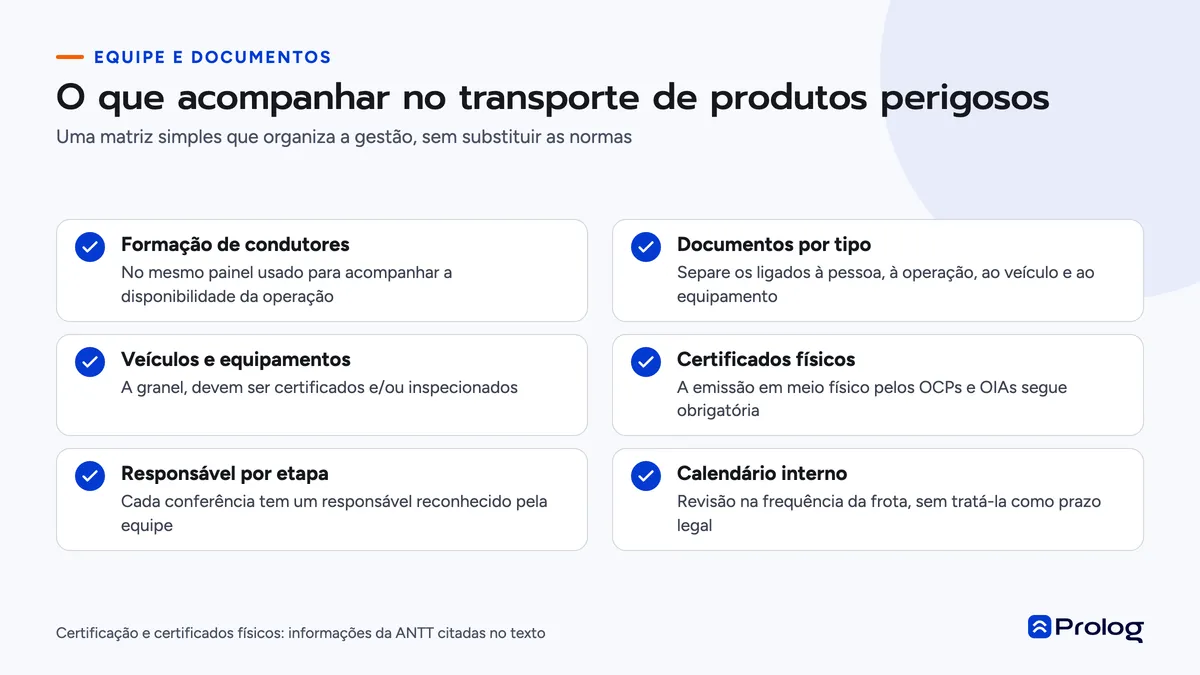
For fleet management, the practical consequence is to maintain a documented process that is easy to repeat. Training, renewal, documentation, certificates and responsibilities need to appear in a routine the team can consult. When controls are clear, the fleet can discuss professional availability based on internal records, rather than just memories or scattered messages.
The next step is to turn the topic into a simple matrix: who can work, which documents need to be kept track of, which vehicles and equipment are part of the operation, which physical certificates need to be available and who confirms each step. This matrix does not replace reading the regulations, but it organizes management so that dangerous goods transport receives the attention the regulations require.
Frequently asked questions
Why does training matter in dangerous goods transport?
Who regulates dangerous goods transport by road and rail?
How should renewal be handled when no deadline is confirmed?
Does document control involve only the driver?
Are physical certificates still part of the routine?
// newsletter
Fleet management content, straight to your inbox
Articles on tires, maintenance and fleet operations. No spam.