
What fleet maintenance downtime is and how to reduce it
 Luiz Felipe 7 min read

Downtime is the time when a vehicle is unavailable for the planned activity. In fleet maintenance, this interval may begin when the vehicle is removed from service and end when it is released again according to company procedure.
An unplanned stop can generate urgent repairs, vehicle reallocation, route changes, delays and pressure on the team. Not all unavailability is avoidable, but recording what happened helps distinguish an isolated occurrence from a pattern deserving investigation.
To reduce downtime, the fleet needs to know when the stop began, what cause was reported, which service stages took place and when the vehicle returned. With this history, it is possible to discuss priorities without treating downtime solely as a final number.
Explore:
- What fleet maintenance downtime is
- What losses does fleet maintenance downtime cause?
- Main causes of problematic fleet maintenance downtime
- How to measure fleet maintenance downtime
- Strategies for reducing vehicle downtime
What is fleet maintenance downtime?
“Downtime” means “time spent inactive.” In fleet maintenance, it refers to the period when the vehicle is unavailable for operation due to planned maintenance, a failure, waiting for a part, technical assessment or another company-defined condition.
This definition needs internal agreement. A vehicle may be physically in the workshop but still waiting for diagnosis, approval, a part, a third-party service or a release test. Recording these stages prevents all the time from being attributed solely to repair.
The indicator does not replace case analysis. It shows the extent of unavailability and raises questions about cause, process and priority: which vehicle stopped, in what condition, for how long and what could have been done differently?
What losses does fleet maintenance downtime cause?
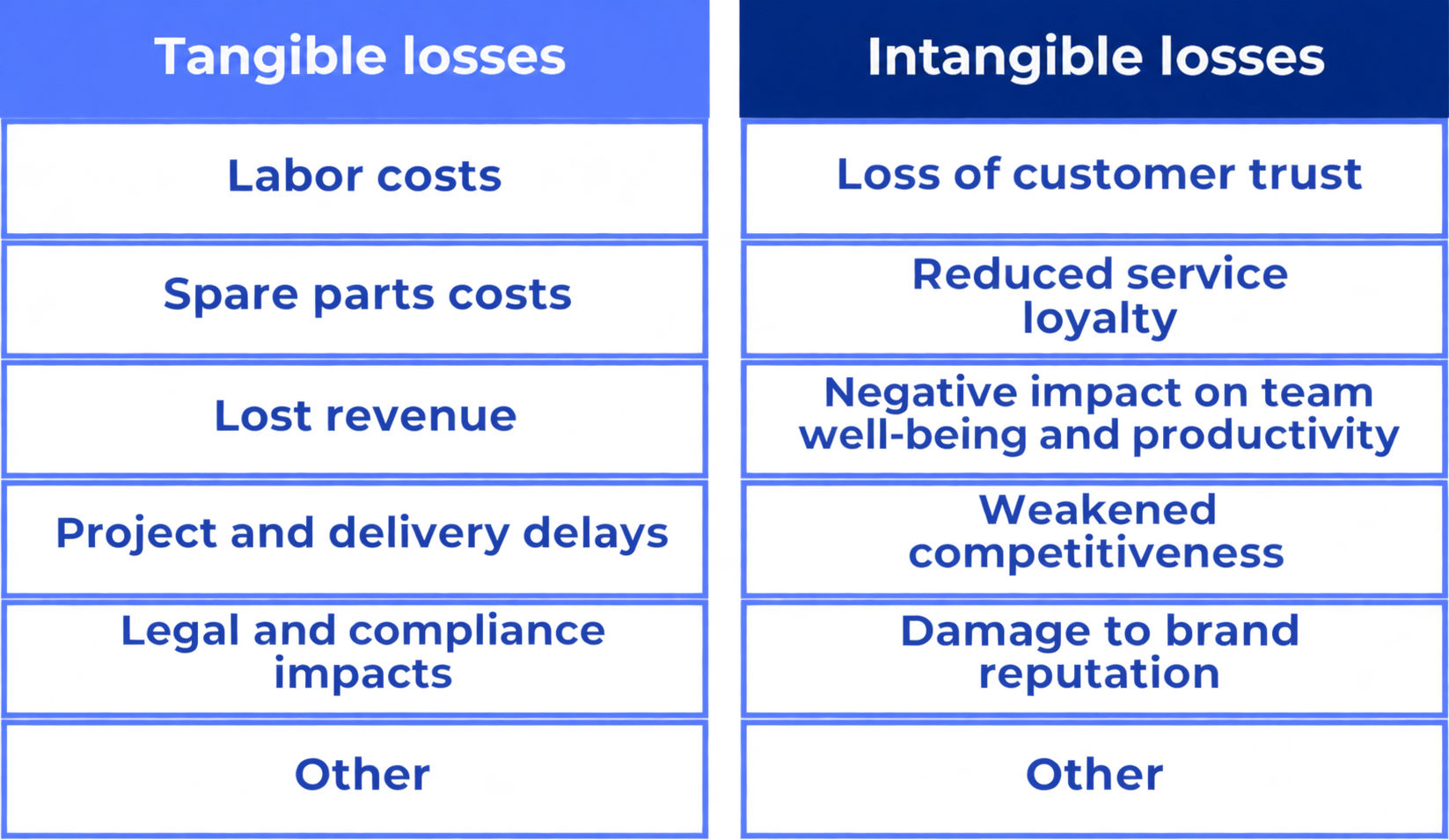
Downtime losses can be tangible and intangible. The former include labor, parts, emergency services, a replacement vehicle and impacts on an activity left unperformed. Each cost must be calculated according to the company’s financial model.
There are also effects that are harder to measure, such as route replanning, team overload, deadline pressure and strained relations with customers or business partners. They should not be ignored, but neither should they be turned into estimates without criteria.
When the same stop type appears frequently, history helps check whether there is a maintenance, inventory, diagnostic, supplier, planning or recording issue. The cause should not be presumed simply because two vehicles were stopped for the same period.
Main causes of problematic fleet maintenance downtime
Failed preventive maintenance scheduling
The absence of, or failure to carry out, a preventive maintenance schedule can increase the risk of the company discovering an issue only when it already affects availability. Inspections and scheduled services do not eliminate all failures, but offer an opportunity to identify conditions requiring assessment.
To work, the plan needs to consider the vehicle, application, technical recommendations and company routine. A schedule that exists only in a spreadsheet, without a person responsible, execution records or handling of outstanding issues, does not prevent a stop by itself.
Preventive maintenance is a way to organize attention before a more serious failure. When an inspection indicates an abnormality, a decision must be made and recorded on whether it will be corrected, monitored or sent for technical assessment.
Lack of spare parts in inventory
The unavailability of a necessary part can extend downtime. After the team identifies the item, quotation, approval, purchase, delivery and installation may still be needed; the wait therefore needs to appear in the history rather than remain hidden in total workshop time.
Maintaining strategic inventory does not mean storing every possible part. The decision depends on criticality, consumption, replenishment lead time, cost, space and vehicle characteristics. Maintenance records themselves help identify which items deserve closer attention.
It is also important to check that the received part matches the application and that the withdrawal and return flow is recorded. Inventory without identification or checks can create a new cause of waiting.
Maintenance management shortcomings
Management inefficiencies can arise when there is no defined priority, communication between workshop and operations, service history or oversight of outstanding issues. A lack of a maintenance management system can make organization difficult in some fleets, but a system only helps when the process and records are consistent.
A work order with date, vehicle, symptom, diagnosis, parts, people responsible and current stage makes the discussion more concrete. It does not replace technical knowledge but allows an understanding of where service stalled and what information is still missing.
With a routine for keeping track of work, the company can organize preventive and corrective maintenance, communicate impacts to operations and review recurring causes. The aim is to provide process visibility, not promise that vehicles will always be available.
Poor maintenance service quality
An incomplete repair, an unsuitable part or an incorrect diagnosis may cause the vehicle to return to the workshop and increase unavailability. This does not justify concluding that every return is a supplier failure: each occurrence needs analysis using the vehicle and service history.
Training, inspection procedures, part specifications and service validation are measures that help reduce rework. When releasing a vehicle, record what was done, who assessed it and which signs require a return or monitoring.
How do you measure fleet maintenance downtime?
Start by defining the starting and ending events of the calculation. One possible rule is to record when the vehicle is removed from service and when it is released to return to operation. The company needs to document whether waiting, diagnosis, parts purchasing and testing periods form part of the indicator.
Total unavailable hours show stop duration but do not explain the issue alone. Also record vehicle, reported reason, service type, person responsible, parts used and service stages. This allows analysis to compare similar occurrences rather than group different situations together.
Data can be recorded manually or in a management system. The tool can facilitate access and alerts, but accuracy depends on who reports each stage and a routine to correct incomplete records.
The formula for calculating downtime is a starting point:
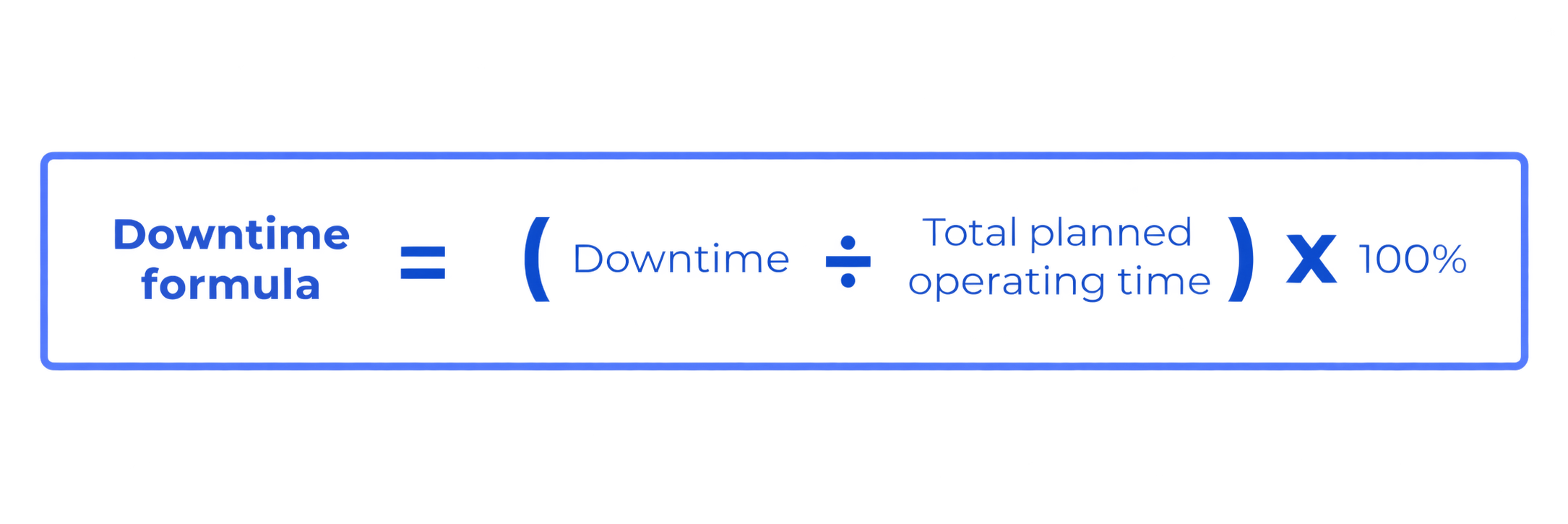
Complement the interpretation with indicators such as Mean Time Between Failures (MTBF) and Mean Time To Repair (MTTR). They answer different questions: interpretation needs to consider definition, period, vehicle population and record quality.
Strategies for reducing vehicle downtime
Implement a preventive maintenance routine
A preventive routine helps plan inspections and services before a known condition develops. Preventive maintenance needs intervals, criteria, people responsible and records; without these, it becomes merely an intention.
Use history to review intervals and priorities. A plan should be adjusted when the application, vehicles, load or fleet occurrences show that the current routine no longer represents the operation.
Manage parts inventory properly
Inventory management connects parts, consumption, suppliers and maintenance services. Identify critical items, keep track of replenishment lead times and review quantities based on history, without copying another fleet’s parameter.
Besides increasing predictability, this control allows bottlenecks to be located: a stop may be related to purchasing, approval, delivery or item identification, and each case requires a different action.
Train the maintenance team
Continuous training and development help the team follow procedures, record diagnoses and perform repairs consistently. Training should be compatible with each professional’s vehicles, components and responsibilities.
A well-prepared team does not eliminate the need for parts, tools or planning, but is better placed to communicate findings and prevent relevant information from being lost between workshop and operations.
Establish partnerships with external suppliers
External suppliers can expand service capacity when the internal workshop does not perform a particular service. Before depending on this alternative, define scope, quality criteria, contact, response deadline and how the company will record the service.
The partnership can reduce waiting in some cases, but the result depends on availability, approval and vehicle condition. Keep track of history to assess where the relationship works and where recurring bottlenecks exist.
Use technology and data analysis
Maintenance monitoring systems can organize work orders, outstanding issues, inventory and vehicle history. The value lies in turning records into action: identifying a stop, confirming the current stage, assigning responsibility and reviewing what recurs.
Historical data analysis also allows comparison of service types, waiting times and reported causes. It points to where to investigate but does not replace technical assessment or prove a cause without evidence.
To structure your operation’s records, explore the Prolog App solution. Explore the maintenance management system and features focused on maintenance routines.
Frequently asked questions
What is downtime?
How do you calculate fleet downtime?
What are the main causes of fleet maintenance downtime?
What losses does downtime cause?
How can fleet downtime be reduced?
// newsletter
Fleet management content, straight to your inbox
Articles on tires, maintenance and fleet operations. No spam.
Read also
 Fleet maintenance management

 Fleet maintenance management
Automatic truck: signs of transmission failure
See the signs of automatic transmission failure in trucks, fluid care tips and when to take the truck to the shop for a specialized diagnosis.
Image: Ford Caminhões
 Jean Zart