Rest stops for professional drivers in Brazil
 Prolog 5 min read

For those operating road freight or passenger transport, a stop is more than a break along the way. When routes depend on professional drivers, deciding where to stop needs to consider rest, safety, comfort and the actual availability of facilities.
Brazil's Pontos de Parada e Descanso, known as PPDs (stopping and rest areas), are one part of this planning. They were established by Brazilian Law No. 13.103 and exist to support waiting, rest and breaks for professional road transport drivers.
What are rest stops for professional drivers?
In Brazil, PPDs are stopping and rest areas located beside highways or in areas under federal jurisdiction. Their purpose is to offer suitable places for waiting, rest and breaks for professional road transport drivers.
In fleet operations, this changes the way routes are viewed. A stopping point should not be treated merely as a commercial convenience or a fuel station familiar to the driver. When it comes to professional rest, the reference becomes a recognized facility meeting minimum sanitary, safety and comfort conditions for users.
This difference matters because stopping is no longer an improvised choice along the way. It enters planning as part of working hours: where drivers can stop, what conditions exist there and whether the facilities suit the type of operation on that stretch.
How PPD certification fits into compliance
Recognition of establishments as Ponto de Parada e Descanso on Brazil's federal highways follows procedures defined by official regulation. Ordinance No. 45, of March 11, 2021, establishes procedures for this recognition.
In Brazil, to become a PPD, the establishment needs to attach documentation such as an active CNPJ (Brazilian company registration number), operating permit and photos of its facilities. It must also host an inspection by the body responsible for the highway's jurisdiction and be present throughout it.
There are formal deadlines in Brazil's process. Preliminary assessment has a maximum period of 40 calendar days from the opening of the administrative PPD certification process. Inspection must occur within a maximum of 30 days.
For carriers, the central point is operational: a location planned as a rest stop needs a documentary basis and an inspection, rather than just an informal reputation. When planning a route, it is worth distinguishing known stops from stops recognized as PPDs, especially when professional driver rest depends on that stop.
Minimum infrastructure: what to check before adding a stop to a route
Rules from ANTT, Brazil's National Land Transport Agency, indicate that PPDs must have minimum essential services, without preventing other services from being offered. The specified items include a kitchenette, rest lounge, tables and chairs for meals.
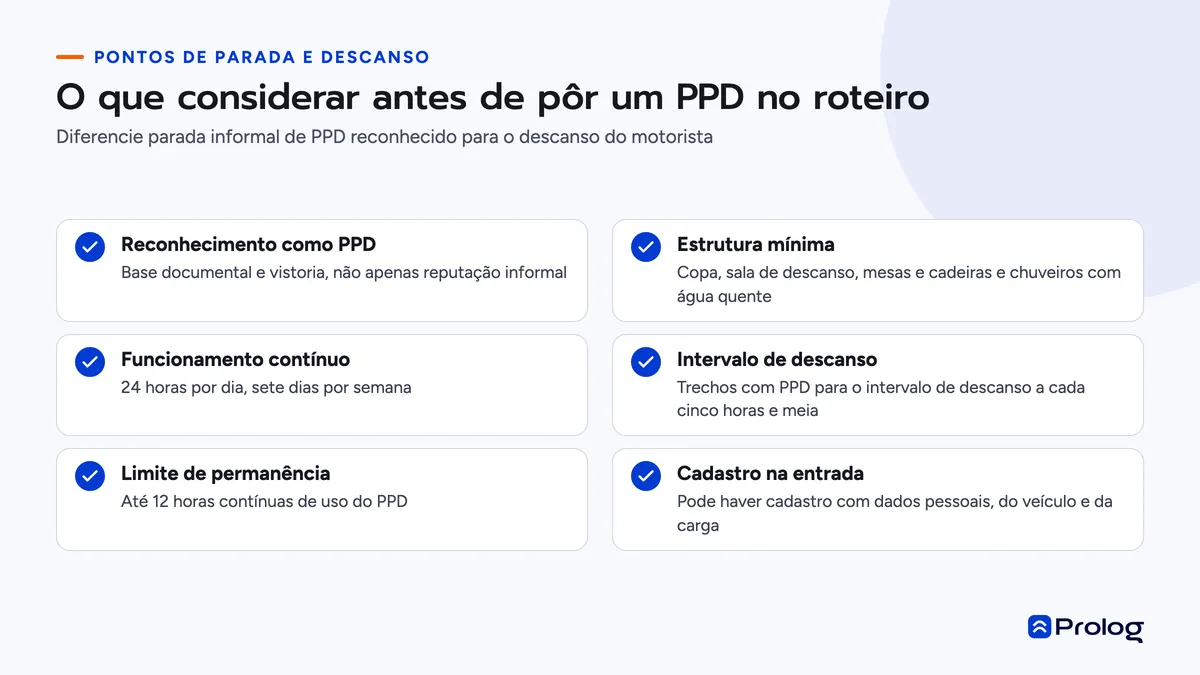
Accessible showers with hot water are also listed in Brazil's rules. These details seem simple, but are important for assessing whether a stop really supports driver rest and recovery, rather than just a quick interruption of the trip.
Another point is continuous availability. The rule cited by Brazil's ANTT provides for operation 24 hours a day, seven days a week. On routes with varying schedules, this reduces the risk of planning rest at a location unavailable when the vehicle arrives.
Signage also plays a role in operations. In Brazil, the number of available spaces must be displayed on the main highway in both directions. For managers, this information helps reduce uncertainty: the team does not depend only on prior contact or on a trip report to know whether there are visible facilities along the stretch.
Rest, usage time and parking access
In Brazil, PPDs are facilities intended for fulfilling mandatory rest periods. Working hours planning should therefore treat these stops as part of operations, rather than an issue isolated to the driver.
Brazil's ANTT also provides for stretches to include a minimum number of PPDs to meet the rest interval every five and a half hours. This rule is relevant to route designers because it connects distance, driving time and availability of a suitable stopping place.
In Brazil, there is also a maximum limit of 12 continuous hours for using a PPD. This prevents the area from being treated as indefinite parking and reinforces that use is related to operational rest.
Access to the restricted parking area also has a rule in Brazil: only road passenger or freight transport vehicles may enter. In some cases, truck drivers must register personal information, vehicle data and details of the cargo carried. For operations, this means drivers may need advance guidance on documents and information required at entry.
PPD models and the start of operations
Brazil's ANTT distinguishes PPD models. The basic model is intended only for professional road passenger and freight transport drivers. The partnership model is developed as part of a project generating non-tariff revenue.
This distinction helps avoid treating all stops the same. Not every PPD will have the same implementation approach, additional services or operational arrangement. What needs to be preserved for planning purposes is the main function: serving professional driver rest within the conditions provided.
For new PPDs in Brazil, starting operations depends on compliance with the applicable resolution. This matters to carriers because a facility that is announced or being implemented should not automatically be considered available on the route. Before including it as a rest stop, operations should confirm it is already fit to operate under the rules.
How to apply the rules to route planning
Practical application starts with a list of critical stretches. Long routes, night operations and trips with tight windows require greater care to identify stops compatible with rest. When there is a PPD along the way, record its location, known conditions and access guidance for drivers internally.
Then connect the stop to driving and rest times. Brazil's rule on rest intervals every five and a half hours shows that the distribution of PPDs along a stretch is part of route feasibility. Calculating arrival and delivery is not enough; you need to know where drivers can rest in suitable facilities.
It is also worth standardizing communication with drivers and the operations control tower. Explain whether the stop requires registration, what data may be requested and the length-of-stay limit indicated by Brazil's rule. This avoids surprises when accessing the facility, lost time at entry and improvised decisions on the shoulder or at locations without facilities.
Finally, review routes whenever a stop's condition changes, it stops meeting requirements or a new PPD emerges under Brazil's resolution. The aim is not to turn managers into establishment inspectors, but to ensure planned rest is supported by stops compatible with the rules and the reality of the route.
Frequently asked questions
What are rest stops for professional drivers?
What minimum conditions should a PPD offer?
How does an establishment become a PPD?
How do PPDs affect route planning?
Can every stopping point be treated as a PPD?
// newsletter
Fleet management content, straight to your inbox
Articles on tires, maintenance and fleet operations. No spam.