
Heavy vehicle fleet management: where to start
 Luiz Felipe 7 min read

Truck fleet management organizes the operation's assets, costs, maintenance, people and information. It helps the company see its priorities, but the results depend on consistent processes and on decisions suited to the context of each activity.
The starting point is to understand which routines need to be recorded, who is responsible for each one and how the team turns records into actions. Having a task list is not enough: you need to check whether it was carried out and what the data indicate.
See the concepts and practices that make up this routine:
What is truck fleet management?
It is a type of management focused exclusively on truck fleets. In it, there is full control of the vehicles, from action planning through to the operational side.
It is generally carried out by someone who already has broad experience in the sector and knows a lot about heavy vehicles.
Why does truck fleet management matter?
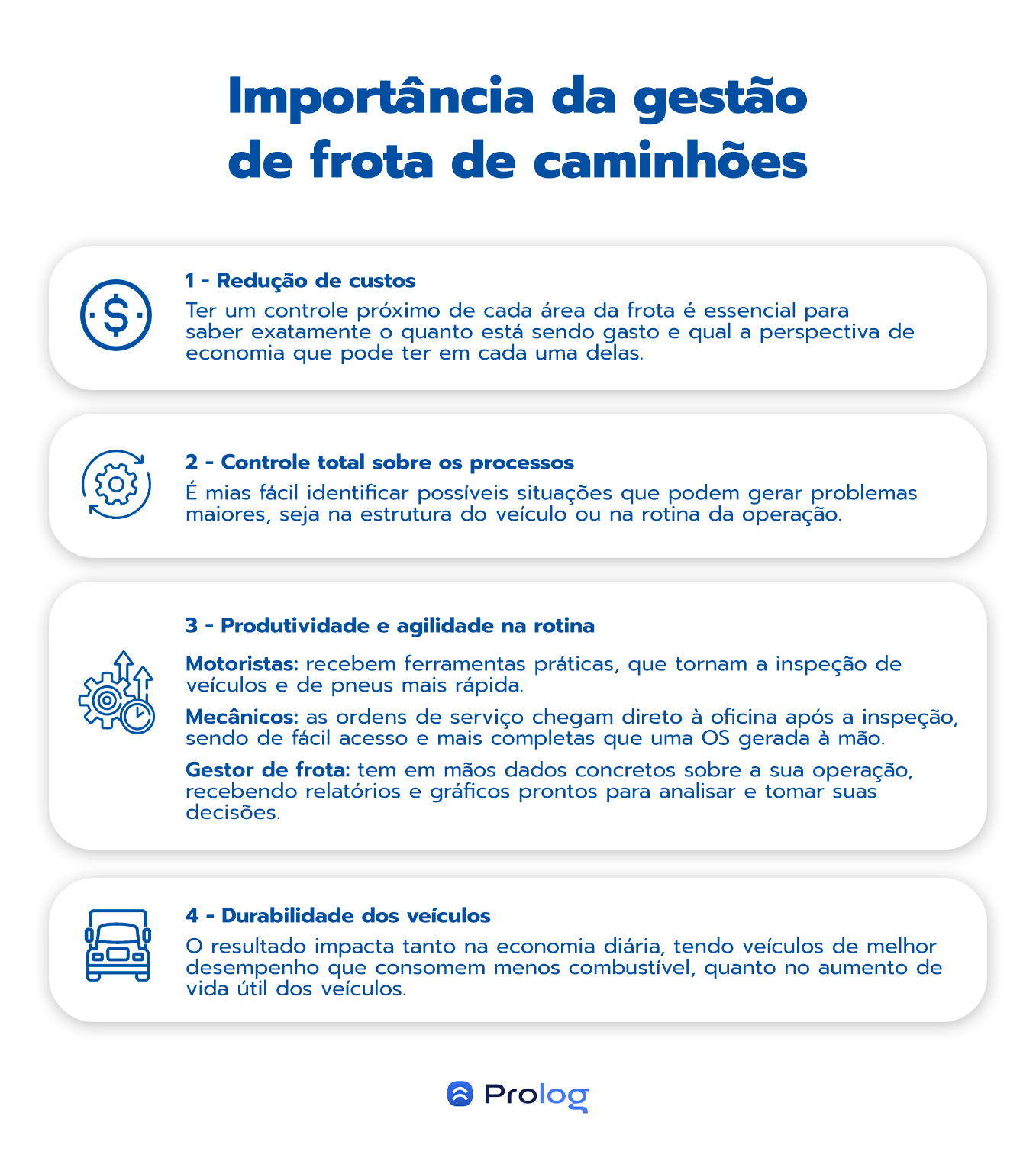
Trucks concentrate assets, components and routines that require continuous attention. Management focused on them helps organize costs and maintenance; safety also depends on inspections, operating conditions, training and an appropriate response to incidents.
The benefits that make truck fleet management essential are:
Cost reduction
When we talk about costs, there are several factors involved, from fuel expenses to the purchase of new vehicles.
Having close control of each area of the fleet is essential to know exactly how much is being spent and what the savings outlook in each of them may be.
In addition, starting from the principle of having full control over the processes, truck fleet management helps identify possible situations that can create bigger problems, such as tire wear.
Productivity and agility in the operation's routine
With well-defined processes and tools suited to the routine, the team can organize the work on several fronts:
- For drivers: they have guidance and tools to record vehicle and tire inspections according to the defined process.
- For mechanics: work orders can bring together the incident report, the priority and the history needed for the service.
- For the fleet manager: the records can support reports and analyses, as long as they are verified before decision-making.
Vehicle durability
Truck fleet management should include a preventive maintenance plan. The intention is to identify service needs before they get worse, following the technical recommendations and the company's procedures.
You need a standard for carrying out fleet inspection, always checking the crucial items daily and having a forecast for wheel alignment services, replacement of suspension springs, and so on.
How do you manage a truck fleet well?
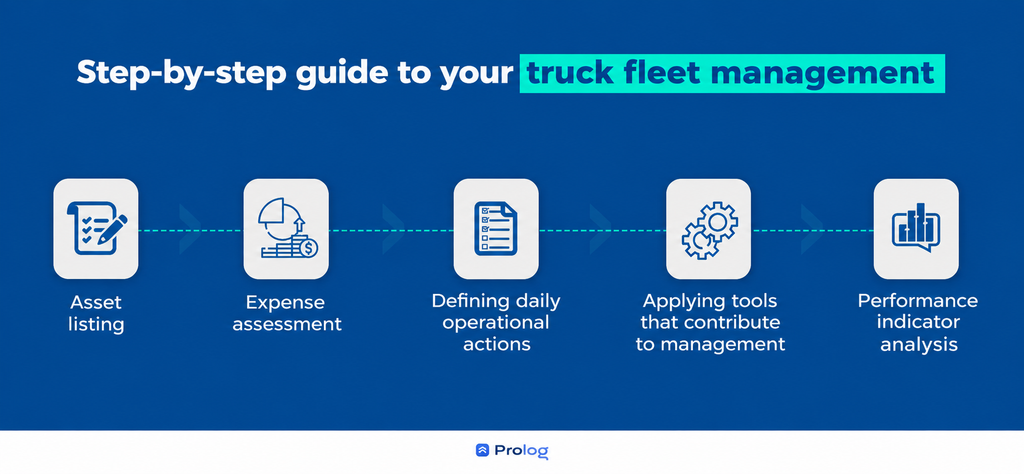
1 – Asset listing
As with any fleet, to start your management, you need to list all the vehicles in the operation, whether they are available for use or not. After all, even idle vehicles bring costs to your business and must be accounted for to also determine what will be done with them.
In this record, you can also identify elements such as:
- Model and make;
- Mileage driven by each truck;
- Date of the last inspection;
- Whether there is an open work order;
- Vehicle year;
- Among other information.
2 – Expense survey
Next, organize the operation's expenses into fixed and variable, with categories that make sense for the company. Comparison between periods is only useful when the recording criteria remain clear.
For example, record the assumptions used to plan the purchase of vehicles, fuel, tires, maintenance and other expenses. A historical average can guide the analysis, but it does not replace investigating relevant variations.
3 – Defining daily actions in the operation
What should each employee do to help your management? Drivers, for example, should complete the truck inspection checklist every day, requesting preventive services whenever necessary.
This way, they contribute to your management by preventing vehicles from having problems and generating higher costs in your budget.
4 – Applying tools that contribute to management
Finding out which are the main tools that collect the data you need for your management, and taking part in product demonstrations, can be somewhat time-consuming work, but it pays off quickly.
Focus fully on what really solves a problem in your operation's routine.
5 – Analysis of performance indicators
Daily routines can generate useful data for analysis:
- Inspections record observed conditions and pending items that need technical assessment; on their own, they do not prove the cause of any damage.
- Monitoring services hired from third-party providers can support mileage control and the analysis of a vehicle's useful life.
- Tire inspections can feed the cost per kilometer calculation when the company defines the method, records the necessary data and checks its consistency.
Therefore, it is essential to include keeping track of and analyzing the indicators in your task list, always understanding the fleet's performance and where it can improve even further.
Golden tip for economical, high-performance management
To achieve the best results in truck fleet management, you should pay close attention to the vehicles' preventive maintenance area.
After all, they are fundamental to the fleet. Their proper operation makes it possible to generate savings in the other areas, such as fuel and tires.
That is why you should have a complete maintenance management process in your routine and even bring in someone to be responsible for it and give this area all the attention it needs.
For example, to create different inspection checklist templates to carry out fleet maintenance — something that you, taking care of all the fleet's other bureaucratic and administrative matters, may not be able to do.
What is preventive maintenance?
Preventive maintenance brings together planned services to reduce the chance of failures and identify needs before they get worse. The frequency and the items of each activity should follow the technical recommendations, the operating conditions and the company's plan.
The driver can carry out checks provided for in the procedure when instructed to do so. Inspections or services that require technical competence should be referred to the responsible team.
Through a vehicle checklist, several items are listed and must be inspected to determine whether they are damaged or worn. Other factors, such as engine oil and tire calibration, are essential for a vehicle to run properly and should likewise be on the inspection list.
This maintenance process in truck fleet management is what helps maintain high performance and productivity in operations.
How do you carry out preventive maintenance in truck fleet management?
As we mentioned, the maintenance checklist is essential. It helps make the task faster and more practical, optimizing the company's transport operation.
In recent years, many solutions have emerged to make managers' work easier. Among the alternatives, the digital checklist (also called “electronic”) helps make preventive maintenance faster.
Next, to carry out preventive maintenance correctly, you need a trained team.
In addition, you need a maintenance routine and a schedule with the forecast of the next truck inspection dates.
The next step is to run the checklist defined for that activity and record the result.
In daily checklists, include the essential items for the route, such as headlights, brakes and seat belt, according to the internal procedure and the applicable requirements. Items with irregularities should have a clear follow-up action.
When making long-distance trips, or for less frequent inspections, such as semiannual ones, you need a complete checklist.
You should check the internal components, the electronic fuel injection, the engine compartment, the lower components, the wheel geometry, the brakes and the exhaust.
It is important to note that these are the checklist's “broad groups”. Within each of them, several details are included.
For example, when we talk about the engine, you need to check the oil, whether there is any leak, the level of the coolant reservoir, etc.
What is more, tires should be included in the checklist. Although they are managed almost separately from general management, they need to be checked before the trip — both to analyze their operating condition and to carry out the correct calibration.
Prolog offers maintenance management, tire management and electronic checklist modules. Discover the solutions and assess how well they fit your operation's processes.
Frequently asked questions
What is truck fleet management?
How do you start managing a heavy vehicle fleet?
What is preventive maintenance in a truck fleet?
What should go into the truck's daily checklist?
What is the difference between the daily checklist and the complete one?
What data does the fleet routine generate for analysis?
// newsletter
Fleet management content, straight to your inbox
Articles on tires, maintenance and fleet operations. No spam.


