Autonomous trucks in transportation: tests and impacts
 Luiz Felipe 6 min read
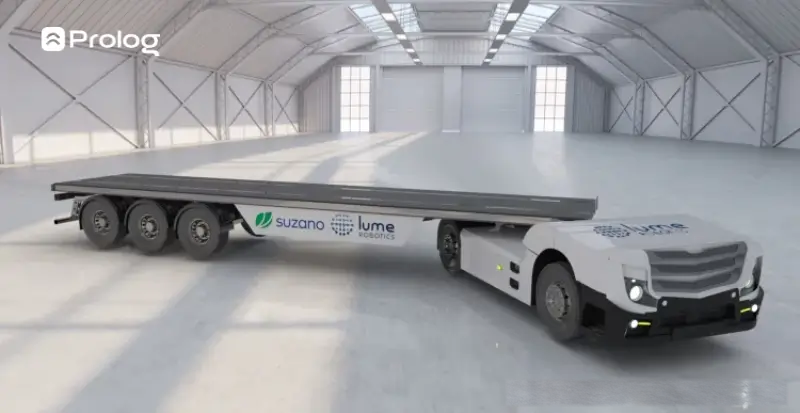
Image: Press handout/Lume Robotics
Have you imagined a fleet with trucks capable of running longer, reducing some dependence on drivers and supporting driving decisions with onboard technology? Autonomous truck transportation already appears in tests and limited operations, but still requires caution before being treated as a widespread reality on highways.
For fleet managers, this evolution raises many questions: How does this technology work? Will it replace drivers? What will the impact be on operations and costs?
In this article, we will answer these questions and show what to expect from autonomous transportation in the coming years:
- What are autonomous trucks?
- What is autonomous truck transportation?
- How do autonomous trucks work?
- What impact does “autonomous transportation” have on fleet management?
- How can you adapt to the future of logistics?
What are autonomous trucks?
Autonomous trucks are vehicles equipped with sensors, cameras, artificial intelligence and other technologies to perform some or all driving tasks, according to their design, automation level and operating environment.
Unlike traditional trucks, these vehicles use systems capable of perceiving their surroundings, interpreting road situations and supporting decisions such as accelerating, braking or maintaining a path. In leading industry technologies, perception combines LiDAR, radar and cameras to form a detailed view of the driving environment.
Some companies are currently validating autonomous technologies through road tests, simulations and structured analyses. There are also driver assistance solutions, in which human drivers remain attentive and ready to take over. But the main goal for part of the industry is to reach highly automated models, such as L4 systems within defined operational domains, which can transform how freight transport works.
What is autonomous truck transportation?
Autonomous truck transportation refers to using autonomous vehicles to make deliveries on highways, in urban centers and industrial areas, with less dependence on human drivers according to the automation level and conditions intended for that operation.
Some companies already use or test autonomous trucks in specific sections, such as ports, industrial areas, mining operations and more controlled routes, where the environment is more predictable. In parallel, industry developers are working to integrate autonomous systems into existing freight operations and allow trucks to run almost continuously, within safety limits and the defined operational domain.
With the evolution of transportation technology, this is a likely industry trend, but should not be confused with universal, immediate adoption on any route.
How do autonomous trucks work?
Autonomous trucks operate through systems combining route planning, environmental perception and automated decision-making, adjusting driving according to the conditions intended for the road and the domain they were designed for.
In some cases, human supervision supports complex or uncertain situations, adding a layer of operational safety. In practice, their functions result from combining sensors, artificial intelligence, maps, connectivity and constant analysis of the surrounding environment.
These vehicles use a range of technologies to pursue safe, efficient driving, such as:
- Sensors and cameras that capture information about traffic, surrounding objects, weather and road conditions.
- Radar and LIDAR that help identify obstacles, nearby vehicles, distance, speed and road signage.
- GPS, maps and connectivity that help the truck follow the planned route and communicate with support systems or control centers.
- Artificial intelligence that processes collected data and supports decisions such as accelerating, braking, keeping a lane or changing lanes when the system is authorized to do so.
What impact does “autonomous transportation” have on fleet management?
If you have asked this and still wonder what to expect, it is important to distinguish expectation from practical application. The impact can be significant, but depends on route type, automation level, technology maturity, available infrastructure and the rules that will guide these vehicles’ use.
With that in mind, some of the main expected impacts are:
- Reduced operating costs: with less dependence on drivers in certain scenarios, labor expenses may change. Technology also seeks more precise, efficient driving, which can influence consumption, maintenance and productivity, provided the operation is prepared for it.
- More efficient operations: autonomous trucks may be designed to operate for longer periods and, in some systems, almost continuously. This can make deliveries more predictable, but does not eliminate stops for refueling, maintenance, inspection, loading, unloading and safety checks.
- Fewer accidents and greater safety: the promise is to reduce factors such as fatigue, distraction and human error, but accident reductions should not be treated as guaranteed in every scenario. There is already evidence of fewer collisions with assistance technologies such as forward collision avoidance, lane departure prevention, blind spot detection and rear-end collision prevention.
Despite these positive aspects, there are also some concerns, such as:
- High initial costs and implementation challenges: despite expected benefits, adopting the technology requires investment in vehicles, systems, operational integration, training and adaptation of road infrastructure.
- Impact on the workforce: drivers remain indispensable in transportation, but their role may change, requiring new skills to operate vehicles with advanced assistance, oversee operations, provide remote supervision or intervene in specific situations.
- Regulation and uncertainties: laws for autonomous trucks are still being discussed in different markets. This means that, however advanced the technology, implementation in road transportation may take longer than expected.
Ultimately, autonomous trucks will not replace traditional fleets overnight, but managers who start adapting now will be one step ahead.
How can you adapt to the future of logistics?
Logistics 4.0 has been transforming transportation through automation, artificial intelligence and real-time data integration.
Until recently, autonomous truck transportation was a distant scenario for many fleet managers, but with this industry transformation already in progress, it must be said: those who prepare early get ahead.
To adapt to the future of logistics, it is essential to pay attention to trends and understand how they may affect your operation. One of the first steps is to closely follow market developments, without treating controlled tests as full adoption.
Team training is another important aspect to consider. With new technologies, the driver’s role and the fleet manager’s role tend to evolve.
Instead of only driving vehicles, industry professionals will need skills to oversee operations, control vehicle performance, supervise automated systems and make strategic decisions.
Also, AI in fleet management is already being applied to optimize routes, support maintenance analyses and organize operational information; gradually testing these new solutions is essential for adopting more efficient processes without depending on promises that are hard to prove.
This can already facilitate the transition when autonomous trucks become a more accessible reality.
In other words, start reviewing maintenance practices, optimizing fleet use, preparing people and developing more structured planning to keep up with industry changes.
If you want to keep up with innovations affecting fleet management and prepare for the industry’s future, subscribe to our free newsletter (in Portuguese)!
Frequently asked questions
What are autonomous trucks?
How do autonomous trucks work?
Will autonomous trucks replace drivers?
What impacts does autonomous transportation have on fleet management?
How can fleet managers prepare for autonomous trucks?
// newsletter
Fleet management content, straight to your inbox
Articles on tires, maintenance and fleet operations. No spam.