Why Avilan Transportes has used Prolog for over 10 years
 Jean Zart 6 min read
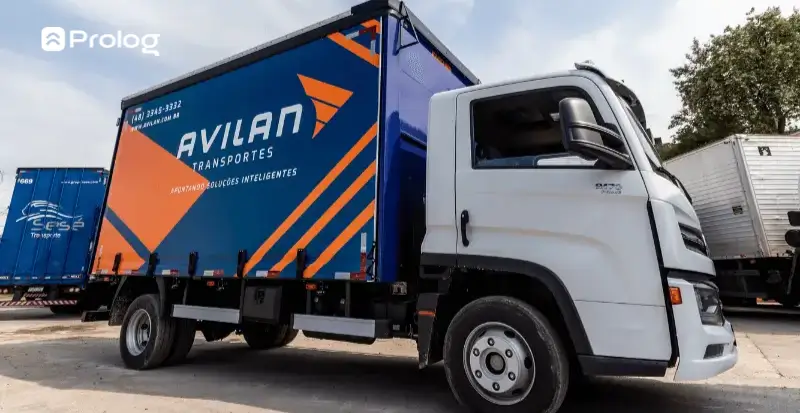
When a carrier with more than 350 vehicles, 850 employees and 70,000 monthly deliveries has operated for more than 10 years with the same management platform (in Portuguese), that says something about the results the tool delivers day to day.
Avilan Transportes is one of Prolog's longest partnerships. The relationship began in 2015, even before Prolog had the solutions it has today, and evolved together with the operation.
Take a look:
- Who is Avilan Transportes
- How management worked before Prolog
- What technology changed in the operation
- The concrete results of the partnership
- What Avilan's path teaches other operations
Who is Avilan Transportes
Avilan is a carrier with more than 30 years of activity in road freight transportation, specializing in urban distribution and warehouse logistics. The operation covers 7 branches, more than 350 active vehicles and a team of more than 850 employees, making more than 70,000 deliveries per month.
Its customers include companies such as Ambev, Leroy Merlin and Portobello, serving segments such as beverages, building materials and ceramics.
It is the kind of operation in which the fleet needs to run every day and any unplanned downtime directly affects the service level.
For an operation of this size, fleet management needs visibility, standardization and reliable data. After all, it has to support decisions that affect hundreds of vehicles and thousands of tires at the same time.
How management worked before Prolog
As happens at many carriers, Avilan operated with manual processes. Tire control was done on paper, inspections depended on notes written in notebooks and information circulated in a fragmented way across the tire shop, the workshop and management.
In the words of an employee, Avilan's corporate manager: “For a long time, we struggled a lot with this tire management. It was something very manual, a lot of paper.”
This scenario is familiar to many fleet managers. The operation works, the deliveries go out, but without real visibility into the condition of the assets, the accumulated costs and where the losses are.
Decisions end up being made out of urgency or individual experience instead of making use of the huge amount of data generated every day.
The partnership with Prolog began in 2015, initially with a driver payment control feature, a solution that has since been discontinued. However, it was from this first contact that the technology began to expand within the operation. And, over the following years, it took in tire management and the electronic checklist.
What technology changed in the operation
Prolog's arrival at Avilan was not a one-off implementation; it was a gradual transition from a paper-based operation to a data-based operation.
In tire management, the electronic tire inspection kit and the control system made it possible to keep an individual record of each tire: pressure, tread depth, position on the vehicle, relocation history, retreading and disposals.
With the electronic checklist, vehicle inspections stopped being paper forms piling up on the manager's desk.
The driver began carrying out the inspection in the app, and any item outside the standard generates a work order automatically, connecting the identification of the issue to the corrective action with no manual steps in between.
This change was not just about the tool. It was about the process.
The standardization the system brought made all employees, at any branch and on any shift, follow the same workflow. As a result, information came to be collected in the same way, analyzed with the same criteria and turned into decisions based on the same indicators.
The impact of this change shows in the leadership's own words. The corporate manager sums it up: “Ever since we got to know the Prolog tool, we migrated to this management model. Our management became much more efficient, much more accurate, with much more speed in decision-making, and today we can no longer see ourselves without using this tool.”
The concrete results of the partnership
Over more than 10 years of use, Avilan's results with Prolog have translated into measurable gains on three fronts:
136% more productivity in tire management
With the electronic tire inspection kit and the integrated system, the tire inspection and control process became significantly faster and more accurate than the previous manual model.
More tire inspections done in the same amount of time, with data going straight into the system, with no retyping and no loss of information.
Elimination of more than 2 tons of paper per month
Digitizing the checklist and tire management removed a significant volume of printed forms, sheets and reports from the operation.
Besides the environmental gain, this meant agility: information that used to take days to reach the manager became available in real time, as each record is made in the app.
Significant reduction in tire costs
With an individual record for each tire, CPK control by make and model, and data-driven purchasing and retreading decisions, the operation managed to significantly reduce what the company's employee calls the “tire bill”:
“The tool came to revolutionize our company, and that led to a significant reduction in spending on the tire bill.”
What Avilan's path teaches other operations
(video in Portuguese)
Avilan's experience with Prolog is not an isolated case but a path that many carriers can follow.
Some points along this path apply to any operation that is considering better structuring its maintenance management and asset control.
The first point is that the transformation does not need to happen all at once. In fact, Avilan started with a simple feature and gradually added solutions as the operation matured. What matters is taking the first step and making sure each stage prepares the next.
The second is that technology without process does not produce results. In practice, Prolog brought the tool, but the results came because Avilan structured processes around it. To do so, it standardized routines, trained the team and began using data to make decisions. In the end, the tool makes it possible, but it is the operation that brings about the transformation.
The third is that the return is cumulative. The first months are for adaptation, process adjustment and building a database. From then on, each following month generates more intelligence, more comparability and more ability to anticipate issues before they turn into costs.
It is no coincidence that, more than 10 years later, Avilan continues to operate with Prolog because the tool keeps delivering results. And that is perhaps the most relevant indicator of a success story: staying power.
Talk to a Prolog specialist to also structure your operation's fleet management with more control and visibility.
Frequently asked questions
Who is Avilan Transportes?
What was Avilan's fleet management like before Prolog?
What results did Avilan achieve with Prolog?
What changed in Avilan's operation with tire management and the electronic checklist?
What does the Avilan case study teach other carriers?
// newsletter
Fleet management content, straight to your inbox
Articles on tires, maintenance and fleet operations. No spam.