
Preventive vs. corrective vs. predictive maintenance
 Jean Zart 10 min read

Replacing parts only when they break, stopping the truck without planning or even wasting money on poorly scheduled services. If you have been through any of these situations, your fleet probably lacks a well-defined maintenance plan — or it is applying the types of maintenance at the wrong time.
It does not matter whether you are just starting out in fleet management or already know the operation well: understanding the differences between corrective, preventive and predictive maintenance is essential to make more strategic decisions and avoid unnecessary losses.
In this guide, you will learn:
- What are corrective, preventive and predictive maintenance?
- What are the differences, and when should corrective, preventive and predictive maintenance be applied?
- How do you deal with unplanned maintenance?
- What are the main indicators in fleet maintenance?
- How do you create an efficient maintenance plan?
Ready to get your maintenance plan right and gain more control over your operation? Then keep reading.
What are corrective, preventive and predictive maintenance?
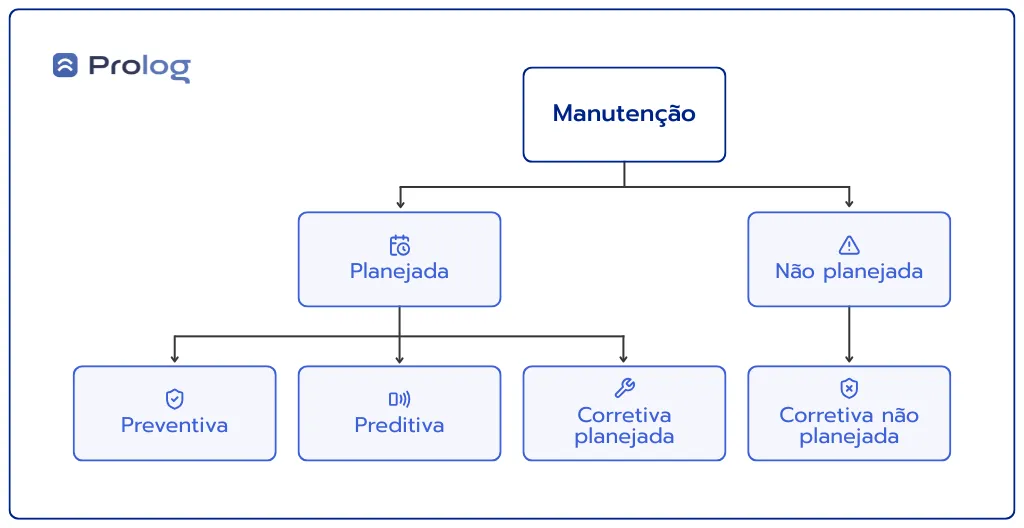
To keep the fleet operating efficiently, it is fundamental to understand the three types of maintenance that are part of the daily routine of those who look after heavy vehicles. Each one has a specific application — and knowing when to use each strategy makes all the difference in cost control and fleet availability.
Corrective maintenance
Corrective maintenance happens when the problem has already appeared. It is the well-known “fix it when it breaks” approach — which can be dangerous for the operation. But it is not always an emergency. There are two main types:
- Unplanned corrective: occurs when a component fails unexpectedly. This forces the vehicle to be taken off the route, causing delays, impacts on the operation and, generally, a higher cost for parts and labor. It also puts the safety of the driver and the cargo at risk.
- Planned corrective: in this case, the defect has already been identified, but the repair can be scheduled for a more convenient stop. It is common in situations where the component is still functional but shows signs of wear.
Although it is still quite common, corrective maintenance should be the exception, not the rule. The more structured your maintenance plan, the less you depend on this type of repair — especially the unplanned kind, which means high cost and little control.
Preventive maintenance
Preventive maintenance is scheduled in advance, based on time, mileage or hours of use. The focus here is preventing the problem from happening.
Oil changes, brake servicing, electrical system inspection, alignment and balancing are examples of preventive actions. They are carried out periodically, following a schedule or maintenance plan.
This type of maintenance is essential to:
- Increase the useful life of components
- Avoid unexpected failures
- Reduce emergency repair costs
- Keep the fleet in compliance with safety standards.
Well-organized fleets work to make most of their maintenance preventive, ensuring greater predictability in the operation and lower financial impact.
Predictive maintenance
Predictive maintenance, in turn, is more advanced. It goes beyond the fixed calendar and acts based on the actual condition of the component. This is possible thanks to the use of sensors, telematics, an electronic checklist and tools that analyze the behavior of the vehicle's systems in real time.
A practical example: the sensor detects a gradual drop in tire pressure or above-normal vibration in the engine. Based on this, the manager can act before the failure happens — preventing the problem from becoming serious and interrupting the operation.
The main benefits of predictive maintenance include:
- Better-targeted interventions at the ideal moment
- Less waste from early replacements
- Greater vehicle availability
- More precise control over the condition of the fleet.
This type of maintenance requires technology and structure, but the return is high: more efficiency, fewer stops and much more predictable costs.
What are the differences, and when should corrective, preventive and predictive maintenance be applied?
In everyday fleet management, it is not enough to know what each type of maintenance is — you need to understand how they differ in the routine, in financial planning and in operational impacts.
Each type of maintenance has the right moment to be applied. Corrective maintenance comes into play when something has already gone wrong. Preventive maintenance tries to keep that from happening. And predictive maintenance anticipates the failure before it even shows up, based on data and monitoring.
See a direct comparison between them:
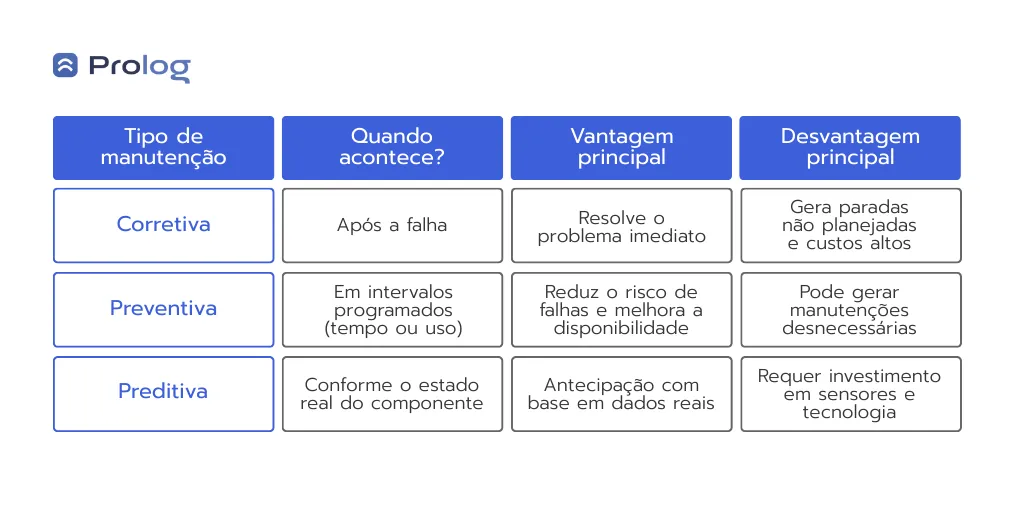
Beyond the practical difference, there is also a strategic difference in financial impact. More mature and structured fleets seek to reduce the number of corrective maintenance jobs and increase the share of predictive and preventive maintenance.
In general, a recommended budget split for efficient operations is:
- 15% for corrective
- 30% to 40% for preventive
- 40% to 50% for predictive
This balance shows management focused on anticipating failures and not just reacting to them. And the further you advance in this maturity, the more financial control, fleet availability and road safety you achieve.
But if you are looking for something even more tailored to your fleet's reality, the ideal is to calculate the maintenance cost to revenue ratio (MCR). The MCR is simply an indicator that measures the relationship between vehicle maintenance costs and the revenue generated by the corresponding operation.
When the MCR is high, it means maintenance is consuming a significant share of the company's profits. When it is low, it indicates that maintenance management is efficient and balanced.
How do you deal with unplanned maintenance?
Even if your fleet has a well-structured maintenance plan, unplanned maintenance can (and will) happen. A tire blows out in the middle of the route, the brakes fail earlier than expected or a sensor simply stops working. Situations like these interrupt the operation and have a direct impact on deadlines and costs.
But the way you react to these occurrences makes all the difference. See some essential actions for handling this type of maintenance in the best way:
1. Have a clear emergency protocol
The first step is to make sure that drivers, mechanics and those responsible for the operation know exactly what to do when something unexpected happens. Who should be called? How should it be recorded? When should the vehicle be stopped? Having a well-defined flow prevents wrong decisions under pressure and reduces response time.
2. Record each occurrence in detail
All unplanned maintenance needs to be recorded with as much information as possible: date, time, vehicle, type of failure, location of the occurrence, repair cost and impact on the operation. This history is essential to identify patterns and prevent similar failures in the future.
3. Use data to your advantage
When you have organized and consolidated records, it is possible to turn unplanned maintenance into an opportunity for improvement. Which failures repeat? In which vehicle models? With which supplier? This data helps adjust preventive maintenance plans and make more strategic decisions.
4. Keep critical parts and supplies in inventory
An unexpected failure does not have to become a bigger problem because of a missing part. Keep in inventory the components with the highest history of emergency replacement, such as valves, filters, tires and fast-wearing items.
5. Prioritize technology in management
With a Maintenance Management system, like Prolog's, you can record failures on the spot, open work orders in a few clicks and generate complete reports. This brings more control, more agility and keeps the unexpected from becoming routine.
What are the main indicators in fleet maintenance?
Keeping track of maintenance performance indicators is also essential to make decisions based on real data — not on guesswork. They help identify bottlenecks, anticipate failures and improve the performance of the fleet as a whole.
Below are the main indicators you should keep track of in your operation's maintenance management:
MTBF (Mean Time Between Failures)
This indicator shows the reliability of vehicles and equipment, revealing the average time they operate without failing. The higher the MTBF, the better the performance and the lower the frequency of corrective maintenance.
How to use it: if your fleet's MTBF is very low, it may be a sign of flaws in the preventive maintenance plan or excessive use of vehicles without proper oversight.
MTTF (Mean Time To Failure)
It indicates the average time a new component takes to fail. This indicator is used mostly for parts that cannot be repaired, such as sensors or disposable electronic components.
How to use it: MTTF helps predict when a given part needs to be replaced, optimizing inventory planning and reducing unexpected stops.
MTTR (Mean Time To Repair)
It reveals how long, on average, a vehicle takes to return to operation after a problem. It is an important indicator of maintenance team efficiency.
How to use it: a high MTTR may mean process failures, a lack of parts or low workshop productivity. With this data, you can act to improve response time.
How do you create an efficient maintenance plan?
An efficient maintenance plan is what separates a fleet with high vehicle availability from one that is always putting out fires. More than knowing when to change the oil or service the brakes, it is about having organized processes, data-driven decisions and technology as an ally of the strategy.
In your maintenance plan, it is also important to include indicators, such as the ones in the previous section. They will guide your operation's next actions.
See the pillars for putting together a good maintenance plan — and how the Prolog solution can make each step easier:
1. Carry out a complete fleet diagnosis
Before planning any intervention, you need to understand your fleet's reality: which vehicle models you have, which have already been through maintenance, which have a history of failures or a high CPK.
With the Prolog system, you have all this information organized and up to date, with reports by vehicle, by type of failure or by mileage.
2. Classify the types of maintenance
Organize the plan into preventive (based on time or use), predictive (by actual condition) and planned corrective maintenance. This helps prioritize what needs to be done before a failure turns into a serious problem.
The platform lets you configure all these types and trigger automatic work orders, ensuring that nothing goes unnoticed.
3. Automate alerts and schedules
Spreadsheets and manual reminders do not work in complex operations. An efficient maintenance plan needs automation. With Prolog, you set alerts by time, mileage or even by the vehicle's technical condition (via checklists, for example).
This reduces the risk of delays and makes it easier to keep track of the operation day to day.
4. Control costs in real time
Efficient maintenance management also involves financial control. Knowing how much you spend per vehicle, per failure and per type of maintenance is essential to make decisions and identify waste.
The Prolog dashboard shows this in real time, as records are entered in the system, with easy-to-read charts — including for presentations in meetings and audits.
5. Unify maintenance, tires and inventory
The most efficient plan is the one that connects all the areas involved. Prolog's maintenance app integrates maintenance with tire management and the electronic checklist, offering a complete view of the fleet's health.
You have seen that unplanned maintenance costs more, compromises deadlines and puts safety at risk. Preventive and predictive maintenance, on the other hand, offer more control, predictability and savings. And that the best way to put all this into practice is through a structured plan, supported by technology.
With Prolog's Maintenance Management solution, you automate the process, organize the data and gain a complete view of the operation. But if you are still taking your first steps, we have a free tool that can help you right now.
Download Prolog's maintenance control spreadsheet and start recording your fleet's maintenance in a practical, accessible and efficient way.
Click here for the free download (in Portuguese)!
Your maintenance plan starts with good management — and now you have what you need to put it into action.
Frequently asked questions
What is the difference between preventive and corrective maintenance?
What is predictive maintenance?
How much of the maintenance budget should go to each type?
What are the main fleet maintenance indicators?
How do you deal with unplanned maintenance?
How do you create an efficient maintenance plan?
// newsletter
Fleet management content, straight to your inbox
Articles on tires, maintenance and fleet operations. No spam.


