Documents and tools for fleet management
 Jade Zart 5 min read

Fleet management tools serve to turn scattered routines into processes that can be recorded, checked and improved. The starting point is not choosing the most extensive technology: it is defining which activity needs control, who records the information and what decision will be made from it.
An operation can combine simple resources, such as forms and spreadsheets, with specialized systems. Each has a role: standardizing inspections, keeping history, organizing costs, supporting communication and making action needs visible. Without responsible people and a routine for analysis, however, even a complete tool becomes merely a data repository.
Here are some tools that can form part of this work:
- Paper checklist;
- Electronic checklist;
- Fleet management spreadsheets;
- ERP systems;
- Telematics and cargo tracking;
- Fleet policy;
- Logistics control tower;
- Fleet planning.
Paper checklist
A paper checklist brings tasks and inspection items together in a list. It helps prevent a known step from being forgotten during an inspection, delivery or quality procedure. For a fleet, it can record conditions observed in the vehicle; in logistics, it can also guide warehouse routines and other processes.
Its limits emerge after completion. Records need to be saved, forwarded and consulted with discipline so they do not get lost in files or on clipboards. It is therefore useful to define where the form will be kept, who will check it and how a nonconformity will be handled.
Electronic checklist
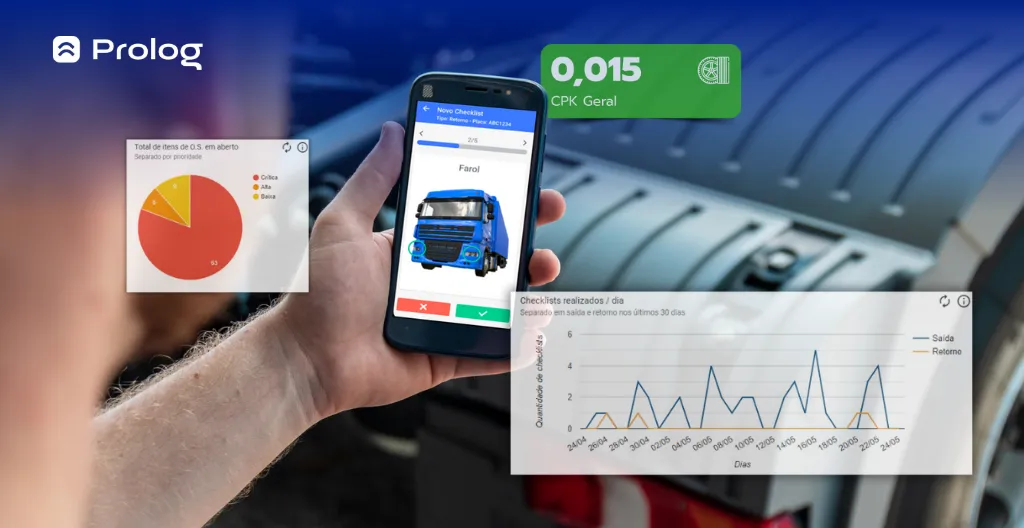
The digital checklist replaces the paper list with a form accessible on an electronic device. It can standardize questions, record answers and evidence, and forward records to the responsible person. Its practical usefulness depends on the form reflecting daily routines and a defined response existing for each incident.
Different questionnaires can be created for light and heavy vehicles, selecting the asset before inspection. This prevents a generic list from omitting important items for a particular vehicle type. It also makes consulting inspection history easier when the team needs to understand whether a problem is recurring.
The gain is not just faster completion. An electronic process can reduce transcription rework and clarify outstanding matters, provided records are reviewed and do not remain without action.
Fleet management spreadsheets
Companies organizing their first controls can use fleet management spreadsheets to centralize records, costs and routine information. A well-structured spreadsheet enables period comparisons, simple reports and identification of matters worth investigating.
To work, it needs standardized fields, people responsible for updating it and rules for correcting incomplete data. As the number of vehicles, people and connections between maintenance, inventory and costs grows, manual updates can become a weak point. This is a sign to review the process, not an automatic obligation to change tools.
Tire control spreadsheet
A tire management spreadsheet (in Portuguese) can bring together asset identification, inspections, services and relocation history. This record helps examine spending, wear and maintenance decisions based on what the operation has recorded.
For comparable data, agree on how each inspection will be performed and which fields are required. The spreadsheet does not replace technical assessment, but provides context for investigating costs and preserving organized tire history.
Driver control spreadsheet
A driver control spreadsheet (in Portuguese) can bring together driver records, vehicle entry and exit records, and operational cost oversight.
It can also support building a ranking and a bonus system, as well as recording and keeping track of incidents. The data allows monthly reports on each driver’s behavior patterns to be generated.
Maintenance control spreadsheet
In a maintenance control spreadsheet, a company can record inspections carried out, open services and completed services, parts in inventory, estimates, costs and vehicle availability status.
- Inspections and records per vehicle;
- Open, approved and completed services;
- Parts, requests and inventory movements;
- Estimates and costs associated with the service;
- Vehicles cleared for use, unavailable or awaiting assessment.
This information helps prioritize daily routines and consult history before deciding. It needs updating at the right time; delayed data can give a misleading impression of fleet condition.
ERP systems
ERP stands for enterprise resource planning. Generally, it is a system aimed at integrating information from areas such as finance, purchasing, sales, inventory and registrations in a single database, depending on the modules subscribed to and the company’s configuration.
In fleet management, this integration can avoid duplicate records and facilitate information exchange with the administrative area. Before implementation, map which data needs to flow between departments and who will be responsible for the quality of each record. Not every operational routine will be handled by ERP alone; some require complementary controls or systems.
Telematics and cargo tracking
Telematics and tracking are solutions available on the market for keeping track of movement, speed, consumption or cargo condition data, depending on the equipment and contract adopted. They can serve operations needing this type of information, but do not replace policies, analysis and safety procedures.
When assessing a solution, define which data is needed, who will be able to consult it, how privacy and record use will be handled, and which decisions the company expects to support. Interpretation should consider trip context and working conditions, rather than turning an isolated measurement into a diagnosis.
Fleet policy
A fleet policy is the document that brings together guidelines for vehicle use, upkeep and management. It clarifies responsibilities, procedures and criteria for recurring situations, such as inspections, communicating problems and asset use.
To be useful, the policy needs to be known by those carrying out daily routines and reviewed when the process changes. Filing it is not enough: responsible people must be able to apply the rules and know where to direct questions or exceptions.
Logistics control tower
A logistics control tower is a way of organizing supply chain information and communication. It can bring together data from different processes to support the coordination of incidents, priorities and short- and long-term decisions.
More than a screen or software, the concept requires agreements about information sources, responsible people and communication flows. A center improves visibility only when incoming data is reliable and people know what to do with alerts and reports.
Fleet planning
Fleet planning records objectives, resources, responsible people and actions to address identified operational needs. It connects daily controls to decisions about budget, maintenance, people and availability.
Use indicators that answer concrete questions and compare periods measured by the same criterion. When a result differs from expectations, investigate its cause before defining an action. This cycle of recording, analyzing, deciding and reviewing is what makes management tools part of continuous improvement.
To explore operational organization further, consult the Fleet Management Guide (in Portuguese).
Frequently asked questions
What are fleet management documents?
What is the difference between a paper checklist and an electronic checklist?
Is a fleet management spreadsheet still useful?
What is a fleet policy for?
What is a logistics control tower?
Does an ERP handle fleet management on its own?
// newsletter
Fleet management content, straight to your inbox
Articles on tires, maintenance and fleet operations. No spam.