Best fleet management software: 5 types and 7 criteria
 Jean Zart 11 min read
The market for fleet management systems has grown considerably in recent years, and along with the options, so has the complexity of choosing between them.
Today there are solutions for tracking, telematics, tire management, maintenance, checklists, refueling, tolls and routing. While some serve corporate fleets, others specialize in freight transport, and others still try to be the everything-for-everyone system.
For those who need to make this decision, the sheer volume of options can be more paralyzing than useful.
To make sure you reach a decision and choose the best fleet management software for your operation, read on:
- What is fleet management software?
- What is fleet management software for?
- What are the benefits of using fleet management software?
- 5 types of fleet systems available on the market
- How to choose the best fleet system for your operation?
- How does Prolog's management system work?
What is fleet management software?
Fleet management software is software that centralizes, organizes and automates the control of operations involving a company's vehicles. This includes, for example, information on maintenance, refueling, tires, drivers, tracking, costs and much more.
Generally speaking, the more accurate data you have about your fleet, the better the decisions and the lower the operating costs.
Today, many trucking companies have not yet adopted technology, but many have already started this process.
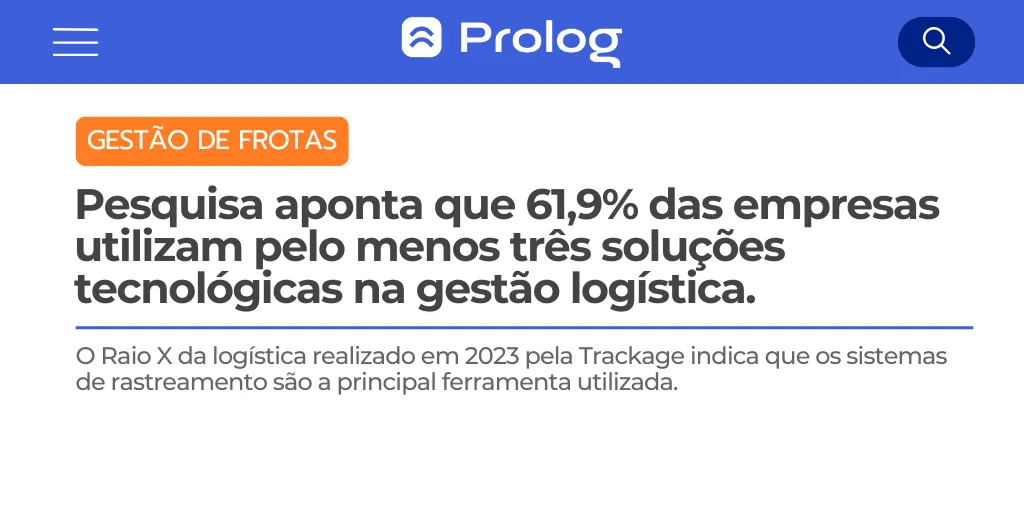
Recently, a survey on logistics in Brazil carried out by Trackage found that 61.9% of companies already use at least three technology solutions in their logistics management. Meanwhile, 68.7% say that tracking systems are the main tool they use.
This shows that technology is increasingly present in the industry and that those who adopt these solutions run a more efficient, more strategic operation, with a great opportunity to get ahead of the competition.
What is fleet management software for?
Fleet management software serves to simplify and optimize the management of the operation. In practice, it enables:
- Cost control: detailed monitoring of fuel, maintenance and tire expenses.
- Preventive maintenance: fewer unexpected breakdowns and management of vehicle health.
- Driver oversight: analysis of behavior behind the wheel and prevention of accidents, as well as working hours.
- Tire management: control of wear, rotation and retreading to extend the useful life of the assets.
- Strategic decision-making: reports and insights generated from concrete data.
What are the benefits of using fleet management software?
The truth is that fleet management software is not a luxury, it is a necessity. With it, you have full control over costs, the maintenance schedule, document expiration dates and even real-time vehicle tracking.
Beyond that, you can generate detailed reports and make data-driven decisions, not guesswork. At the end of the day, the company gains efficiency, reduces waste and also increases the safety of the operation.
Impact on transport operations
With so many benefits, you have probably already reached a conclusion: the impact of fleet management software on the operation is enormous and is reflected in several areas of the business.
When everything is well structured, drivers work better, without having to deal with operational failures or confusing manual processes. This helps retain talent; after all, people who want to grow in their careers prefer to work at a structured company that invests in technology and provides the best tools to make day-to-day work easier.
On top of that, fewer errors and more organization mean fewer vehicles off the road and deliveries happening on time. This directly affects customer satisfaction, as customers receive the service at the right time and with higher quality.
See how one thing leads to another? A satisfied customer generates more demand, more profit and lower operating costs. A good system organizes everything, avoids rework and turns the operation into something predictable and optimized.
But if complete software does not yet fit the budget, the solution can be to start with the operation's biggest bottleneck. If the biggest expense is tires, a tire management system will deliver a faster return. The same goes for maintenance, fuel or any other critical point.
The most important thing is to understand that the right technology generates a return on investment (ROI) quickly, whether through lower costs, better productivity or higher customer satisfaction. The biggest mistake is not investing, but continuing to improvise and, worse still, to lose money.
A good example is the case of Klabin, Brazil's largest paper producer, which, after starting to use Prolog in the preventive maintenance of its fleet, with the electronic checklist, achieved major improvements in the operation, such as:
- Visibility of scheduled and completed inspections by date through the maintenance schedule;
- Speed in vehicle inspection through the checklist completed on a smartphone;
- Productivity in inspection and issue resolution with the automatic opening of work orders (WOs).
5 types of fleet systems available on the market
Before choosing, it is essential to understand that there is no single type of fleet management software. The market is organized into categories with different focuses. Knowing each one lets you identify where your operation's biggest bottleneck is and look for the right solution for it:
1. ERP (Enterprise Resource Planning)
Enterprise Resource Planning (ERP) centralizes all of the company's operations, including fleet management. It enables financial control, invoice issuing, purchasing, parts inventory and even contract management and supplier management.
For fleets, ERP is very useful for tracking operating costs as a whole, and it also helps integrate the fleet with other departments of the company, such as finance and logistics, making communication easier and reducing rework.
Although it is a robust system, ERPs can be complex and require customization to meet the specific needs of fleet management. So, if you opt for this type of system, it is important to choose an ERP that has modules aimed at the transportation industry or that allows integration with other specialized systems.
2. DMS (Driver Monitoring System)
A Driver Monitoring System (DMS), as the name itself says, monitors driver behavior in real time, identifying fatigue, distraction and risky driving patterns. Using cameras and sensors, it analyzes facial expressions and eye movements and issues immediate alerts to prevent accidents.
For fleets, a DMS improves road safety and operational efficiency, reducing incidents and enabling more targeted training. In addition, a DMS can be integrated with other fleet management systems, such as tracking and telematics, providing a more complete view of the operation. This not only increases safety but also contributes to lower operating costs, by preventing accidents and extending the useful life of the fleet's vehicles.
3. Maintenance Management System
A maintenance management system helps schedule services, keep tabs on parts and issue alerts for preventive maintenance, avoiding serious problems and unexpected costs.
With it, the company can create a maintenance schedule, ensuring that vehicles are always in good condition. This type of system also records recurring failures, helping to identify patterns, improve component durability and make audits easier.
Prolog's maintenance management system supports all of these functions, designed around the challenges and day-to-day routines of your fleet's operation, including inventory control, opening of standalone work orders and automated preventive maintenance.
And who is it for? Any transport operation that has an in-house workshop or its own tire shop and a vehicle count high enough to make manual control unworkable. From 30 to 40 vehicles, the spreadsheet starts to be more of a problem than a solution.
4. Tire Management System
Tires are among the three biggest costs for any fleet, and without good control, waste is inevitable. A tire management system lets you keep a record of each tire's useful life, pressure and retreading.
With advanced technology, the system identifies pattern deviations, which increase fuel consumption and compromise safety. This enables preventive action and greater operational efficiency.
At Prolog, we know that tire management makes all the difference in reducing fleet costs, and that is why it is our flagship! Our system delivers detailed reports showing which tires perform best, how to avoid premature replacements and how small changes generate big savings in the long run.
In addition to the app, our system also comes with an Inspection Kit, with which you can measure tire pressure and tread wear in less than 1 minute.
It is a system that makes the most sense for road freight transport fleets, where tires represent the second-largest operating cost after fuel. After all, efficient tire management can reduce CPK by up to 30% by extending useful life and lowering the rate of early disposal.
5. Telematics and Tracking System
Tracking shows where each vehicle is in real time, with a history of routes and stops. Telematics goes further: it captures data from the vehicle itself, such as speed, engine temperature, fuel consumption per route, harsh braking events and excessive acceleration.
Who it makes sense for: operations that need route visibility, monitoring of driver behavior and control of idle time. In freight transport fleets, telematics feeds fuel-efficient driving training and helps reduce fuel consumption.
There is, however, a small limitation, since tracking and telematics do not measure what happens in the fleet's workshop, yard and/or tire shop.
How to choose the right system: 7 criteria to evaluate
With so many options on the market, choosing the best system for fleet management can seem challenging. But the answer lies in understanding the specific needs of your operation. Evaluate based on the following questions:
What is the main issue you need to solve?
The right system starts with the right pain point.
So, if you list the three biggest bottlenecks in your operation today, the system you choose should directly solve at least two of them. And this is the first criterion you should evaluate.
Is the solution specialized or generic?
Generic systems try to cover a lot with limited depth, while specialized systems go deep into one specific area.
For most road freight transport fleets, it is worth more to start with a system specialized in the biggest problem and resolve it well than to implement a generic platform that does everything halfway.
Was the system built for road freight transport, or is it an adapted solution?
Truck fleets have specific characteristics: multiple tires per vehicle (up to 22 on a combination vehicle), heavy maintenance with expensive parts, long working hours and specific regulation by ANTT, Brazil's National Land Transportation Agency.
That is why a system developed for corporate car fleets or for vehicle rental companies may not cover these specifics with the necessary depth.
What is the level of implementation effort?
Adoption by the operations team (drivers, yard technicians and tire shop staff) is the main factor in the success or failure of any system. A system with a complicated interface will be abandoned.
Evaluate: can the driver use it? Will the tire shop technician record the service? Does the system make things easier or create friction in the work of those on the front line?
Is the data generated actionable?
Many systems generate good-looking dashboards with dozens of charts. But data that does not lead to action is noise, not information. Ask the supplier: with this system, what will I be able to do differently tomorrow? Which alerts are generated automatically? Who receives them? Within what timeframe?
Does the system scale with the operation?
A fleet of 50 vehicles can become 150. The system chosen today needs to grow along with it without requiring a new implementation from scratch, loss of history or a platform switch.
What are support and after-sales follow-up like?
Implementing fleet management software is not installing an app, it is changing processes. Without a doubt, this creates uncertainty, resistance and the need for adjustments along the way. A supplier that disappears after the contract signature is a real operational risk.
Evaluate: is support reactive (it responds when you call) or proactive (it follows up on adoption and value delivery)?
How Prolog positions itself in this landscape
Prolog specializes in fleet management for road freight transport. In more than 10 years on the market and with more than 1,500 operations in its portfolio — including customers in Brazil, South Africa, Ghana and Paraguay — it has built the largest tire management platform in Latin America and has evolved to cover the three areas that most affect the operating cost of freight fleets: Tire Management, Maintenance Management and Electronic Checklist.
Broadly speaking, the Tire Management System lets you keep a record of the useful life, mileage, pressure, retreading and performance of each tire, ensuring greater durability and less waste.
The Maintenance Management System and Electronic Checklist, in turn, organize preventive maintenance, generate work orders automatically and prevent unexpected breakdowns, increasing fleet availability. All of this is integrated and easy to access, so that you have accurate data and make more strategic decisions.
Our focus is to make fleet management smarter and less bureaucratic, reducing costs and increasing productivity. If you do not yet use a system or want to improve the one you already have, Prolog can help you transform your operation.
Discover Prolog's solutions now and see how we can transform your operation!
Frequently asked questions
What is fleet management software?
What are the types of fleet management software?
How do you choose the best fleet management software?
Specialized or generic software: which should a fleet choose?
When does a maintenance management system make sense?
What are the benefits of using fleet management software?
// newsletter
Fleet management content, straight to your inbox
Articles on tires, maintenance and fleet operations. No spam.