Live cargo: Brazil's Contran rules and 8 challenges
 Jonatan Fernandes 9 min read
Live cargo transport is one of the most challenging in the road sector. If freight transport of indivisible, hazardous or refrigerated cargo requires attention to road safety and cargo integrity, transporting animals requires even more: you need to ensure the well-being of the cargo itself.
Beyond logistical obligations, this type of transport involves sanitary, environmental and ethical issues, which increases the complexity of the operation and demands a high level of responsibility. Any failure in these areas can cause stress, injuries, weight loss and even the death of the animals — as well as financial losses, citations and damage to the company's reputation.
That is why, if you work (or intend to work) with this type of transport, it is very important to know the legal requirements, understand the main challenges and know how to make the operation safer and more efficient.
In this post, you will find:
- How is live cargo transported?
- What are the rules for live cargo transport?
- 8 logistical challenges of live cargo transport
- How can you increase efficiency and safety in live cargo transport?
Keep reading and find out how to avoid risks and turn this type of transport into a more controlled, ethical and profitable operation.
How is live cargo transported?
Live cargo transport requires specific care that goes far beyond moving from one place to another. More than following a route, you need to ensure the well-being of the animals throughout the trip — from loading to arrival at the destination. And for that, the starting point is the vehicle used.
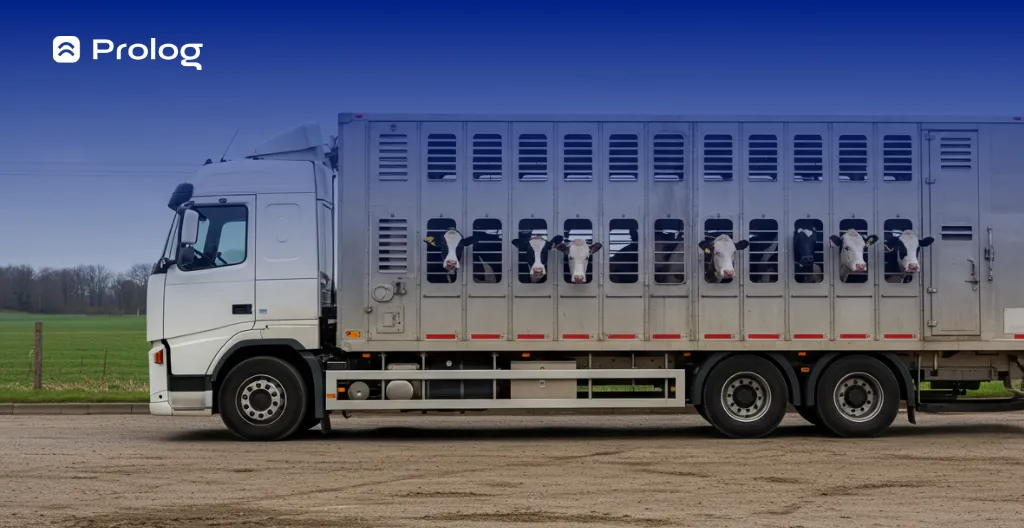
In Brazil, according to Resolution No. 791/2020 of Contran, the National Traffic Council, live animal transport vehicles (VTAV) must be built or adapted so as to prevent suffering, injuries and excessive agitation. This means that the body must have a size compatible with the species transported, allowing the animals to remain standing during the trip, as well as a non-slip floor to prevent slips and falls and locking mechanisms for removing the animals in an emergency.
These vehicles also need to ensure adequate ventilation throughout the compartment, whether through openings or thermal control systems — especially in the case of box trucks, which must have ventilation and temperature systems. The goal is to protect the animals from both excessive heat and intense cold, keeping conditions stable during the trip.
Another important point is the physical safety of the animals. The compartment must have sides and a roof that prevent escapes, falls or body parts sticking out of the vehicle. Internal surfaces must be free of sharp points or elements that could cause injuries. In addition, the vehicle must have an emergency phone number visible at the rear, and it must prevent waste from spilling onto public roads.
When transporting in containment crates, the vehicle must be equipped with structures that keep these crates from shifting or falling. VTAVs with more than one deck, in turn, need a lifting system, and ramps may be used as long as they have a non-slip surface to protect the animals during loading and unloading.
It is worth remembering that these vehicles must be type-approved and obtain the specific Certificate of Compliance with Traffic Legislation (CAT). And, in addition to Contran's requirements, it is also necessary to follow the sanitary regulations and guidelines of Brazil's Ministry of Agriculture, Livestock and Food Supply (MAPA), especially regarding maximum load per species and the sanitary conditions of transport.
In practice, live cargo transport is a complex operation that involves ethical, technical and legal responsibility. Ignoring these requirements can compromise not only the integrity of the animals, but also road safety, the operation's compliance and the company's reputation.
What are the rules for live cargo transport?
Live cargo transport in Brazil is regulated by several rules, notably CONTRAN Resolution No. 791/2020, which sets mandatory criteria for live animal transport vehicles, and the sanitary requirements defined by MAPA (Ministry of Agriculture, Livestock and Food Supply).
The legislation covers the transport of animals — production animals or animals of economic interest, such as mammals (cattle and buffalo, equines, pigs, sheep, goats and rabbits) and production poultry — in specific vehicles, the so-called VTAVs (Live Animal Transport Vehicles). These vehicles need to meet strict safety and animal welfare standards, such as good ventilation, a non-slip floor, protection against extreme temperatures and the absence of elements that could injure the animals.
But the requirements are not limited to the vehicle's structure. To carry out this type of transport, you also need to check the applicable documentation, including:
- GTA (Animal Transit Permit): must be checked according to the sanitary rules that apply to the species, origin and destination of the animals;
- CAT (Certificate of Compliance with Traffic Legislation): a specific certificate that the VTAV must obtain to prove the vehicle complies with traffic legislation; in addition, the operation may require an invoice for the cargo and, in some cases, environmental authorizations, depending on the origin and destination of the animals.
In addition, the operation must be aligned with the sanitary and environmental rules in force, such as vaccination control and quarantine, when required.
Ignoring these rules can have serious consequences, such as fines, seizure of the vehicle, impoundment of the cargo and even civil or criminal liability in cases of mistreatment or harm to public health.
That is why, more than a matter of caring for the transport structure, complying with the rules is a way to protect the animals, the team and the company's reputation — as well as to avoid operational and legal losses.
8 logistical challenges of live cargo transport
Live cargo transport has a series of particularities that make it one of the most complex in road logistics. When dealing with animals, the carrier needs to consider technical and operational issues as well as legal, sanitary, environmental and ethical aspects.
Below is a list of the main challenges faced by those who work in this type of transport:
1. Animal welfare
This is the central point of the operation. Animals that are stressed, poorly accommodated or exposed to high temperatures can suffer injuries, a drop in performance (such as weight loss) and even die during the journey. That is why the vehicle needs adequate ventilation, a non-slip floor, partitions and space proportional to the species transported.
2. Vehicle adaptation
Not every truck is fit for this type of transport. The law requires the VTAV (Live Animal Transport Vehicle) to be built or adapted according to specific technical criteria. This includes structural strength, ease of cleaning, safe containment and the absence of elements that could injure the animals.
3. Temperature control
Sudden temperature changes or prolonged exposure to heat are especially critical when transporting poultry, pigs and small animals. In box trucks, for example, there must be a ventilation and thermal control system, which needs to work efficiently throughout the journey.
4. Loading and unloading logistics
Loading and unloading animals requires technique, care and suitable facilities. Inadequate ramps, slippery surfaces or excessive noise increase the risk of traffic accidents and stress for the animals. In addition, this process needs to be quick and safe, both for the animals and for the workers.
5. Transport time and itinerary
The longer the transport time, the greater the impact on the animals. Long distances without scheduled stops for rest, feeding and hydration raise the risk of mortality. That is why route planning needs to consider both the road infrastructure and the support points along the way.
6. Documentation and inspections
As seen, the applicable sanitary documentation must be checked according to the species, origin and destination of the animals, and the operation may require an invoice and additional authorizations, depending on the case. Any error in these documents can result in the cargo being held and in fines being issued. Inspections are strict, especially at state borders.
7. Sanitization and biosecurity
The truck must be cleaned and disinfected before each new load, to prevent cross-contamination between animals from different origins. This care reduces the risk of disease outbreaks — both among the animals and for end consumers.
8. Risk and contingency management
Live animals are subject to behavioral and physiological changes that can compromise the transport. Mechanical problems with the vehicle, accidents or sudden weather changes are challenges that require a well-defined risk management plan to ensure the integrity of the cargo and the continuity of the operation.
How can you increase efficiency and safety in live cargo transport?
Given so many challenges and requirements, ensuring efficiency and safety in live cargo transport takes more than complying with the law. You need to adopt a strategic approach, with detailed planning, a trained team and the use of technologies that support decision-making.
Here are some good practices that help raise the quality of the operation:
Train everyone involved in the operation
Drivers, assistants and professionals responsible for the cargo need to understand animal behavior, recognize signs of stress, know how to act in critical situations and follow animal welfare protocols. Periodic training is indispensable to avoid mistakes and ensure safe and ethical driving.
Adopt route planning
Avoid long routes or routes with poor infrastructure. Ideally, plan routes with good pavement conditions, fewer stops and suitable support points. Whenever possible, anticipate factors such as weather, roadworks or traffic jams to reduce travel time and the strain on the animals.
Do preventive maintenance
Unexpected stops or mechanical failures during transport can compromise the entire load. Having a well-defined maintenance schedule and keeping constant track of the vehicle's condition are efficient ways to avoid this type of problem and protect the integrity of the cargo.
Use suitable, well-equipped vehicles
The truck must be fully adapted to the requirements of CONTRAN Resolution No. 791. In addition, controlled ventilation systems, adjustable partitions and non-slip surfaces make transport safer and more comfortable for the animals.
Keep documentation up to date
Before each trip, make sure the applicable documentation is filled out correctly and travels with the cargo. This avoids delays at inspections and helps maintain compliance with sanitary and traffic rules.
Manage the operation with data
Using an electronic checklist, maintenance records and operational data makes fleet management easier and allows you to act preventively. With the right data, it is possible to organize inspections, anticipate corrections, reduce waste and keep deliveries on schedule more efficiently.
Live cargo transport requires responsibility, preparation and well-defined processes. When these measures are put into practice, the operation becomes safer, more sustainable and more profitable for everyone involved — including the animals.
And if you want to improve your fleet management even further, the first step is to have full control over the main indicators.
Download the Fleet Management Guide (in Portuguese) now and see how to improve operational performance with intelligence, planning and technology.
Frequently asked questions
Which documents must accompany live cargo?
Can any truck transport live animals?
Which animals does this rule cover?
What happens if the rules are not followed?
How can you reduce animal stress during the trip?
Which good practices make the operation safer?
// newsletter
Fleet management content, straight to your inbox
Articles on tires, maintenance and fleet operations. No spam.