How to optimize your fleet's in-house tire shop and cut tire costs
 Diego Paludo 11 min read
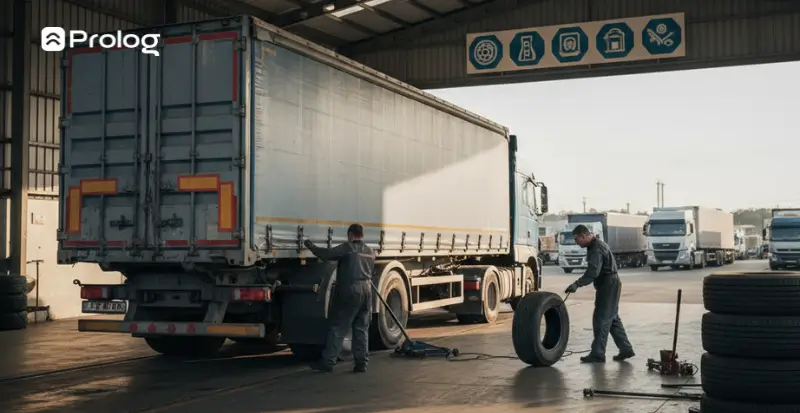
Your operation already has a structured in-house tire shop. But is it efficient?
Tires represent between 8% and 20% of a fleet's total costs, a variation that has everything to do with the maturity level of management. The difference between these percentages? It can represent hundreds of thousands of reais a year.
When well managed, the in-house tire shop is a strategic asset. When not so well managed, it compromises results and consistently reduces the operating margin.
This post was written for managers who have already moved past the implementation phase and want to take the operation to a new level of performance. Let's get straight to the point: the critical issues that limit results and the concrete actions to solve them.
In this post, you will see:
- Main challenges in managing the in-house tire shop
- Tips for optimizing the in-house tire shop
- How to turn the data collected in the tire shop into real savings
Main challenges in managing the in-house tire shop
Before talking about optimization, you need to recognize where there are opportunities for improvement. These are the five most recurrent problems in tire shops that already exist but do not yet perform at the expected level:
1 – Lack of standardized tire control
Control exists, but it is fragmented. Outdated spreadsheets, handwritten notes in notebooks, information scattered among the tire technician, the storekeeper and the fleet supervisor.
The result is not at all pleasant: you do not know exactly how many tires you have, where each one is, or in what condition.
Without individual traceability (from the fire number to the complete history of each tire), any attempt at analysis becomes mere guesswork. And management based on guesswork is expensive.
The lack of standardization prevents you from identifying wear patterns and problems in advance, gets in the way of comparing performance between suppliers to identify the best cost-benefit, or even of calculating the real cost per kilometer of each asset.
2 – Irregular wear and premature losses
Tires coming out of service before completing the expected cycle.
Casings going to disposal when they could have one or two more retreads.
Disproportionate wear between axles.
If any of these problems sounds familiar, you have a problem. And it has a name: the lack of tire control and management.
These problems usually point to three causes: inconsistent calibration, lack of planned rotation or mechanical failures not detected in time (misalignment, suspension problems).
Operations that still treat tires reactively (replacing them only when they blow out or the rubber is ruined) may be losing up to 25% of the potential useful life of each asset. And every tire lost early affects not only the replacement cost but also the fleet's availability.
3 – Disorganized inventory or no traceability
New tires mixed with retreaded ones, lack of clear identification of the condition of each item and no FIFO (first in, first out) control: when inventory has no logical organization and traceability, you lose the ability to make quick decisions.
In addition, without knowing what you have on hand, it is common for operations to end up making hasty purchases or, worse, leaving tires sitting for too long. And this speeds up the degradation of the rubber even without use.
There is also the problem of the lack of history: you cannot identify which makes or models deliver the best cost-benefit because you simply do not have the structured data.
4 – Limited integration with fleet maintenance
If tire data does not talk to the preventive maintenance system, your tire shop becomes isolated. For example, when there is abnormal wear, the information does not reach the mechanics department so it can investigate the root cause.
The result is that you keep replacing tires but never solve the problem that is causing the accelerated wear.
This same lack of integration also makes routine planning harder. In other words, rotations are delayed because they are not synchronized with the scheduled maintenance windows, tread depth inspections happen in isolation, without cross-referencing mileage or route data, and so on.
This disconnect causes preventive maintenance opportunities to be lost, turning small adjustments into major repairs (and, in the end, increasing your operating costs as a whole).
5 – Difficulty measuring real costs
You may even know how much you spent on tires last month. But what about the cost per kilometer of each tire? The real difference between makes A and B after all the retreads? How much you are losing on outside repairs that could be done in-house?
Without structured indicators, such as CPK (cost per kilometer), the premature loss rate, the retreading index and the repair cost per event, you are in the dark. When there is no clarity about where the money is going, it becomes impossible to justify investments or demonstrate efficiency gains to the board.
Tips for optimizing the in-house tire shop
Did you identify any of these problems in your operation? Then let's get to what really matters now, how to solve them:
Implement data-driven tire management
(video in Portuguese)
If without data you are managing in the dark, with the wrong data it is even worse.
The foundation of everything is having reliable and accessible data. This means abandoning scattered manual controls and adopting a centralized tire management system that records every relocation: entry, allocation, rotation, retreading, disposal.
Each tire needs a unique identifier (fire number) linked to the vehicle, with a record of make, model, size, purchase date, accumulated mileage, and history of maintenance and retreads. With this structured base, you can calculate the indicators that really matter:
- CPK (cost per kilometer): divides the total cost of the tire (purchase + retreads + maintenance) by the mileage driven. It is the number that shows which make/model delivers the best return.
- Casing utilization rate: how many retreads you are managing to get out of each tire before disposal. If the average is below 2 retreads per casing, there is waste.
- Premature loss index: percentage of tires disposed of before completing their expected useful life. Above 15% indicates systemic problems.
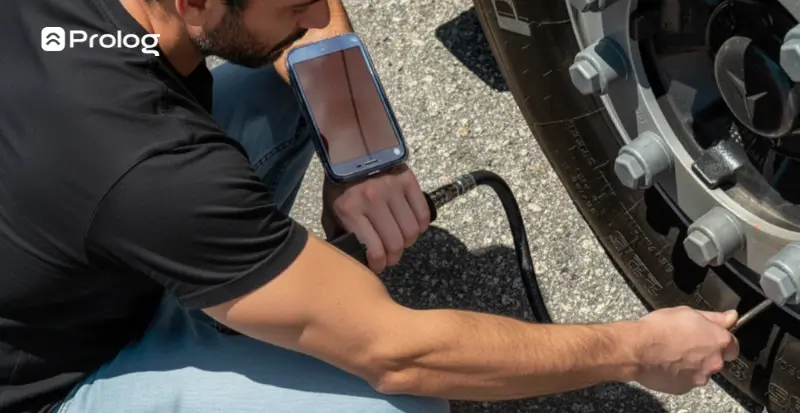
Digital tools, such as electronic tread probes integrated with management systems, eliminate typing errors, speed up data collection and generate automatic reports. The investment pays for itself quickly when you manage to reduce tire costs by 10-15% a month (in Portuguese) just by having visibility into what is happening.
Have preventive maintenance routines
An efficient tire shop is not the one that repairs quickly, but the one that prevents problems before they happen. This requires well-defined routines that are rigorously followed:
Regular calibration should be, at a minimum, weekly for vehicles in continuous operation.
Inadequate pressure (both above and below the ideal) drastically reduces the tire's useful life and increases fuel consumption. Operations that adopted digital calibration with automatic recording managed to reduce irregular wear by up to 20%.
Another indispensable routine is the tread depth inspection. It should be measured every 15 days or every 10 thousand km, recording the values. This makes it possible to identify accelerated wear before the tire reaches the legal limit in Brazil (1.6 mm).
More importantly: it reveals patterns. If wear is disproportionate between axles or between the sides of the same tire, there is a mechanical problem to be solved.
Planned tire rotation is another standard procedure, and you should not wait for the tire to “ask for it”. Set fixed intervals (30-40 thousand km or every 6 months, whichever comes first) and carry it out within the scheduled maintenance windows. Rotation balances wear and can extend the useful life of the set by 15-25%.
Alignment and balancing? You should integrate these services into the preventive maintenance plan. Misaligned vehicles cause accelerated tire wear and compromise safety. Assess the need every 10-15 thousand km or whenever tires are changed.
Structure the team and tire inventory
Operational optimization does not happen with technology alone. You need trained people and clear processes.
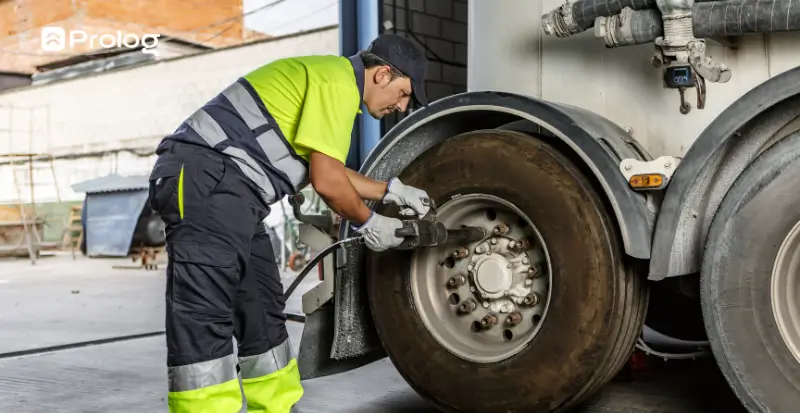
Tire technicians need to understand not only how to change and repair tires, but how to identify problems, record information correctly and follow safety procedures. Invest in regular technical training, both in operating procedures and in the use of systems and tools.
In the same vein, you need to define responsibilities. Who does the inspection? Who updates the system? Who decides when a tire goes to retreading or disposal? Processes without an owner become no man's land. Establish clear owners for each stage and demand execution.
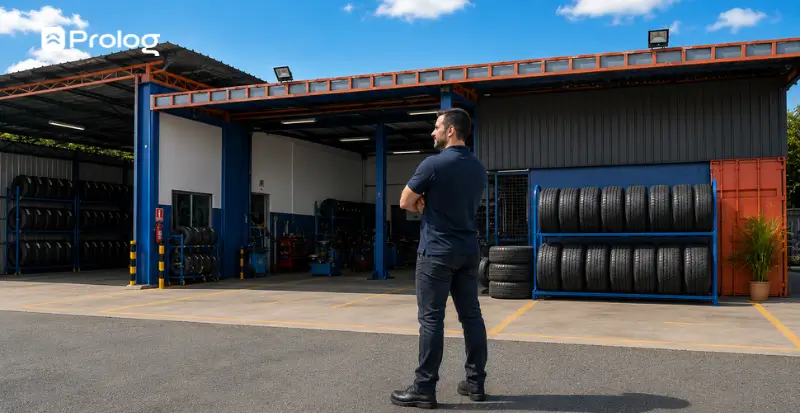
To simplify the work, physically separate the tire inventory into new, retreaded and awaiting disposal. Implement a location system and visual inventory control (shelves identified by type and size).
You can also use the FIFO (first in, first out) criterion to keep tires from sitting too long. Disorganized inventory causes wasted time and mounting errors.
And, still on the subject of inventory, it is essential to control what comes in and goes out. Every tire that comes in or goes out needs to be recorded, without fail. If you do not do this, you lose traceability and cannot close inventories. Implement verification checklists and periodic audits.
Carry out cost control and recycling
Controlling costs is different from cutting costs. The goal should always be to maximize the return on every Brazilian real invested.
To do so, you can evaluate suppliers and products not only by the initial price, but by the total cost over the life cycle. A tire that is 20% cheaper and lasts 30% less is a bad deal. Compare the CPK, not the sticker price.
In addition, each well-done retread costs between 30-40% of the price of a new tire and can deliver 80-90% of the mileage. Operations that manage to get 3 or more retreads per casing have a big financial advantage. But this requires care: preventive maintenance must be active and fully working, repairs must be well done and disposal carried out at the right time (before the casing is compromised).
In a conversation about costs, we need to talk about repairs. When they are done outside, they can cost around R$100 per tire. Tire shops that build in-house repair capacity with a professional kit recover the investment in a few months and gain control over the quality of the service.
Bringing it in-house also makes it easier to manage disposal and control scrap tires, which have residual value if disposed of correctly. Seek partnerships with recycling companies that pay for the material. Besides generating marginal revenue, you strengthen the operation's sustainability.
Prioritize safety and team training
A tire shop is not only about savings, it is about safety. Tires in poor condition increase the risk of accidents, and inadequate procedures expose the team to serious risks.
Explosions during tire calibration or mounting do happen. So you need to take care to use safety cages when inflating tires. Train the team on the risks of reusing compromised parts or mounting tires on incompatible wheels (e.g., a 17″ tire on a 17.5″ rim). Errors of this kind can be fatal.
Tires with protrusions (bulges) must be disposed of immediately, never reused. What is more, severe irregular wear indicates mechanical problems; you need to investigate the cause before putting on a new tire. Safety cannot be traded for productivity.
Among other problems that can happen, ideally you should create channels for the team to report unsafe conditions without fear of retaliation. Hold DDS (daily safety talks) focused on preventing accidents in the tire shop and ensure the team has access to suitable equipment, such as safety glasses, gloves, safety boots and ear protectors.
The tip, when there is a standard safety procedure, is: do not negotiate, demand the correct use of the equipment and inspect, and review procedures whenever there are incidents.
How to turn the data collected in the tire shop into real savings
Does your tire shop have the capacity to turn operation into intelligence? If you apply all the optimization tips we have just given you (or if you have found that you already apply them in your operation), then the answer is yes.
When you have standardized control, well-defined routines, a trained team and full visibility into costs, the results show up. You can achieve a 10 to 30% reduction in tire spending, greater fleet availability, fewer emergency stops and more accurate purchasing decisions.
It is not about having the most modern tire shop or the most expensive system. It is about having processes that work, data that informs and people who execute. Optimization begins when you stop putting out fires and start preventing them from happening.
Want to structure tire management that really delivers results? Talk to our team and understand the role of Prolog Tire Management in your operation.
Frequently asked questions
My tires are coming out of service earlier than expected. What do I investigate first?
How to control the cost per kilometer of a fleet's tires?
What to look at when comparing tire suppliers and models?
How often should I check tire pressure, measure tread depth and rotate tires?
Is it worth bringing tire repair in-house to your own tire shop?
What safety precautions cannot be missing in a fleet tire shop?
// newsletter
Fleet management content, straight to your inbox
Articles on tires, maintenance and fleet operations. No spam.