Work order control: how to organize fleet work orders
 Jade Zart 8 min read

Before we talk about work order control, you should first understand: what exactly is a work order?
Also called simply a “WO”, it is a document that requests a service to be provided, recording the technical information needed for the request to be understood, carried out and tracked. In the case of vehicle fleets, it helps identify parts that should be replaced, components that need preventive adjustments or failures that require corrective maintenance.
Basically, it formalizes the request for a job.
Work order control helps keep the fleet's vehicles running smoothly and safely, bringing more agility and greater assurance that the necessary corrections are recorded and kept track of until completion.
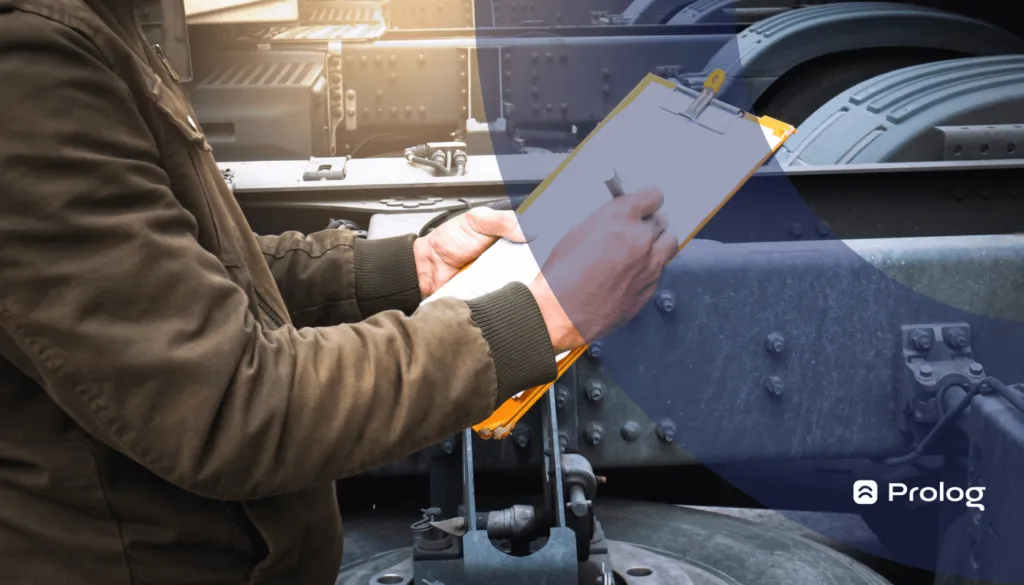
In transport operations, it helps ensure that the failures found by the driver when performing a vehicle checklist are sent to the workshop, at the time of corrective maintenance, without depending only on informal conversations or notes that are hard to trace.
Keep reading to understand:
- How to carry out work order control;
- The difference between a manual and a digital work order;
- Why work order control matters in maintenance management;
- How to gain more productivity in the work order control routine.
How do you carry out work order control in the fleet?
To do this, you first need to divide the control into two stages, a fundamental view for organizing your management:
- The work orders that have been generated and should be sent to the workshop.
- The completed work orders.
This initial separation especially helps those who still file work orders on paper. Within the first large category, you can divide work orders by criticality of the issue, cost involved, expected completion of the request and other criteria that make sense for the workshop's routine.
In the second, perhaps the most useful approach is to file by order of completion and by year of closing. This way, the company can consult the history more easily and also review, according to its internal policy and accounting or legal guidance, which documents still need to remain in the archive.
Instead of treating all work orders as loose papers, set a retention period and a person responsible for the archive. This care avoids losses, duplicates and doubts when it is necessary to prove what was requested, carried out or closed.
Knowing what needs to be in the work order is also important. This avoids rework and the creation of new work orders, piling up papers and documents, to correct a form-filling error or missing information.
What should be included in a work order?
In the work order, you need to start by including the company name, vehicle license plate, address and contact information. Identifying who is responsible for the service is also important, whether an internal or external team.
The focus of the work order is to describe the issue and request its correction. Therefore, the list of services to be performed on the vehicle cannot be missing, with a clear description of what was observed and what needs to be done.
If you have notes to include, use the work order; do not rely only on verbal communication when sending the record to the person responsible for the service. Information that stays only in conversation can get lost between shifts, drivers, mechanics and managers.
The request date must be present, as well as a space for the work order's completion date — which will be filled in at that time. These two milestones help track service time and understand which requests remain open.
In certain cases, the technical report for the vehicle in question can be sent along with the work order, especially when the workshop needs more context to assess the defect or record the decision made.
To make your management easier and even provide greater peace of mind and safety in day-to-day work, digital work orders can be generated automatically from digital inspections on a mobile phone, with templates that you fill in at the time of the vehicle inspection.
You can even add photos and files so that the mechanics team can better see the issue and correct the failure more efficiently. In Prolog, digital inspections on a mobile phone can open work orders automatically, based on the record made by the person responsible for the inspection.
What is the difference between a manual and a digital work order?
A manual work order is one done on paper, while a digital work order is generated using smartphones and/or computers.
The differences are many, since, with the first option:
- You need to create a document from scratch, whether handwritten or typed, with the components that should be part of the truck's daily checklist.
- You need to have copies and understand that this informational paper must reach those responsible for fleet maintenance after each delivery trip.
- It takes a lot of time to organize the workload and hand over service requests to the mechanics team.
- Those responsible for the vehicle's maintenance service need to be ready to read the records and carry out the necessary repairs, which may be urgent or scheduled.
- To store the maintenance history, you need an archive to keep it in the operation's office.
A digital work order, on the other hand:
- Has an electronic checklist that can be customized for each trip/truck, allowing items to be added and removed in a few clicks.
- Makes it possible to send the checklist data to the fleet manager, who evaluates the records made in the inspection and schedules further servicing and maintenance when necessary.
- Can open work orders from the result of the truck checklist, reducing the interval between identifying the issue and sending it for service.
- Allows photos of the components showing defects to be attached, making it easier for the mechanic to understand and correct the issue.
- Gives access to reports and maintenance history whenever the team needs to consult the recorded information.
In general, a manual work order takes longer to be prepared, filled in and reach maintenance management, in addition to increasing the chances of data loss due to poor storage of the papers.
These characteristics do not invalidate this model, but they make the routine a little slower and increase the chances of human error in day-to-day execution.
The digital one, in contrast, makes the data available in the palm of your hand whenever needed, makes it easier to pass the recorded information on to those responsible for fleet management and makes agility an ally of safety and organization.
Why does work order control matter in maintenance management?
Carrying out more detailed work order control gives the company greater confidence, since it has at hand the details of each need of the vehicle, increasing the business's credibility.
Likewise, it is a great way to manage roles, improving the organization and output of employees, who have a schedule to follow and know which requests need to be prioritized.
And there is more:
The maintenance records, saved in the work orders, can be consulted every time the truck shows new or recurring failures in a component, helping to accurately identify the reason for defects in the fleet's assets.
After all, everything is recorded in the work order — the services requested, components that were repaired or replaced, costs, people responsible, dates and relevant notes. This is also a way to improve the carrier's internal control and records.
Finally, in Brazil, Article 157 of the Consolidation of Labor Laws (CLT), amended by Law No. 6,514 of December 22, 1977, establishes that it is up to the company to:
Instruct employees, through work orders, on the precautions to take to prevent work accidents or occupational diseases.
How can you generate more productivity in the work order control routine?
Training employees
A trained team always has its practical and theoretical skills improved. Training comes from courses, workshops and clear instructions within the carrier.
As a result, you have employees with fewer chances of making mistakes in their tasks, being prepared, confident and aware of their roles. This reduces rework, improves how work orders are filled in and makes it easier to understand who should act at each stage.
Having good communication
Within a company, one employee constantly depends on another, requiring good communication for all processes to run without problems.
It is no different for the work order.
In a work order, as we explained above, the tasks that must be carried out are communicated. Given this, at the time of the request, it is essential to write precisely, making clear the services to be performed and describing which issues were found.
Using an efficient system to your advantage
The practicality that technology brings to a carrier's processes is undeniable.
Besides speeding up tasks, it stores data on a computer, app or smartphone and provides easy access to information when the team needs to consult the history, keep track of pending items or understand what has already been done on a given vehicle.
Fleet management has countless tools that make the routine of transport operations easier. For example, the digital checklist, which, when it comes to work order control, offers a great advantage.
With it, the work order can be opened automatically, at the moment the vehicle inspection checklist is being carried out by a person responsible for the record.
In addition, those responsible for handling these requests receive the update in the system, and can prioritize the issue according to criticality, workshop availability and impact on the operation.
In other words, the platform makes day-to-day work more practical, because it brings together the inspection, the opening of the work order, keeping track of maintenance and consulting the history.
And did you know that at Prolog we have an electronic checklist solution?
A platform to customize and carry out checklists, control work orders and keep track of the maintenance records generated from the inspections done by the team.
Talk to one of our specialists and schedule a free system demo.
Frequently asked questions
What needs to be included in a work order?
How long should I keep filed work orders?
What is the practical difference between a manual and a digital work order?
Does the work order appear in labor legislation?
How can you reduce rework in the work order routine?
// newsletter
Fleet management content, straight to your inbox
Articles on tires, maintenance and fleet operations. No spam.