
Airless tires: how they work and why they are not yet viable
 Jean Zart 4 min read
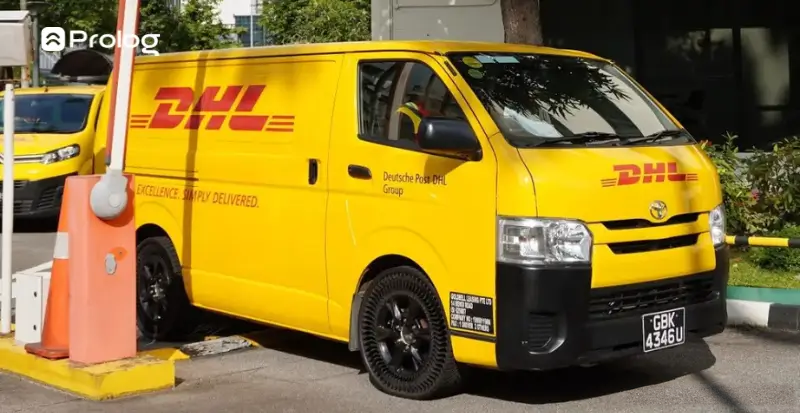
Image: DHL/Press handout
Imagine no longer having to worry about flat tires, incorrect calibration or unexpected blowouts on the road. For fleet managers, these problems mean delays, extra costs and lost productivity.
Airless tires are emerging as a promising solution to end these difficulties, offering greater durability, safety and less need for maintenance. But is this technology already ready for commercial fleets, or are other types of tires more suitable?
Below, we will explore:
- What is a tire without an air chamber called?
- How does an airless tire work?
- Are airless tires a trend?
- Why are airless tires not yet viable for road transport fleets?
- Tire management comes first
What is a tire without an air chamber called?
Airless tires may be known by different names, depending on the manufacturer and concept adopted. Some of the most common names include:
- Airless tires: a generic term used for any tire that does not use air in its structure.
- Non-pneumatic tires: emphasizes that these models do not depend on air pressure to work.
- Michelin Uptis (Unique Puncture-proof Tire System): Michelin's patented technology, which has already undergone several tests and is closer to commercial production.
- Tweel (tire + wheel): a model developed by Michelin, combining tire and wheel in a single piece.
Regardless of the name, the aim is the same: to offer greater resistance, safety and lower maintenance costs.
How does an airless tire work?
Unlike conventional tires, which depend on compressed air to maintain their structure, airless tires use solid materials and innovative structures to support the vehicle's weight.
Instead of an air chamber, they have a special tread structure connected to a series of flexible spokes that absorb impacts and ensure ground grip.
In practice, this means these tires do not puncture or deflate, reducing the need for unexpected repairs and replacements.
Are airless tires a trend?
In the 2020s, there was much discussion about airless tires reaching the market and how this technology could revolutionize the transport industry.
If you keep up with innovations in fleet management, you have probably heard that makes such as Michelin, Goodyear, Bridgestone and Hankook were developing models that promised to eliminate problems such as punctures and uneven wear.
But what has happened since then?
The truth is that, despite high expectations, airless tires have not yet reached the market on a large scale. Initial forecasts indicated that they would be commercially available by 2024, but so far few concrete advances have been announced.
Since 2022, news about this technology has become scarce, raising the question: does this innovation still make sense for the transport industry?
What has been happening is that, instead of widespread application to all vehicle types, manufacturers are focusing on more specific niches, such as agricultural machinery, military vehicles and autonomous vehicle fleets, where puncture resistance is more important than high-speed performance.
Why are airless tires not yet viable for road transport fleets?
The main obstacle to large-scale adoption lies in technical challenges that have not yet been resolved, such as:
- Excess weight, which can increase fuel consumption.
- Excessive heat buildup, since the airless tire structure flexes constantly.
- Noise and vibration at high speeds, which affect vehicle comfort and stability.
- Accumulation of debris, such as mud and stones, which can become trapped in the tire structure and compromise performance.
Although some companies have already tested these tires, there are still no signs that they will reach road transport anytime soon.
For fleet managers, this means that conventional tires remain the most viable choice for now.
The market continues investing in technologies to increase traditional tire durability, which makes much more sense than betting on an innovation that has not yet become established.
In other words: airless tires are not yet a real trend for freight transport.
Whatever the tire type, good tire management makes all the difference
Airless tires emerged as a promising innovation, but they were not the only change in the industry. Other tire management trends have been gaining prominence, such as pressure and wear monitoring technologies.
Today, the best strategy to reduce costs, avoid unexpected stops and ensure fleet safety is to invest in efficient management of conventional tires.
Keeping track of wear, correct calibration and choosing the right model for each operation can make a big difference to the company's productivity and savings.
Technologies such as the electronic tread probe and tire management system help anticipate problems and avoid unnecessary spending on premature replacements or unexpected failures.
If you want to deepen your knowledge and learn how to get the most out of your fleet's tires, take Prolog's tire management course now (in Portuguese), taught by Diego Paludo, a specialist with over 20 years of experience!
Frequently asked questions
What is a tire without an air chamber called?
How does an airless tire work?
Are airless tires already on the market?
Why are airless tires not viable for road transport fleets?
Are airless tires a trend in freight transport?
// newsletter
Fleet management content, straight to your inbox
Articles on tires, maintenance and fleet operations. No spam.


