Technology in fleet tire management: worth the investment?
 Luiz Felipe 6 min read
Tire management is essential to maintaining safety, efficiency and profitability. With technological advances and the introduction of specialized software, tire management has also been transforming, bringing even greater benefits to transport operations.
Replacing traditional methods, which often involve manual notes and later data entry, with specialized systems already means fewer errors and real-time information updates as data is entered.
This ensures that everyone involved has instant access to reliable, up-to-date data. However, the transition to these technologies also brings new questions and challenges for fleet management.
See below:
- What technologies are used in tire management?
- Why use technology in tire management?
- How can you implement more technology in your fleet's tire management?
- Challenges and questions about technology in tire management
- Technology trends in tire management
What technologies are used in tire management?
Among the main technologies used in tire management are:
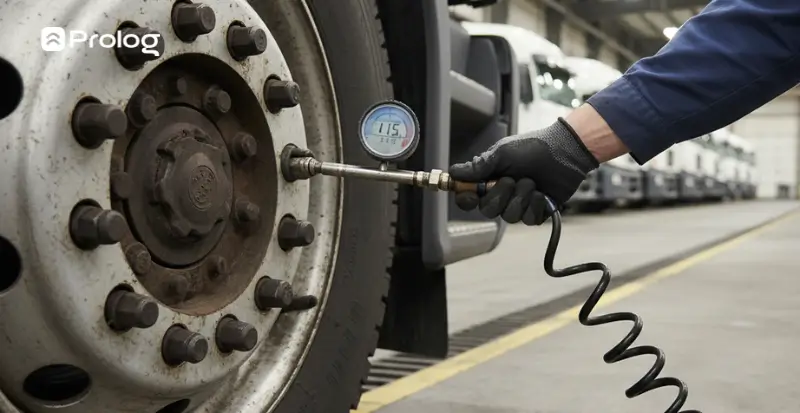
- Pressure and temperature sensors: provide real-time data on these aspects, alerting managers to any abnormalities that could lead to premature wear or failures.
- IoT systems: the Internet of Things (IoT) allows the integration of various sensors in vehicles, which collect and transmit data to a central platform, enabling a comprehensive view of tire health across the fleet.
- Tire management software: helps manage and analyze data collected by sensors, potentially generating detailed reports on tire condition, predicting useful life and recommending the best time for maintenance or replacement.
- Predictive analytics: can predict failures before they occur, based on usage patterns and monitored tire conditions, thereby reducing the risk of unexpected failures and optimizing the maintenance schedule.
- Electronic measuring device: works connected to a management system and quickly collects tire pressure and tread depth data, generating reports to assess the durability and value for money of the fleet's tires.
Why use technology in tire management?
Saving time, effort and resources
One of the main concerns when implementing a technology is its share of operational costs. That is why it is important to understand the benefits and associated costs that can be reduced or even eliminated with the new tool.
Compared with a manual tire management method, you can already be sure that technology reduces the time needed for activities, human resources (team effort) and material resources (paper, printing, office supplies).
It can also contribute to lower fuel consumption, less impact on vehicle maintenance and lower traffic accident rates.
Process standardization
Using software, apps and other technologies contributes to process standardization because it allows parameters and routines to be configured to ensure uniformity and accuracy in the activities performed.
Through preregistered data, required fields and customized forms, all necessary details are systematically integrated into teams' daily routines.
Besides simplifying the establishment of workflows and assignment of responsibilities, this also increases the reliability of the process as a whole.
In general, technology in tire management makes it possible to clearly define rules and procedures, ensuring all stages are completed as planned and providing the ability to monitor team adherence to and engagement with scheduled tasks.
Generating information
One of the most impactful aspects of technology in tire management is its ability to store, analyze and centralize data.
This centralization makes it easier to access up-to-date, accurate information about tire condition, wear patterns and maintenance needs, enabling an integrated view covering all tire management processes.
This way, collected and analyzed data becomes strategic information that can underpin important decisions, from scheduling preventive maintenance to optimizing tire purchasing and inventory.
Anticipating actions
The ability to anticipate necessary tire management actions is improved by technology. With optimized technological resources, tire managers not only keep operations more organized but can also anticipate needs and plan interventions.
Technology should be seen as an investment that brings efficiency and resource savings over the long term, even though it has initial acquisition and implementation costs.
Return on investment (ROI)
ROI helps quantify an investment's financial benefits relative to its cost, providing an objective basis for business decisions. A positive return on investment indicates the investment exceeded its cost, justifying adoption of the technology.
In many cases of implementing technology in tire management, ROI can be positive when the tool addresses real operational needs, reduces rework and improves decision-making. Ideally, treat customer results as a reference rather than an automatic promise, and confirm the provenance of every number presented by the supplier.
These results reflect not only direct operational savings but also improvements in efficiency and productivity.
How can you implement more technology in your fleet's tire management?
This involves some strategic stages to achieve greater success and positive returns on your technology investments. They are:
Assessing current needs
The first step is to carry out a complete assessment of existing tire management processes.
Identify gaps in current processes, any recurring tire problems and your fleet's specific needs that technology can address.
Researching available solutions
Explore technologies available on the market that align with the identified needs. These may include tire management software, real-time monitoring systems, pressure and temperature sensors, among others.
Financial feasibility and expected ROI
Before implementing any new technology, assess its financial and operational feasibility. Understand the expected return on investment and consider the long-term impact on operational efficiency and maintenance costs.
Many companies can provide real customer results, offering a basis for comparison and expectations of achievable ROI.
Team training
Ensure everyone involved, from managers to drivers and technicians, receives adequate training on using the new technology. Team commitment is essential to maximizing the benefits of new tools.
Challenges and questions about technology in tire management
Initial investment cost
One of the main challenges is the initial cost associated with acquiring technologies. Companies need to carefully assess return on investment and determine whether long-term benefits justify the initial costs.
In most cases, technology pays off, but it must meet the company's demands and needs to make sense.
Technological complexity
The complexity of new technologies can be a barrier, especially for teams used to more traditional methods. This raises questions about ease of use and the learning curve associated with new tools.
It is important to focus on choosing systems and tools with intuitive, easy-to-use interfaces.
Integration with existing systems
There are concerns about compatibility and the ability to synchronize data without interruptions or information loss. Integration itself becomes an issue, as it can involve incompatibility complications and sometimes require help from an IT department to work properly.
That is why it is important to research and understand all features and the technology implementation process before starting to apply them to your fleet.
System updates and scalability
Another concern is the ability to update and scale technological solutions as the fleet grows or needs change. This involves assessing whether the chosen technology is flexible and adaptable over time.
Technology trends in tire management
Tire management trends are driven by the need for efficiency, safety and sustainability in transport operations.
IoT sensors and predictive analytics are advanced technologies that can greatly affect information transmission speed and the accuracy provided for analysis.
Augmented reality technologies are starting to be used for training and maintenance assistance and can show how to perform specific maintenance procedures or check tire condition, improving service accuracy and efficiency.
In addition, automation for tire inspections and maintenance is constantly evolving, being developed to improve accuracy and reduce manual workload, especially in large fleets.
The Prolog App tire management solution is also a trend and is present in an increasing number of fleets in Brazil and abroad — more than 1,500 operations already use our tool. Learn more and schedule your free demonstration.
Frequently asked questions
What should I look at before adopting tire management software?
My team still records measurements on paper; what changes with digitization?
Is it worth the investment? What return can I expect from technology in tire management?
I worry that the team will not adopt the new tool; how can I reduce this risk?
What if the new system does not communicate with the ones the fleet already uses?
Which tire technologies are emerging now?
// newsletter
Fleet management content, straight to your inbox
Articles on tires, maintenance and fleet operations. No spam.