Prolog tire management: 5 problems solved
 Jean Zart 6 min read
Most tire managers have been dealing with the same problems for years. They know they are losing tires prematurely, feel they could make better purchasing decisions, and recognize that paper or spreadsheet control can no longer keep up. Yet they postpone change because implementing a solution seems to require stopping the operation and starting from scratch.
It does not.
Prolog fits into the existing operation, with the tire repair shop already there, the team already at work and the processes already running. What changes is the level of control, visibility and intelligence the operation gains over its tires.
Take a look at the five problems that come up most often in operations that turn to Prolog (and that we actually solve).
Problem 1: Not knowing the actual CPK of tires
(video in Portuguese)
Many operations know how much they spent on tires during the month, but do not know how much each tire cost per kilometer traveled.
Without CPK (cost per kilometer), purchasing decisions are based on the price tag, and the cheapest tire to buy may be the most expensive over its full life cycle. Without this metric, it is also impossible to compare makes, models or suppliers objectively.
With Prolog, the system calculates each tire's CPK automatically, considering the purchase amount, retreading and service costs, and the mileage actually covered.
The system performs this calculation for each individual tire (identified by its hot brand), by make, by model and by route profile.
The manager gains concrete answers to questions such as “which make offers the best value for money in my operation?” And that answer comes from the fleet's own data, rather than the manufacturer's catalog.
Problem 2: Premature tire disposal
Tires leaving the operation before reaching their expected useful life. Casings rejected for retreading because they have gone too far. Disposals with no recorded reason, preventing any analysis of why losses are occurring.
Each tire discarded prematurely represents a financial loss for the operation. Rather than treating the full purchase price as the minimum loss in every case, the analysis should consider how much useful life has already been used, the casing's remaining value and that tire's service history.
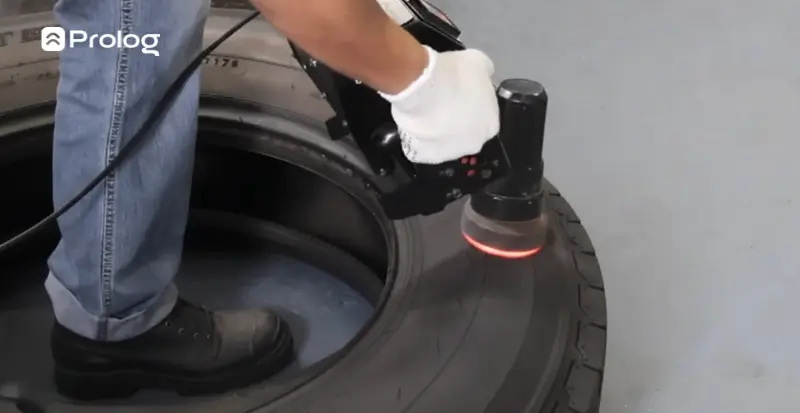
The system keeps track of how quickly each tire wears through tread depth and pressure inspections performed with Prolog's electronic tread probe kit.
With this database, the system projects when each tire will reach its limit, allowing the team to schedule replacement or dispatch for retreading at the right time, before the casing is compromised.
The system records each disposal with a standardized reason, allowing the manager to identify patterns: whether the problem relates to mechanical issues (misalignment, suspension), operations (route, load) or the supplier (an underperforming make).
Conlog, for example, brought premature tire disposal down to zero with Prolog's tire management tool.
Problem 3: Lack of standardized tire inspections
When tire inspections do not follow a defined process, results vary depending on who performs them. Inspections may take place at different intervals, or tread depth may be measured using different methods.
As a result, if and when the data reaches management, it cannot be compared. And if the database is unreliable, any indicator calculated from it is unreliable too.
Prolog's electronic tread probe kit collects pressure and tread depth in a single device, with 99% data accuracy. Beyond that, the device updates data in the system, reducing manual typing and the risk of transcription errors.
The inspection schedule defines the frequency per vehicle, and the system organizes the queue by priority: vehicles that have gone longest without an inspection automatically move to the top of the list. When the tread probe identifies a tire outside the configured standard, the system itself opens a maintenance work order.
In other words, the entire process, from collection to recording to triggering action, follows a standard, regardless of who is doing the fieldwork.
Problem 4: No visibility into inventory and tire relocation
Simple questions such as “how many new tires do we have available?” or “has that tire sent for retreading 40 days ago come back yet?” require a trip to the warehouse to check, because control does not keep up with relocations quickly enough.
In daily operations, the team fits tires without deducting them in the system, casings leave for refurbishment without a dispatch record, and physical inventory drifts further from what any spreadsheet or notebook shows.
This discrepancy is one of the most recurring tire management errors and one of the most costly, because it compromises everything from purchasing decisions to asset traceability.
By using a system, you gain traceability for each individual tire, from entry into inventory to disposal. Every relocation is recorded through the app when the team enters the record.
This way, you can see how many tires are fitted, how many are in inventory, how many are undergoing refurbishment and how many have been discarded. This reduces reliance on periodic manual counts and helps reduce discrepancies between the system and reality.
Problem 5: Paper or spreadsheet management that does not scale
When management involves processes with extensive manual work during data collection and recording, two things can happen: you spend too much time maintaining control and moving data “back and forth,” or you lack that control altogether because you have no time to stop and analyze the information.
That is in addition to other problems that could arise along the way, such as failures to record information, difficulty reading information when transferring it to the system (not everyone's handwriting on paper is very legible), and so on.
With Prolog, you centralize all information on a platform accessible through the web and app. Data is entered in the field (tire repair shop, yard) and becomes available for analysis (office, management) after the team makes the records.
Dashboards and reports are generated automatically and can be exported or integrated with BI tools through an API. It is the transition from paper to data without the operation having to stop for it to happen.
And why Prolog solves this “without changing everything”
Implementing Prolog does not require the operation to stop. It fits into the existing structure: the tire repair shop keeps working, the team keeps operating and the vehicles keep running.
The implementation process starts with a tire inventory audit (a count of what exists), moves through system configuration (parameters, vehicles, branches) and continues with team training.
Prolog also integrates with the systems the operation already uses. The open API allows the tire management system to connect to the ERP, BI and other tools, eliminating rework and ensuring data flows between platforms.
What changes is not the operation. It is the level of control and intelligence your management gains over one of your largest cost centers.
Talk to a Prolog specialist to learn how we solve YOUR tire management problems. We look forward to hearing from you.
Frequently asked questions
How can you know the actual CPK of each tire in the fleet?
How can you avoid premature tire disposal?
How much does discarding a tire prematurely cost?
How can you standardize tire inspections?
How can you keep track of tire inventory and relocation?
Does implementing the system require stopping the operation?
// newsletter
Fleet management content, straight to your inbox
Articles on tires, maintenance and fleet operations. No spam.