How many fleet vehicles make Prolog worthwhile?
 Jean Zart 4 min read
Before adopting any system, it makes sense to ask: does this work for an operation my size? In Prolog's case, the answer is not a magic number of license plates, but there is indeed an operation profile that achieves the best results.
Read on:
- Ideal size is about more than the number of vehicles
- How many vehicles make Prolog start to make sense
- The difference between having a tire module and having tire management
Ideal size is about more than the number of vehicles
When we talk about ideal size, the number of vehicles is just one variable. What really determines whether Prolog makes sense for an operation is the combination of three factors:
- Volume of tires under management: the greater the volume of assets, the sooner manual control can no longer keep up and the more value a dedicated system delivers.
- An in-house tire repair shop: Prolog was developed for operations that control tire services internally. Without an in-house tire repair shop, Prolog works, but lacks the operating context in which the tool generates the most value.
- Someone dedicated to tire management: this need not be an exclusive role, but someone must be responsible for this area. Someone who actually manages it and reviews the indicators, makes retreading decisions, assesses the performance of makes, keeps track of CPK, and so on.
When these three factors are present, Prolog fits like a glove. In other scenarios, the tool contributes and delivers good results, but not everyone can make the most of what we actually offer.
How many vehicles make Prolog start to make sense
In practical terms, Prolog starts to make more sense from 50 motor vehicles.
We do not consider the number of license plates alone (because trailers and semi-trailers are part of the fleet but do not determine tire management complexity in the same way). What really counts is the volume of vehicles that run, use tires and require active maintenance.
From this size onward, the volume of active tires, the frequency of tire repair services and the amount of data to record and analyze make manual management unfeasible if the goal is real control.
Of course, smaller fleets also benefit from structured tire management. The difference is that, for fleets of 20 or 30 vehicles, an in-house tire repair shop is not always justified, or one person cannot focus solely on tires to manage them and keep the inspection and maintenance routine active.
In many cases, a well-organized tire control spreadsheet (in Portuguese), disciplined processes and drivers' help in collecting data can maintain reasonably good control.
The cost-benefit ratio of a dedicated system becomes more clearly justified when the volume of data and decisions exceeds what manual control can handle.
Another point: operations that already have more structured maintenance management can benefit from the Tire Management solution faster.
The difference between having a tire module and having tire management
If you already use a transport ERP or TMS with a tire module that records data and generates reports, you may be wondering why you would need another tool.
The difference is depth.
A tire module within a general-purpose system usually offers purchase records, basic inventory control and mileage alerts for replacement. It lets you know what the fleet has and when to replace it. This view is closer to an inventory list than to control.
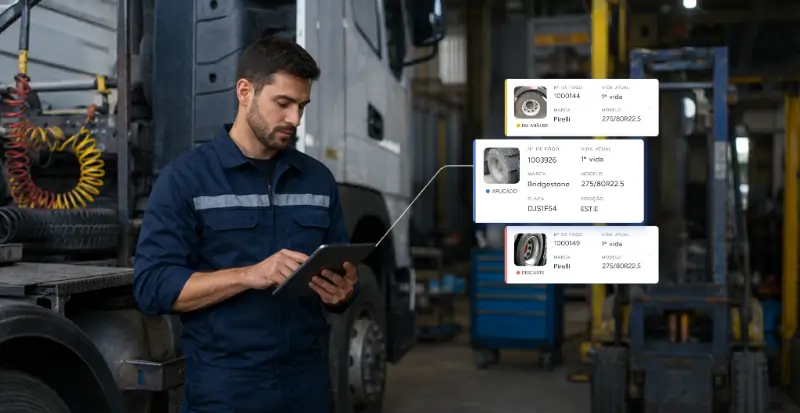
Prolog operates at another level. Traceability is individual, by fire number (the serial number branded on the tire), with each tire's complete history: pressure, tread depth, services performed, relocations between vehicles and retreading cycles.
CPK is calculated per asset, rather than as a fleet average. In addition, disposal cause analysis shows why each tire left the operation, and digital field inspections (with a proprietary tool developed by Prolog) integrate automatically with the system.
In practice, the difference is data-driven tire management: when you use a tire module in a general-purpose system, you can see that you spent R$5,000.00 on tires during the month in Brazil. When you use Prolog, you can understand why you spent it, which tire was discarded prematurely and for what reason (leading to insights into what to do differently in the next cycle).
If this profile sounds like your operation, the next step is to see how Prolog works in practice with your operation's data. Book a free demonstration and learn how the solution applies to your fleet.
Frequently asked questions
How many vehicles make Prolog worthwhile?
What factors determine whether Prolog fits the operation?
Can small fleets use Prolog?
What is the difference between an ERP or TMS tire module and Prolog?
// newsletter
Fleet management content, straight to your inbox
Articles on tires, maintenance and fleet operations. No spam.