How Brazil's 2026 driver's license rules impact road freight
 Thiago Concado 4 min read

The rules for obtaining the National Driver's License (CNH) in Brazil have changed. And for those who manage fleets in road freight transport, the changes directly affect the dynamics of hiring, training and operational safety.
Resolution 1.020/25 of Contran (Brazil's National Traffic Council), which came into force at the end of 2025 with full effect in 2026, reshapes the driver training process in Brazil. The central change is the end of the requirement to attend a driving school to obtain a license or change category, including the professional categories C, D and E, which are the ones that qualify a person to drive trucks. In practice, the candidate can now prepare independently, for both the theoretical and the practical test.
Theoretical training began to be offered in digital format, accessible even through an app. The minimum number of hours of practical lessons dropped to 2 hours, a 90% cut (it used to be 20h). In addition, the parallel parking test is no longer mandatory in several states, such as São Paulo, Santa Catarina, Espírito Santo, Amazonas and Mato Grosso do Sul. Those who fail the practical test also get their first retest attempt with no additional fee.
The stated goal of these changes is to reduce the cost of licensing and lower the entry barriers for new drivers. And, in fact, the financial impact should be significant. With the drop in the fees of the driver training centers (CFC) and the opening to private instructors, the total cost of obtaining a license or changing category falls. For the transport sector, which has lived for years with a high shortage of professional drivers, the measure may accelerate the entry of new drivers into the market.
But this is precisely where the scenario gets complicated for the fleet manager. If the process became faster and cheaper, more people should get licensed in categories C, D and E. This expands the labor supply, which is positive. However, the practical training these drivers bring with them will, in many cases, be less than that of those who went through the previous model. Two hours of mandatory practice do not prepare a driver to maneuver an articulated vehicle, back up to a loading dock or operate on mountain highways with a heavy load.
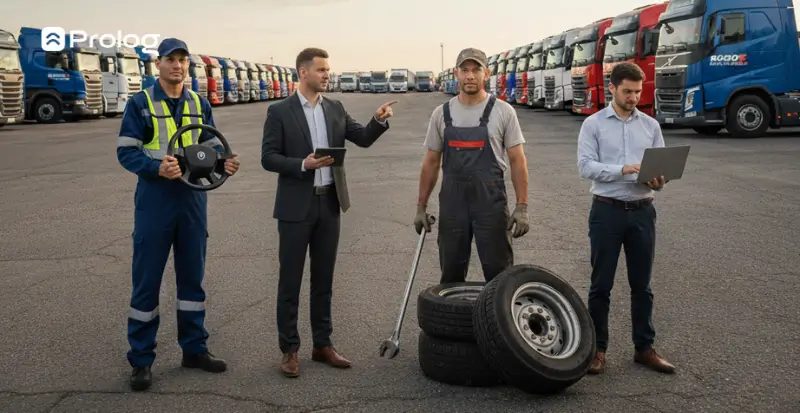
The responsibility for practical training now shifts to the trucking companies themselves. The driver may arrive licensed according to the law, but without the experience the operation requires. It is up to the manager and the company to create mechanisms to assess this gap and fill it before the professional takes the wheel of an asset worth hundreds of thousands of reais and carrying a load that may be worth much more.
Not everything has been relaxed, however. Some requirements were maintained or even reinforced. The drug test, for example, became mandatory as early as the issuance of the first driver's license, regardless of the category. Before, it was required only for professional categories and at renewal. For categories C, D and E, it remains mandatory both when obtaining and when renewing the license. The medical and psychological exams remain in person and mandatory. And the minimum age of 21 for the professional categories remains.
Another relevant change for fleet management is the automatic renewal of the driver's license for drivers (in Portuguese) who have not recorded infractions in the last 12 months. For this “good driver” profile, the renewal process becomes even simpler and free of charge. This simplifies the fleet's document management, but it requires the manager to closely keep track of the situation of each driver and especially of their points score, since professionals with EAR (a notation for drivers who carry out paid work) have a limit of 40 points before suspension.
The scenario taking shape for 2026 is one of licensing that is more accessible, faster and cheaper, but that, on its own, does not guarantee the technical qualification that road freight transport requires. Now, adapting hiring processes, investing in practical training and maintaining rigorous control of the drivers' documentation and behavior is the condition for operating safely within the new model.
Want to start structuring the control and development of your fleet's drivers? Download our driver control spreadsheet (in Portuguese) and organize these processes in practice.
Frequently asked questions
I am hiring drivers who were licensed only recently and I feel they lack practice. Does this have to do with the change in Brazil's driver's license rules?
What remained mandatory to obtain a driver's license in categories C, D and E in Brazil?
What is the difference between the old licensing model in Brazil and the one in force now?
How does this change in Brazil affect the cost of licensing and the supply of drivers on the market?
Does the automatic renewal of the driver's license in Brazil change anything in the fleet's document management?
// newsletter
Fleet management content, straight to your inbox
Articles on tires, maintenance and fleet operations. No spam.