Prolog's preventive maintenance app: 10 advantages
 Jean Zart 9 min read
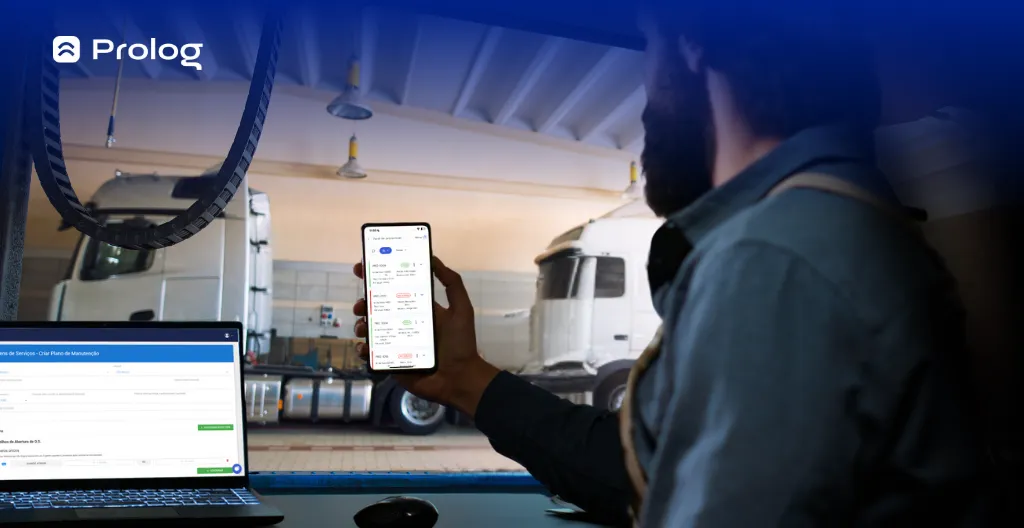
When was the last oil change for your fleet's vehicles? Have the brakes been inspected? And is tire rotation up to date? If you had to think for a moment before answering, relax — you are not alone. The fleet management routine is hectic, and keeping track of all maintenance is a major challenge.
And that is exactly where the preventive maintenance app comes in. It replaces paper reminders, outdated spreadsheets and those old makeshift fixes with automated processes, smart alerts and reliable data — all in the palm of your hand.
The importance of preventive maintenance for a fleet
The data confirms it: fleets that operate with preventive maintenance up to date perform significantly better in both safety and operating costs.
According to Brazil's National Transport Confederation (CNT), 30% of accidents involving cargo vehicles in Brazil are caused by mechanical failures — many of which could be avoided with a consistent preventive maintenance routine.
Bridgestone also reinforces this picture, reporting that vehicles that follow a preventive maintenance plan can save up to 10% in fuel consumption — a difference that adds up quickly in operations with dozens or hundreds of vehicles.
Another important point: the lack of preventive maintenance can make engine problems more serious, increasing corrective maintenance costs.
In short: neglecting preventive maintenance means accepting the risk of paying more, facing frequent unforeseen events, losing competitiveness and, worse, compromising drivers' safety.
Why use apps for preventive maintenance?
Savings, control and safety should already be enough reasons to consider using a preventive maintenance app. But if you are still unsure, it is worth reflecting on some common objections — and understanding why they do not make that much sense:
“Using paper is easier and cheaper”
It may seem more practical day to day, but relying on paper and manual spreadsheets is a huge risk to your operation. A lost checklist, an illegible note or a typing error is enough to cause a mechanical failure, delays or even accidents.
With an app, you standardize processes, automate alerts and ensure that information is recorded correctly — with organized access for the team, without relying on loose papers or outdated files.
“Having an app is expensive”
In practice, the cost of a maintenance app is much lower than the losses caused by corrective maintenance, unexpected downtime or legal problems due to negligence.
In addition, many apps, such as Prolog's, have flexible plans designed around the number of license plates in the operation. This investment pays off in savings, productivity and fewer errors.
“My fleet is still small; I do not need this now”
In fact, the earlier you start, the easier it is to create a culture of control and prevention. And even small fleets face challenges with overdue maintenance, fines and rework.
Using an app from the start helps you structure processes, avoid bigger problems and grow more safely.
“Maintenance is the workshop's responsibility, not mine”
It is true that the workshop usually handles maintenance work, but the role of the fleet manager goes far beyond that. It is up to you to ensure that vehicles are sent in at the right time, that records are up to date and that nothing is overlooked — after all, you are accountable for the operation's results.
With a preventive maintenance app, you take control of the process and prevent the workshop from becoming a “firefighting” operation. Visibility into deadlines, automatic alerts and an organized history ensure greater efficiency and safety for your fleet.
“I prefer to solve problems when they appear”
It may seem practical to deal with problems as they arise, but this approach is expensive. Very expensive. The cost of unplanned maintenance is, on average, 40% higher than that of preventive maintenance — not counting the losses from idle vehicles, disorganized routes and late deliveries.
A preventive maintenance app is not a luxury; it is a way to avoid these losses. It helps identify recorded failures before they become critical, schedules services in advance and keeps the fleet ready to run at all times.
“I do not know whether the team will keep using the app over time”
That is a valid concern. After all, a tool only produces results if it is used properly. But here is the good news: a good app is designed precisely to make everyday work easier — not harder. The more intuitive it is, the greater the team's adoption.
In the Prolog Maintenance Management system, for example, you get a simple, straightforward app with features tailored to the everyday work of fleet professionals. There is also full support for implementation, training and ongoing assistance — from the start through continued use.
“I do not know whether my data will be secure”
Data security is a legitimate concern and deserves attention. But contrary to what many think, leaving your data in scattered spreadsheets or papers around the base is far riskier than using software with cloud storage.
Reputable apps, such as Prolog's, follow strict information security protocols and make automatic backups. In other words, you not only gain speed but also protect your operation's most strategic information.
How can you use apps to create an efficient maintenance management plan?
A good plan starts with data-driven maintenance. And the best way to structure it, keep track of its execution and make the right adjustments over time is by using a preventive maintenance app.
With the app, you start by mapping all fleet vehicles, including make, model, current mileage, type of use and maintenance history. This is essential for tailoring the plan to each vehicle — since a truck that travels 1,000 km per day needs a different plan from one that travels 300 km.
Then the app lets you define maintenance intervals based on time, usage or condition. For example:
- Oil change every 10,000 km
- Brake check every 45 days
- Alignment and balancing when irregular tire wear is detected
The system also sends automatic alerts whenever a service is approaching its due date, so you do not have to rely on manual reminders or outdated spreadsheets.
Another essential app feature is automated work order creation. As soon as a preventive maintenance need is identified, the app opens a WO, assigns it to the person responsible and records the status — from scheduling to completion. This builds a history, avoids rework and makes it easier to keep track of deadlines.
The maintenance app also generates reports with indicators of compliance with the plan, mechanic productivity and items with the most recurring failures. With this data in hand, you can adjust the plan to the fleet's routine: increasing maintenance frequency for more critical assets or extending intervals for vehicles performing above average.
How the app helps with different types of preventive maintenance
Beyond structuring a plan for your fleet's maintenance management, not all preventive maintenance is done the same way. Depending on your operation's strategy, you can adopt different forms of control — and this is where, once again, a preventive maintenance app makes all the difference.
A good system makes it easy to apply each of these approaches, centralizing information and creating customized alerts for each scenario. Here are the main types:
Calendar-based preventive maintenance (fixed time)
This is maintenance scheduled for specific dates, such as monthly servicing, quarterly oil changes or electrical system servicing every six months.
With an app, you configure cycles automatically and receive alerts whenever maintenance is approaching — without relying on manual reminders or paper notes.
Usage-based preventive maintenance (fixed usage)
This strategy considers how much the vehicle is used, such as every 10 thousand kilometers traveled or every 500 engine hours.
The app organizes readings reported by the operation and generates notifications based on the registered cycles, helping each maintenance task happen at the right time, without unnecessary early work or delays.
Conditional preventive maintenance (condition-based)
More advanced, this maintenance is carried out according to the actual condition of components, determined through checklist reports, technical inspections and records made by the team.
The app brings together checklist reports and technical inspections, highlights recorded failures before they become problems and makes it easier to create work orders based on the current conditions observed in vehicles.
10 advantages of Prolog's preventive maintenance app
If you are looking for a complete solution to optimize your fleet's preventive maintenance, Prolog App offers features that go beyond the basics.
Below, we highlight 10 advantages that make Prolog a strategic ally in Maintenance Management:
1. Automated preventive maintenance
Prolog lets you create customized maintenance plans for each vehicle type, with work orders generated automatically based on mileage or specific dates. This ensures that maintenance happens at the right time, avoiding unexpected failures.
2. Opening ad hoc work orders
Besides scheduled maintenance, the app allows work orders to be opened at any time, with parameters for the issues to be resolved, control by priority and deadline, and relevant file attachments.
3. Detailed cost control
Keep track of total operating costs, by vehicle and process, allowing precise analysis of spending and identification of areas that need attention to optimize resources.
4. Organized inventory control
Manage the inventory of parts and supplies with organization by category, records of receipts and issues, and a complete history through the Prolog app, helping avoid shortages when a service needs to be carried out.
5. Customized electronic checklists
Create checklists adapted to your operation, with the option to include photos, electronic signatures and offline functionality, making daily inspections easier and increasing the reliability of the information collected.
6. Maintenance dashboards and reports
Keep track of key indicators such as mean maintenance time, mechanic productivity and vehicles with the most incidents, allowing decisions based on concrete records.
7. Integration with existing systems
Prolog offers a REST API for integration with management systems and analytics platforms, such as ERPs and BI software, providing smoother, more connected operations.
8. Improved maintenance control with real results
At Klabin, Brazil's largest paper producer, adopting Prolog for preventive maintenance and checklists brought greater control and speed. In a short time, the team resolved more than 3,200 work orders, with more organized processes and better-informed decisions.
9. Greater control and visibility
Get a complete view of fleet health, with information about vehicles undergoing maintenance, the person responsible for each work order and incident history, making management and decision-making easier.
10. Increased fleet safety and availability
With maintenance carried out at the right time and rigorous control of vehicle condition, the risk of accidents and unplanned downtime is reduced, ensuring safer and more efficient operations.
Now that you have seen how a preventive maintenance app can transform your routine, it is clear that keeping manual spreadsheets and reminders is far from enough to ensure control and efficiency.
With the Prolog Maintenance Management system, you structure a preventive maintenance plan, eliminate rework, automate work orders and start keeping track of everything with reliable data.
Schedule a free demonstration now and see how Prolog Maintenance Management can transform your operation — from service control to decision-making, all with organized, reliable records.
Frequently asked questions
Why is preventive maintenance important for a fleet?
How can you use an app to create a preventive maintenance plan?
What are the advantages of Prolog's preventive maintenance app?
Which types of preventive maintenance does the app help control?
Isn't using paper or a spreadsheet cheaper than an app?
// newsletter
Fleet management content, straight to your inbox
Articles on tires, maintenance and fleet operations. No spam.