Fleet management software ROI: how to calculate it
 Jade Zart 5 min read

ROI in fleet management is a key performance indicator for analyzing profitability and areas of loss in fleet-related investments.
This metric helps identify the financial success of current initiatives and also guides future decision-making, because it relates the benefit obtained to the investment cost.
Therefore, calculating the ROI of each investment is an action that should be taken with each new initiative, considering operating costs, efficiency, process optimization and the net gain generated after the investment.
In addition, it is essential to understand that the expected period for new fleet management investments to start generating financial benefits depends on the company's operational and financial reality, the project type and how it is implemented.
Take a look below:
- How can you know whether a fleet management investment will deliver a return?
- Why is ROI important in fleet management?
- How do you calculate return on investment in fleet management?
- How soon can we expect a return on investment in fleet management?
- Which factors can influence return on investment in fleet management?
How can you know whether a fleet management investment will deliver a return?
To determine beforehand whether an investment in fleet management will deliver a return, that is, before adopting and actually using the system, you can look for and analyze success stories from other companies.
In addition, to understand whether there will be returns, you also need to consider the fleet's current operating costs, including maintenance, tires, fuel and personnel.
Next, you can estimate expected savings from implementing the new system, such as reduced fuel and maintenance expenses, as well as assessing improvements in efficiency and productivity.
Comparing these costs with the initial investment in the management system will provide a clear view of feasibility. For a more complete analysis, it is also worth looking at direct and indirect costs, because this view helps reveal the real value of a product or service to the operation.
Why is ROI important in fleet management?
Return on Investment (ROI) is essential in fleet management because it offers a clear view of the effectiveness of investments made.
It allows managers to assess whether maintenance-related costs, vehicle acquisition, management technologies and other expenses are being offset by tangible benefits, such as increased transportation efficiency, reduced fleet management costs and operational improvement.
ROI also helps justify future investments and guides strategic decision-making, balancing expenses and benefits. Since the calculation relates benefit and cost, it makes it easier to compare whether an initiative deserves to be maintained, adjusted or replaced.
What can ROI reveal to the manager?
ROI in fleet management can show the manager several crucial aspects of the operation.
For example, it can indicate the financial result of a new telematics system in reducing operating costs or the effectiveness of a training program in improving safety and reducing accidents (in Portuguese).
By analyzing return on investment in different actions, managers can better understand how different aspects of fleet management contribute to savings and profitability, and where adjustments can be made to optimize transportation operations, increase performance and reduce unnecessary costs.
How do you calculate return on investment in fleet management?
To calculate ROI in fleet management, you need to:
1 – Identify total cost of operations
Add up all fleet management costs, including vehicle acquisition, maintenance, fuel, insurance and employee salaries.
2 – Calculate savings and gains
Estimate what the investment generated, including areas directly or indirectly related to the investment made that may have been affected.
3 – Use the ROI formula and analyze the result
Calculate the investment's net gain by subtracting the total cost of the investment from total savings and gains. Then divide that net gain by the total cost of the investment. The formula is:
ROI = (total savings and gains − investment cost) ÷ investment cost
To present the result as a percentage, multiply the result by 100.
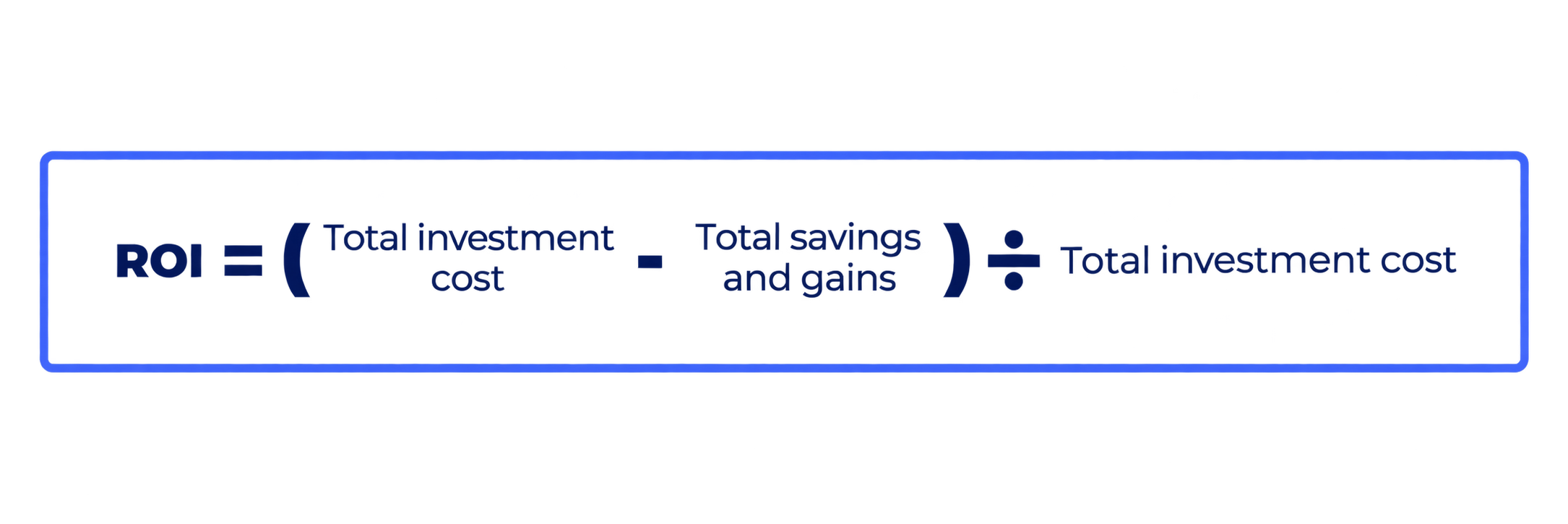
Using figures for an example in Brazilian reais, if the investment made was R$3,500.00 and the return generated was R$5,000.00, the net gain is R$1,500.00. Dividing R$1,500.00 by R$3,500.00 gives an ROI of approximately 0.43, or 42.9% expressed as a percentage. If total savings and gains are less than the initial amount of R$3,500.00, ROI will be negative, suggesting that costs outweigh benefits.
How soon can we expect a return on investment in fleet management?
The time to see a return on investment in fleet management varies with the operational context. Instead of assuming a fixed timeframe, ideally you should keep track of costs before and after implementation and compare the progression of gains with the amount invested.
However, for a more accurate forecast, it is essential to consider the fleet's specific circumstances and the investment's goals.
The time to see a return on investment in fleet management can vary depending on several factors, such as fleet size, the type of investment made and specific operational practices.
Which factors can influence return on investment in fleet management?
Investment scale
Larger investments in fleet management software generally take longer to show a positive return.
This is due to the significant volume of resources allocated initially, which requires a longer period to be offset by the savings and improvements generated.
Implementation efficiency
The speed and efficiency with which fleet management software is implemented directly affect ROI.
Fast, effective implementations can accelerate returns, while delays and installation problems can prolong the time needed to see financial benefits.
Adoption and training
Successful adoption of systems by end users and the effectiveness of the training provided are essential. The faster employees adopt the new system, the sooner benefits may be noticed.
Maintenance and recurring costs
Ongoing costs associated with maintaining and operating fleet management software can influence the time needed to achieve positive ROI.
High maintenance costs can reduce financial benefits and prolong the investment payback period.
Market conditions
External factors, such as general economic conditions, changes in the transportation market and regulations, can also have a significant impact on ROI.
These factors can unpredictably change operating expenses or revenue, affecting return on investment.
To learn more about maximizing return on investment in your fleet management and how our solutions can contribute to it, schedule a free demonstration with Prolog App here.
Frequently asked questions
How do you calculate fleet management software ROI?
How long does fleet management software take to deliver a return?
How can you know beforehand whether a fleet management investment will deliver a return?
Which factors influence ROI in fleet management?
Why is ROI important in fleet management?
// newsletter
Fleet management content, straight to your inbox
Articles on tires, maintenance and fleet operations. No spam.