
Fleet maintenance costs: what goes into the bill
 Jade Zart 5 min read

Maintenance costs include several factors. For example, labor, equipment replacement, parts purchases, tires, fees, insurance, fuel and even losses caused by interruptions to activities.
As a result, and because these involve fixed and variable costs, maintaining precise, efficient control of these amounts becomes complex. They can grow quickly when the fleet operates with little predictability.
Maintenance management is a fleet department that serves as a way to gain greater visibility into vehicle operation and also into the costs in this department. In other words, it is a stage responsible for planning, recording and applying solutions that improve fleet performance.
Can this management also reduce maintenance costs?
Below, learn:
Average fleet maintenance costs
To determine these average costs, you first need to keep track of the processes and services carried out on the vehicles in the operation. You need to know every amount spent on inspections, parts purchases, replacements, repairs, tires, oils, fees, insurance and other items related to vehicle use.
This way, all amounts relevant to fleet maintenance are accounted for and included in the average maintenance cost calculation. This control also helps separate planned routine work, such as parts and labor for scheduled services, from emergency repairs.
Many people think fleet preventive maintenance is an unnecessary expense, but that is where they are mistaken.
Companies depend on maintenance to operate in freight transport because it is a fundamental activity in company planning and organization. It also promotes greater productivity and efficiency across logistics processes as a whole.
So, how do you calculate average vehicle maintenance costs?
We should consider two types of maintenance:
- Corrective: related to unplanned repairs, such as a broken part.
- Preventive: aimed at prescheduled services to prevent failures.
To analyze maintenance costs, we will consider the following factors:
1- Maintenance should be tracked by vehicle, period and service type. Instead of relying on an old percentage with no clear source, use the operation's history to compare preventive and corrective maintenance, parts, labor and other expenses associated with each vehicle.
2- From there, compare how spending changes over time. Routine parts and labor belong in this calculation, but it should also include repairs, tires, oil, insurance, registrations, licenses, depreciation and other expenses that affect the total cost of keeping the vehicle available.
Remember that regular maintenance can support a more efficient operation and help avoid expensive repairs in the future. On the other hand, untreated vehicle problems can reduce efficiency, raise other operating costs and lead to more expensive repairs later.
If a fleet vehicle's maintenance service costs start consuming a significant share of the asset's value before the end of its expected useful life, it is time to review your processes and assess fleet renewal, because that vehicle may be increasing your operating costs instead of supporting the operation.
Maintenance Control Spreadsheet
Make your fleet maintenance easier and organize it in a practical way.
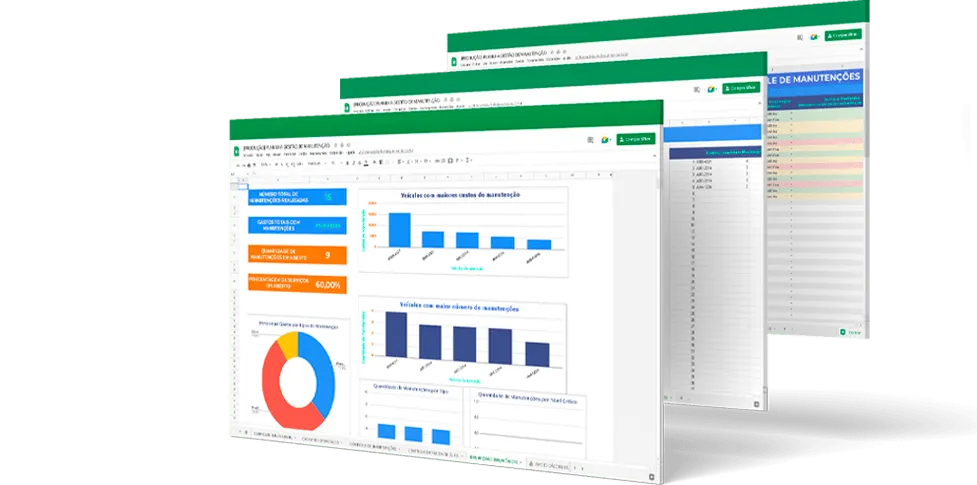
Use the spreadsheet to help organize maintenance records, view recurring expenses and make clear which vehicles account for repairs, replacements and unplanned downtime.
What fleet maintenance costs include
Maintenance-related costs include labor, tools, spare parts, tires, repairs, oil and losses caused by interruptions to company activities.
In addition, the main fixed and variable costs to include in the total maintenance amount are:
- Depreciation: the difference between the vehicle's purchase price and estimated resale or trade-in value;
- Insurance: an expense that should be tracked alongside other vehicle ownership and operating costs;
- IPVA, registrations, licenses and fees: in Brazil, IPVA is a vehicle ownership tax; these amounts are set according to the rules applicable to the vehicle and where it is registered;
- Fuel: an amount that depends on mileage traveled, vehicle consumption and the price paid per liter.
If costs are not controlled, they can become excessive. That is why the manager and their team should always track maintenance processes and activities very carefully.
Furthermore, vehicle maintenance is one of the activities responsible for preserving fleet productivity. It keeps vehicles fully operational, maintaining a regular flow of deliveries and deadlines.
That is another reason to look after vehicles to avoid possible mechanical failures and component breakdowns, which could mean higher spending on unscheduled repairs and idle vehicles. Simple items can also affect the bill: misalignment increases rolling resistance and makes the engine work harder, while components with greater capacity, such as filters suited to the application, can extend the item's useful life and reduce replacements.
How to control fleet maintenance costs
Software is becoming increasingly up to date to assist with maintenance management processes.
With this type of technology, it is easier to centralize information such as inspections performed, issues found, work orders opened and closed and the costs of each service. When these records are organized, the team no longer has to rely on scattered notes and can consult each vehicle's history with greater confidence.
This makes it possible to track key performance indicators (KPIs) to know where you are getting good results and exactly where to improve.
Checking vehicles daily helps keep maintenance costs under control and within expectations or plans. This enables cost reduction, with greater predictability for preventive and corrective services.
How can you tell if costs are above normal?
If you still have no idea how much you should be spending or saving each month on vehicle maintenance, there are some signs of trouble:
- The prevention routine, including daily vehicle inspections, is not being carried out, and corrective services have become the fleet's main maintenance activity;
- Vehicles are constantly failing, spending more time in the workshop than in operation;
- Traffic violations are very frequent, indicating that drivers are behaving inappropriately and damaging the vehicles.
Although not directly related to maintenance costs, these factors contribute to increased vehicle damage and, consequently, higher spending. They therefore deserve attention in fleet management.
Want to start having more control over your operation and fleet maintenance? Download our maintenance management spreadsheet now (in Portuguese).
Frequently asked questions
How much should a fleet spend on maintenance per vehicle?
How can you tell if maintenance costs are above normal?
When is it worth replacing a vehicle instead of maintaining it?
Which fees go into the maintenance cost calculation?
How does software help control maintenance costs?
// newsletter
Fleet management content, straight to your inbox
Articles on tires, maintenance and fleet operations. No spam.


