How to make your fleet tire shop work the same way on every shift
 Diego Paludo 10 min read
If two tire technicians inspect the same tire and record different information, the problem is not the reading itself, but rather the lack of standardized fleet tire shop processes.
And this type of inconsistency is not restricted to inspection. It repeats in mounting, tire pressure calibration, inventory records and disposal criteria. When everyone does things their own way, results change with the shift. And standardization problems translate into rework, asset loss, data unsuitable for analysis and avoidable costs.
The in-house tire shop is one of a transport company’s most operational departments. But operational does not mean it can run on improvisation. On the contrary: the more repetitive the process, the greater the gain from standardization.
Explore below:
- Why operational standardization directly affects tire shop results
- What processes take place in a fleet tire shop
- How to standardize your tire shop processes
Why does operational standardization directly affect tire shop results?
Before getting to the “how,” it is worth considering what is at stake. A tire shop without standardized processes does not necessarily stop working. It keeps changing truck tires, repairing punctures and rotating tires; the problem is that it does all of this inconsistently.
Every time a tire technician mounts a tire without following a defined torque procedure, the chance of rework increases. Every tread depth inspection without standardized recording criteria generates data unsuitable for analysis (because without a standard, how can you know the comparison parameter?). Every inventory relocation that bypasses the system creates an inventory discrepancy that only appears at reconciliation.
These small deviations seem harmless in isolation. Accumulated over a month, they create a very different scenario: tires lost prematurely due to improper mounting, purchasing decisions based on incomplete data, rework that consumes team hours and corrective maintenance that could have been preventive.
Process standardization is not about making the tire shop bureaucratic. It is about ensuring each process delivers the same result, every time, whoever performs it. It transforms an operation dependent on people into one dependent on processes.
And an operation dependent on processes generates reliable data and ensures scalability. One dependent on people fluctuates according to the shift, experience and mood of those on the shop floor.
The direct impact? Reduced rework, fewer premature tire losses, reliable inventory and data that allow actual CPK, retreading rate and loss rate to be calculated accurately.
In financial terms, operations moving from an unstructured situation to a standardized model usually see a 10% to 20% reduction in tire costs in the first few months, simply because they begin to see what they previously could not.
What are the processes in a fleet tire shop?
To standardize, you first need clarity on what needs standardization. In an in-house road fleet tire shop, the main processes are:
Receiving and checking tires
Every tire entering the shop, whether new, reconditioned or returned from a vehicle, needs to be checked, identified and recorded. This includes checking make, model, size, DOT (manufacturing date), fire number (the serial number branded on the tire) and general condition. A tire entering without a record is a tire that disappears from control.
Storage and inventory management
You need to know where the tire is stored, in what condition and for how long. New tires, reconditioned tires and those awaiting disposal should be physically separated and identified.
FIFO (first in, first out) is a typical inventory organization method and prevents tires from sitting idle longer than recommended, with the rubber degrading without use. Inventory management also involves controlling supplies: tubes, flaps, patches, valves and repair materials.
Tire inspection and measurement
This process involves measuring tread depth, checking for visible damage (cuts, bulges, uneven wear) and checking tire pressure calibration. This directly informs decisions: does the tire stay in use, get rotated, go for reconditioning or get discarded? Inspection quality determines decision quality.
Mounting and demounting
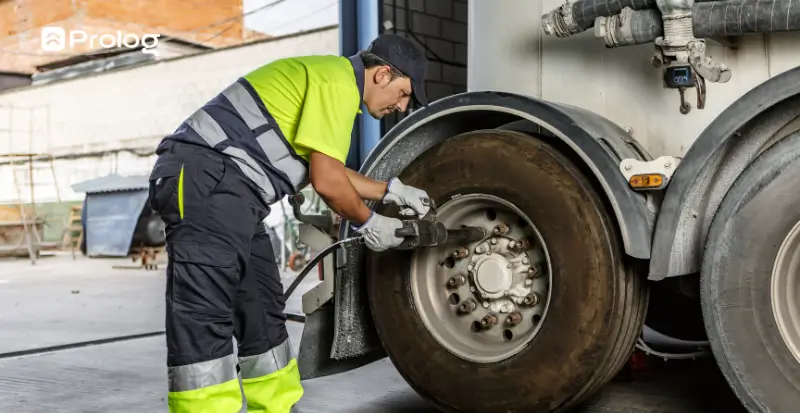
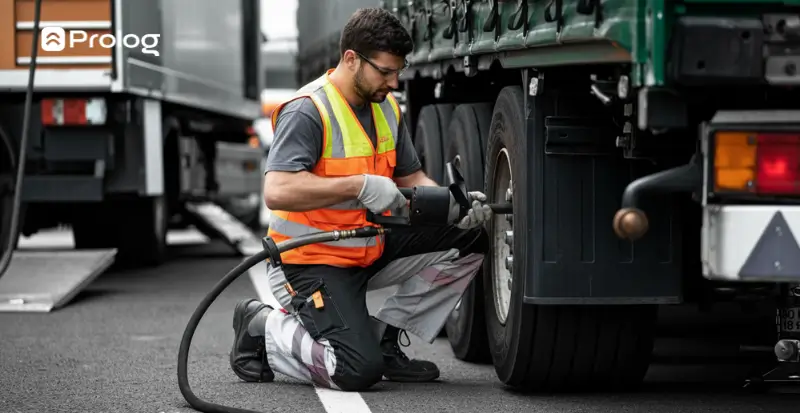
Removing and installing tires on vehicles, including using a torque wrench to tighten bolts, checking tire-wheel compatibility and checking components (valves, tubes, flaps). Errors at this stage lead to immediate rework or, worse, operational failures.
Tire pressure calibration
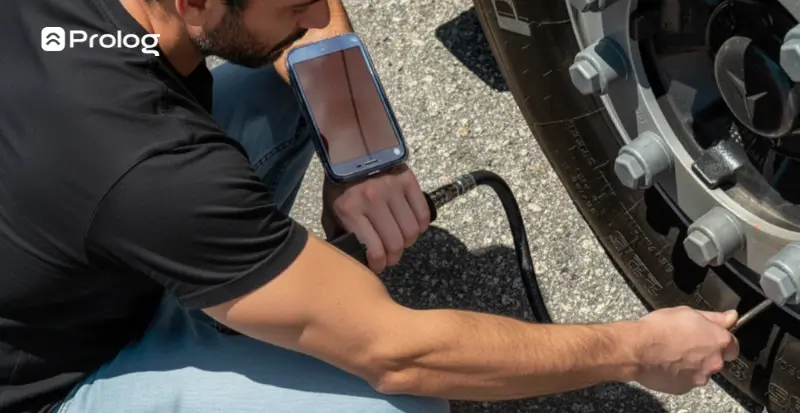
Tire pressure adjustments should follow manufacturer specifications and the type of operation. In addition, tire pressure calibration must be performed with a calibrated pressure gauge and recorded.
Incorrect pressure (either too high or too low) compromises tire useful life, increases fuel consumption and raises the risk of failure.
Tire rotation
Changing tire positions between axles is done to equalize wear. It should follow a defined plan (rather than happening only “when there is spare time”) and respect predetermined intervals, generally between 30 and 40 thousand km or every 6 months.
Repair and vulcanization
Repairing punctures and repairable damage requires careful assessment, because not all damage is repairable, and repairing a tire that should be discarded compromises safety. The process needs clear acceptance and rejection criteria.
Sending for reconditioning (retreading)
The decision on when a casing goes for retreading is critical. Sending it too early wastes useful life, but sending it too late compromises the casing. Objective criteria for minimum tread depth and casing condition are therefore needed, along with a record of how many retreads each tire has already received.
If you have proper, systematic, data-based tire control, you can identify the most suitable depth to make the best use of the useful life of your fleet’s tires.
Disposal of unserviceable tires
Tires that can no longer be used or reconditioned need proper disposal, with records and an appropriate final destination. In Brazil, besides being a legal and environmental obligation, disposal control closes the asset’s life cycle and allows actual utilization indicators to be calculated.
Recording and entering data in the system
All the processes above need to generate data. But, as a good fleet manager, you want to analyze data more than record them, I imagine.
Every tire relocation should be recorded in the fleet tire management system. Without records, there is no traceability, and without traceability, every decision is based on assumptions.
How can you standardize fleet tire shop processes?
Now that the processes are mapped, the question is: how do you ensure they always happen the same way? These are the steps recommended by our specialists here at Prolog:
Create SOPs (Standard Operating Procedures) for each process
Each of the processes listed above should have a documented Standard Operating Procedure (SOP). And no, it does not need to be a 50-page manual.
The most important thing is that it is concise and straightforward, stating what to do, how to do it, with which tools, in what sequence and what to record at the end.
A tire mounting SOP, for example, may include: checking tire-wheel compatibility, visually inspecting the wheel, applying lubricant, mounting with suitable equipment, tightening with a torque wrench to the specified value and recording in the system with tire and vehicle identification.
This document can be posted at the workstation, available digitally or integrated into the system the team already uses. A document kept in an office drawer standardizes nothing.
Assign clear responsibility at each stage
A process with no owner is a process nobody follows. For each activity, it must be clear who performs it, who checks it and who is responsible for the result.
Who performs the tread depth inspection? Who decides whether the tire goes for retreading or disposal? Who updates inventory in the system? If the answer to any of these questions is “it depends,” you have a gap that will generate inconsistency.
This does not mean making the team rigid. It means that, regardless of who is on shift, responsibilities are defined and there is no room for doubt about what needs to be done.
Establish decision criteria
Much of the rework and loss in a tire shop happens because of subjective decisions. Tire technician “A” thinks the tire can handle another cycle; tire technician “B” disagrees. Without objective criteria, the decision varies with experience, intuition or the rush of the moment.
Establish clear, documented parameters: minimum tread depth to stay in operation, to send for retreading and to discard. Visual rejection criteria (bulges, casing cuts, deformations). Target pressure by axle type and operation.
When criteria are defined, decisions move from personal experience to technical grounds. And technical decisions are consistent.
Implement execution and verification checklists
The checklist is the simplest and most effective tool to ensure standardization. It acts as a safeguard, since before completing a service, the operator confirms each stage has been completed.
A mounting checklist may include items such as compatibility verified, wheel inspected, valve replaced, torque applied, tire pressure calibration checked and record made in the system. It seems basic, but the amount of rework a simple list like this avoids is significant.
If possible, use digital checklists integrated with the management system. This eliminates paper, reduces recording errors and generates automatic traceability of who performed the work, when and what was checked.
Structure fixed routines with a defined frequency
Processes without a set frequency happen when someone remembers. And “when someone remembers” does not constitute management.
Define the tire shop’s operational calendar: weekly tire pressure calibration, tread depth inspection every 15 days, rotation every 30–40 thousand km, monthly inventory counts. Link these routines to fleet maintenance planning so tires are checked within scheduled windows, without creating extra stops.
A fixed routine makes the operation work at the pace of the process rather than the pace of urgency.
Train the team and provide frequent refresher training
The SOP exists, the criteria are defined, the checklists are ready. However, you need to understand that none of this works if the team does not know how to use it or understand why it matters.
Training is not a one-time event at hiring. Every new procedure, every criteria update and every incident revealing an execution failure is an opportunity for new training and skills development.
DDS (Daily Safety Dialogues) focused on the tire shop are a practical way to reinforce procedures without stopping operations.
And it is important to teach why, not just how. When a tire technician understands that incorrect tire pressure calibration can reduce tire useful life by up to 25%, they check and adjust tire pressure differently. When they know mounting without correct torque creates an accident risk, they double-check.
Use technology to maintain the standard
Manual standardization works up to a point, generally in fleets of up to 20 or, at most, 30 vehicles (and even then, we are already talking about more than 100 tires in use). Beyond a certain fleet and service volume, technology stops being a differentiator and becomes a necessity.
Tire management systems that automatically record each relocation, electronic measuring devices that eliminate reading errors, digital checklists that block service completion if a mandatory step has not been completed. All this maintains the standard with less effort and greater reliability.
Technology does not replace the process. It ensures it is followed. And beyond that, it turns each execution into data that feed indicators, reveal deviations and support continuous improvement decisions.
Tire shop standardization is not a project with a beginning, middle and end. It is an operating model. Every tire completing its full cycle without premature loss, every additional retread you can obtain and every purchasing decision based on actual CPK: all of this comes from processes that work consistently.
Want to see how technology can support this standardization in practice? Schedule a demonstration with our team and discover how Prolog structures tire management from end to end.
Frequently asked questions
Each tire technician records inspections differently and the data do not add up. How can this be solved?
Which fleet tire shop processes need standardization?
How can you write a standard operating procedure the team will actually use?
At what fleet size does a spreadsheet stop being enough for the tire shop?
How much does standardization change tire costs?
Which fixed routines should the tire shop have on its calendar?
// newsletter
Fleet management content, straight to your inbox
Articles on tires, maintenance and fleet operations. No spam.