Truck tires: the 7 parts and how to care for them in a fleet
 Luiz Felipe 7 min read
As a fleet manager, you need to know the vehicles and processes related to transport operations. That is why today you will learn everything about truck tires.
They are one of the main investments of fleets, and you need to know how to deal with these vehicle components in order to generate savings without compromising safety, availability and maintenance control.
After all, the tire is responsible for supporting the vehicle's weight and keeping contact with the ground. It also helps transmit the traction needed for the engine's power and contributes to the truck's stability during operation.
Since the purchase cost varies according to size, application, make and specification, it is not worth treating a single price as the rule for every fleet. To avoid replacing tires too early, let's look at how to take better care of them through this guide.
Truck tire structure
There are 7 parts in all that make up a truck tire, each with its own function.
Synthetic rubber inner liner
It is located on the inside of the tires and performs a function similar to that of an inner tube. In other words, it helps keep the air inside the assembly and reduce losses in cases of punctures, cuts or leaks, within the limits of each type of damage.
Casing
The casing is the internal structure that gives the tire its support. It can be formed by layers and reinforcement cords, but the number and capacity of these components depend on the tire's design, size and application.
And what does it do? Being integrated into the tire's rubber, it offers resistance to the pressure exerted by the vehicle's weight. This way, it helps take the load and impact of trucks without deforming beyond what the manufacturer specifies.
Bead
The bead helps the tire stay attached to the rims when under lateral stress. Essentially, it is a part that transmits the engine and braking commands from the rim, or wheel, to the tire assembly.
It is also important because it is the part of the tire responsible for keeping the structure in place.
Solid rubber flanks
These large pieces of rubber protect truck tires from impacts and contact that could damage the casing.
Each type of tire has a flank height, and there is a direct relationship with the vehicle's handling and comfort. Normally, the taller the flank, the better the comfort tends to be, but the steering response may become less precise.
Reinforcement plies (belts)
They are made up of very thin but extremely strong steel cables. They are arranged crosswise and overlapping. To explain it better, they are laid diagonally to one another and interlaced with the casing cords, forming triangles.
Thus, their main function is to reinforce the casing.
Tread
This is the outer part of the tire, and it has three divisions:
grooves: they drain water, prevent skidding and cool the tires. The tread depth in some types of tires can be greater than in others; the greater it is, the better the tires' grip on the ground.
sipes: they help cool the tires, letting air pass through the rubber, and reduce resonance.
blocks: they are linked to the vehicle's power, staying in direct contact with the ground and generating traction to move the truck.
Sidewalls
Likewise, they make up the outer side of the tire. The rubber here must be flexible and highly resistant to fatigue. That is why, when this area is thinner, driving can become less comfortable for drivers.
Materials for tire production
As you have seen, there are several tire components that are not made of rubber, as many might imagine. The materials that bring the tire to its final shape include:
- natural rubber, such as latex;
- synthetic rubber, such as petroleum-derived elastomer;
- steel;
- carbon black;
- zinc oxide and stearic acid;
- sulfur as a vulcanizing agent;
- antidegradants;
- accelerators and retarders;
- processing aids.
Types of truck tires
High severity
This type of tire is ideal for driving in the city. Urban routes require driving with constant acceleration and braking; that is why the tires need greater resistance to wear and to frequent changes of pace.
Medium severity
Medium-severity tires are more versatile, because they adapt easily to the various highways in each state.
So they are a good choice for trucks that make trips within a state — which is the case for several Brazilian carriers.
Low severity
The grooves of low-severity tires have an anatomy that allows better performance on long trips.
When you need to do freight transport where the pickup point is very far from the drop-off point, this type of truck tire is usually the most suitable choice.
In fact, it can contribute to fuel savings when used in the right application and kept at the recommended pressure.
Mixed
For routes where the truck needs to travel on dirt roads, in addition to traditional highways, this specific type of tire is needed: the mixed tire.
They have materials and thicknesses that help preserve the tire longer, without increasing the level of wear from constantly switching between road types.
Off-road
Now, if transport takes place only on dirt roads, with a lot of soil, rocks, rough terrain and other obstacles, off-road truck tires are the most suitable.
How to choose?
This answer could not be simpler: analyze the type of cargo and the type of route.
For example, garbage trucks run urban routes and frequently travel on dirt roads, which makes mixed tires ideal.
Trucks that carry industrial raw materials between states, on the other hand, should consider medium-severity tires, always taking into account the manufacturer's recommendation, the cargo carried and the actual conditions of the route.
Which are the best manufacturers?
It is hard to recommend specific brands, because each truck, and each fleet as a whole, will have its own needs.
However, some that stand out for the quality they offer are:
- Bridgestone;
- Goodyear;
- Pirelli;
- Continental;
- Dunlop;
- Firestone.
Truck tire management
Defensive driving
Technically, this is not a tire management task. However, it certainly goes a long way toward extending the useful life of these items.
Taking proper care with acceleration, braking and maneuvers in traffic is a way to avoid excessive tread wear. Incorrect pressure also affects handling, stopping distance, braking grip and directional stability, so the driving routine needs to go hand in hand with maintenance.
Tire rotation
Now, speaking of truck tire management proper, tire rotation is essential. Through it, you help distribute wear among the vehicle's tires over time.
There are a few different ways to carry out tire rotation and, to find out which one best suits your fleet's vehicles, you can check the owner's manual and the tire manufacturer's guidelines.
In addition, to know the right time for this practice, a tire management system will be a great help.
Tire inspection
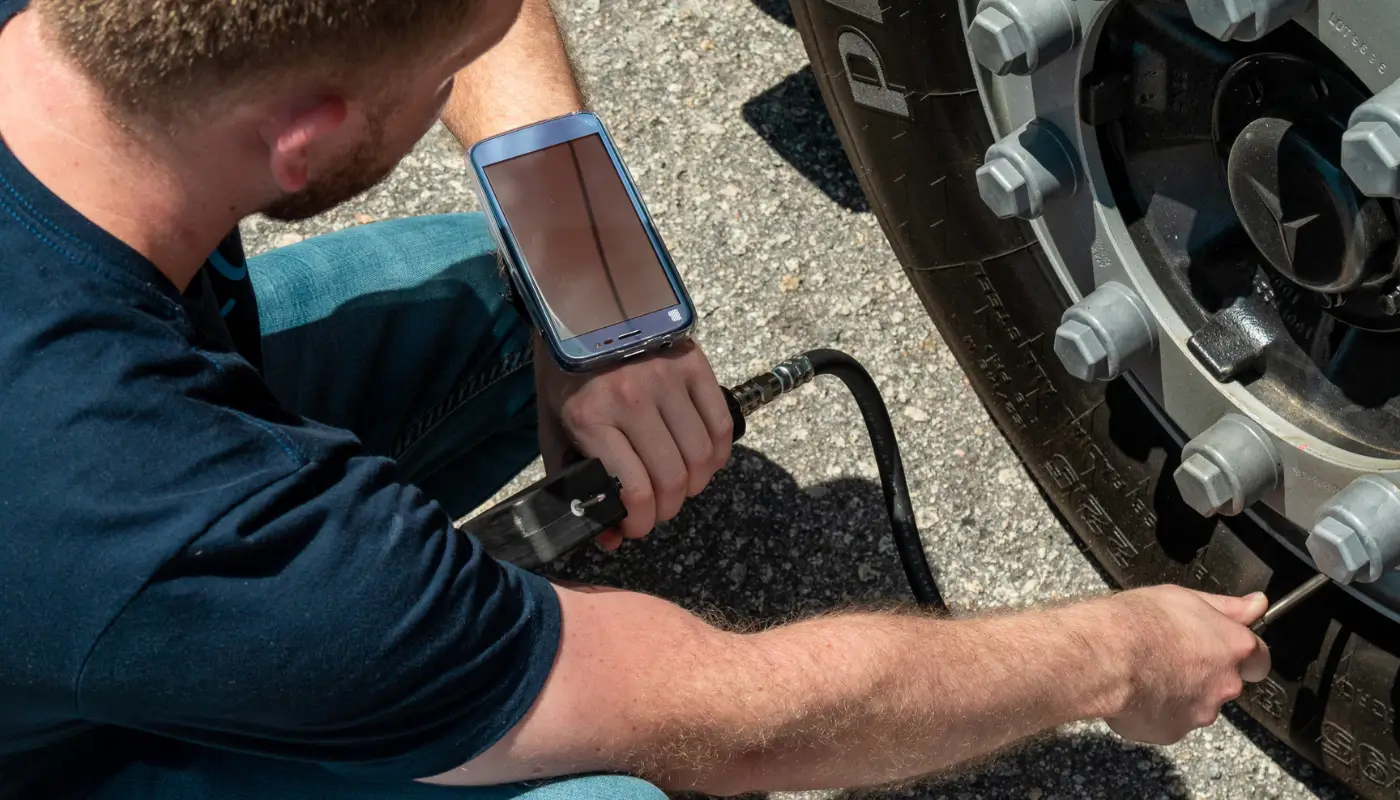
One of the most important parts of caring for truck tires. Through the inspection process, the measuring device determines the pressure and the tread depth of each tire.
This makes it possible to take the actions needed for correction and to increase the durability of the parts. The pressure must follow the vehicle manufacturer's recommendation exactly, and the reading tends to be more accurate when the tires are cold.
What's more, with a digital system, you also record important inspection data to better understand what causes irregularities and make better decisions to save on tires. Checking the pressure frequently helps avoid underinflation, a condition that accelerates wear and can increase heat buildup in the tire.
Assessment before replacement
If you think it is time to replace the tires, hold on. First, assess what condition they are in.
Why? Two reasons:
- retreading can be an alternative to extend the tire's use;
- you need to find out whether something is wrong or some task related to the tires is being neglected.
To make the replacement at the right time, there is no secret: keep close track of your truck fleet's tire management, record the inspections and compare pressure, tread depth, rotations and maintenance history.
Learn more about the technology solution Prolog Tire Management!
Frequently asked questions
What are the parts that make up a truck tire?
Which type of tire should be chosen for each route?
How much load can a truck tire casing withstand?
What should be done before replacing the fleet's tires?
Is a truck tire made only of rubber?
// newsletter
Fleet management content, straight to your inbox
Articles on tires, maintenance and fleet operations. No spam.