
Tire rotation: when, how and who should do it
 Luiz Felipe 6 min read

Tire rotation is another fleet management task in the tire control routine. There is no denying that tire spending is high and is among carriers' areas of concern.
Thus, controlling tires and analyzing data frequently will help extend their useful life and allow your company to reduce the cost of buying new tires.
Each vehicle position can subject tires to different stresses. Therefore, without rotation, some tires tend to suffer more uneven wear than others.
This wear is also influenced by driving, alignment and conditions of use, affecting vehicle control and handling.
To better understand what tire rotation is and why it matters, explore the following:
- What tire rotation is;
- What it is for;
- Why it matters;
- How it works;
- How to do it;
- Who performs tire rotation;
- When it should be done;
- Other tips for preserving fleet tires.
What is tire rotation?
This is a form of vehicle maintenance usually described in each model's owner's manual, since different vehicles can require different rotation methods.
Tire wear is a natural process, but it can be reduced with the right precautions, such as tire rotation.
It is important to avoid excessive wear, since driving on bald tires carries many risks, especially to vehicle and driver safety. It can also lead to retreading rejection, when a tire can no longer be reconditioned and reused in the fleet.
Thus, tire rotation helps tires wear more evenly, contributes to extending their useful life and supports fleet efficiency and productivity.
What is tire rotation for?

What tire rotation is for
- Generate long-term savings for the fleet
- Extend tire life
- Increase the chances of retreading the tires
- Make driving safer
- Ensure vehicle stability
- Reduce tire wear
Goals of tire rotation.
It serves to bring long-term savings to transportation operations.
With less uneven tire wear, you do not need to replace these assets as often, extending their use — both through better tire preservation and through greater chances of retreading when the casing is still suitable for reconditioning.
It also increases driving safety, especially on bends, wet roads, uphill and downhill stretches, bringing greater stability and assurance of properly functioning braking.
Why does tire rotation matter?
Its importance lies in the benefits it brings to the fleet. These are:
Avoiding premature tire loss
When tire durability increases, the logical consequence is fewer tires lost, right? This is the main idea behind tire rotation:
Tires keep changing positions to wear more evenly. This reduces premature casing loss in the fleet.
Making fuel combustion more efficient
When tires wear more evenly and operate at the correct pressure, fuel consumption can also be reduced.
This is because the vehicle has better road-running conditions to exert the minimum necessary effort, burning fuel as efficiently as possible.
Conversely, tires with uneven wear, pressure outside specifications or alignment issues can increase vehicle effort and impair efficiency. That is why rotation should go hand in hand with fuel consumption control, calibration and keeping track of wear.
Improving safety on routes
If tires wear more evenly, the vehicle has greater stability and balance while traveling its routes and moving. The driver also feels more comfortable at the wheel, with less swaying and vibration on trips.
All of this contributes to greater safety and fewer chances of issues on the road, especially when rotation is part of a routine that also checks pressure, tread depth, visible damage and alignment.
Saving money and reducing operating costs
Tires with more even wear also have a greater chance of remaining in use longer and arriving in better condition for a retreading assessment, when the casing allows this reuse.
Generally, costs fall through:
- Buying tires at longer intervals;
- Retreading more tires when the casing is suitable and buying fewer new tires;
- Consuming less fuel per route when tires are inflated correctly and in good condition.
How does tire rotation work?
Tire rotation works by changing tire positions and is recommended for every vehicle according to the mileage and pattern specified in the owner's manual.
This change makes tire wear more even, increasing useful life and reducing the chances of instability while driving.
How should tires be rotated?
Tire rotation is described in the vehicle owner's manual, which means it is not simply swapping tires around. There are different ways to do it according to tire type. They generally work as follows:
- Conventional tires (or symmetric bidirectional tires): use a rotation known as “X.” The right wheel is placed at the left rear, and the right rear at the left front.
- Unidirectional tires: the front wheels should move to the rear positions, and vice versa.
- Asymmetric tires: rotation can follow directions that respect the tires' “outside” and “inside” indications.
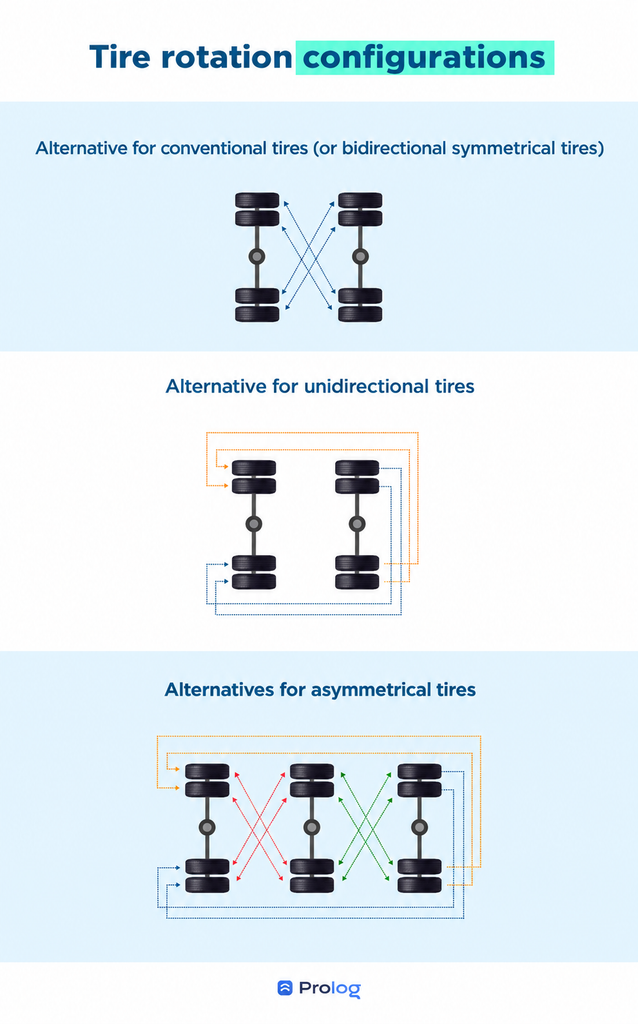
Tire rotation patterns.
Each vehicle model has a more suitable way to rotate tires, so the manual should always be checked before this process.
To avoid mistakes and even injuries during this process, a qualified, certified professional is recommended. If the vehicle driver has that qualification, all the better. Otherwise, arrange for someone who meets the requirements.
Who performs tire rotation?
Tire rotation should be done by a professional. The fleet mechanic or the company's service partner is the person who can perform this task at the right time and safely.
There are some risks to attempting rotation yourself without being a certified professional. After all, tires are completely removed and refitted to the vehicle. Any fitting failure can cause serious accidents.
If you have experience in truck maintenance, you probably already recognize and can take on these risks without issues.
For a truck fleet, the risks are greater. A larger team is usually necessary to perform this activity accurately and safely.
When should tires be rotated?
There is no exact interval, but recommendations usually fall close to 5 thousand to 10 thousand kilometers traveled, always following the vehicle owner's manual. USTMA, for example, recommends rotation every 5 thousand to 8 thousand miles. This precaution helps prevent severe wear and greater tire damage.
Other precautions for preserving fleet tires
Tire management is a fleet management area that has grown and become increasingly common. It includes tasks that contribute to the same goal as tire rotation: increasing these assets' durability and generating savings and safety for the fleet.
Some of the main tips you can take from this process, along with the recommendation to implement it as a whole, are:
- Every 10 thousand km, or according to the fleet maintenance plan, perform preventive alignment, balancing and tire rotation services;
- Frequently inspect tire pressure, tread depth and damage, considering at least one monthly check as a maintenance reference;
- Inflate tires after each rotation or other preventive services, always according to the vehicle manufacturer's specifications;
A final tip is to use a system for carriers that helps with tire control. Prolog App is a solution for keeping track of wear, retreading, life cycle and cost per tire.
You can find out what it is and all its functions in our completely free material about the tool — download it now (in Portuguese).
Frequently asked questions
What is tire rotation?
How many kilometers should you travel between tire rotations?
How should tires be rotated according to tire type?
Who should rotate fleet tires?
What savings can tire rotation generate?
Why do some tires wear more than others?
// newsletter
Fleet management content, straight to your inbox
Articles on tires, maintenance and fleet operations. No spam.


