
Fleet management: a guide to operating better
 Luiz Felipe 12 min read

Fleet management should be organized, practical and efficient. That is how a transport operation manages to turn goals into routine: vehicles available, costs kept track of, maintenance planned and decisions made based on data.
Without a doubt, fleet management carried out with precision boosts the results of the company as a whole. However, it can often be set aside while the manager deals with other, “more urgent” problems.
Many periods of falling productivity, or even of stagnant revenue, can happen because of neglect in vehicle management. Regardless of fleet size and vehicle type, management should be considered a decisive factor in protecting the transport company's margin and keeping the operation running predictably.
In fact, higher profit does not necessarily come from acquiring new customers. It can come from reducing unnecessary costs caused by poor handling of assets. That is why increasing the useful life of vehicles, tires and components is one of the goals of good fleet management.
Keep reading for more details on the subject:
- What fleet management is;
- What fleet management involves;
- How fleet management is done;
- Why fleet management is important;
- The biggest fleet management challenges;
- How to improve fleet management.
What is fleet management?
Fleet management is the part of a transport operation responsible for taking care of and overseeing all the processes that involve a company's fleet. Whether it is a transport company, a construction company, a distributor or any other line of business that uses vehicles as part of its services.
It is a position that demands a lot from whoever takes it on: planning actions throughout the year, acquiring and renewing vehicles and other assets, controlling refueling, keeping track of maintenance, defining routes, analyzing costs and so on.
That is why the fleet manager should have broad knowledge of the field and a range of skills, both professional and personal, since they also need to deal with the whole team of employees working in the department. The role combines an operational view, financial understanding and the ability to prioritize what really reduces risk and waste.
What does fleet management involve?
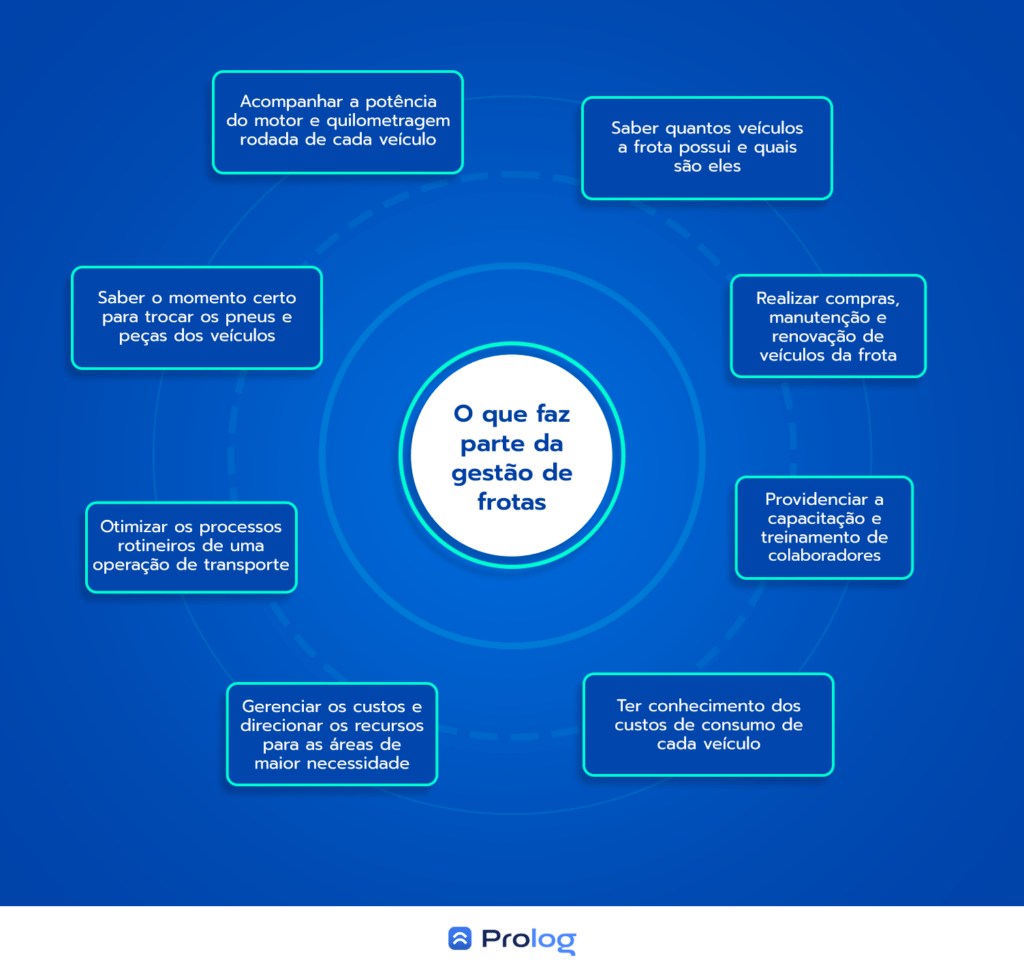
Generally speaking, fleet management includes all the tasks directly related to choosing components, data analysis, maintenance, and supervision of vehicles and employees.
Building strategies to optimize results is also essential to ensure that a company's logistics runs well.
To do a good job, the manager needs to see the operation down to the smallest detail. Any piece of information that goes unnoticed can cause damage to the fleet, delivery delays, low vehicle availability and high repair costs.
So, for competent fleet management, the task list should include:
- Knowing how many vehicles the fleet has, which ones they are and what operating condition each one is in;
- Keeping track of the power, application, age, mileage driven and usage history of each vehicle;
- Knowing the consumption, maintenance, tire, downtime and other costs of each vehicle;
- Purchasing, maintaining and renewing fleet vehicles based on the total cost of ownership, not just the purchase price;
- Providing employee training and development;
- Knowing the right time to replace the vehicles' tires and parts.
When evaluating assets, suppliers or technologies, looking only at the initial outlay can hide relevant costs. The total cost of ownership helps measure the cost of a product or service over its entire life cycle, including initial costs, operation, maintenance, unavailability and value at the end of its useful life.
How is fleet management done?
Currently, it can be done in two ways: with spreadsheets or with systems. In both cases, you need a series of processes to feed in the information required to control the fleet.
For those who are starting to implement fleet management and have a somewhat tighter budget, spreadsheets are a good starting point. But they should be used with vision and planning so that, when it makes sense, the company can raise the funds needed to acquire technologies designed for the fleet's routine.
When you go with the first option, you also need to know what to include for the tool to be truly useful day to day. That is why you need to understand how to create a fleet management spreadsheet before expecting consistent results.
In the case of a system, the way forward is to understand which alternative best meets your needs and adopt the one that makes the most sense for the operation, for the budget and for the team's maturity.
There is no doubt that modern systems and tools can improve the productivity of the team and the manager, also generating more savings and safety in transport operations. Even so, the decision should consider the value delivered, the direct costs, the indirect costs and any hidden costs of adoption, since these factors vary according to the type of product or service and the payment model.
Why is fleet management important?
It is essential for having control over what happens to the vehicles every day and knowing which strategies help reduce costs in the operation.
The impacts and benefits of fleet management are:
- Savings on tires, maintenance and fuel;
- Greater operational efficiency;
- Fewer accidents on the road (in Portuguese);
- Better risk management;
- Optimized cost control.
When the fleet is managed with data, it becomes easier to separate necessary costs from waste. This view improves resource allocation, supports the budget, helps in evaluating suppliers and reduces decisions based only on urgency or perception.
What are the biggest challenges in fleet management?
There are challenges to achieving proper management, even if they are not always obvious. Among the ones that stand out the most, and that need to be overcome, you may find:
Building an expense forecast
A fleet has many costs, both fixed and variable. In some cases, especially for fleets going through a phase of expansion with little planning, expenses can get out of control.
This ends up making it harder to find patterns that show the average amounts used each month, and makes it impossible to forecast expenses over the long term.
To solve this problem, you need to know all the daily expenses and keep the records on an easy-to-access platform. It is also worth separating initial costs, operating costs, maintenance, downtime and resale value, because this breakdown brings management closer to the total cost of ownership of the assets.
Optimizing resources and processes
Although there are many well-known processes in fleet routines that can be applied, they are not always effective. In most cases, you can put solutions in place to bring more productivity and savings to the fleet.
However, for that, you first need data collection to work and performance indicators to be evaluated. Otherwise, you may be seeking improvements in an area that already works well, while others are neglected and hold back the process as a whole.
Consistent optimization starts with simple questions: which cost weighs the most, which failure keeps recurring, which vehicle spends the most time out of service and which process takes up the most of the team's effort. The answer guides the priority.
Internal and technological knowledge
What usually happens is a thirst for external knowledge, always trying to understand what competitors or the industry giants are doing in order to apply it to one's own operation in whatever way possible.
This is a problem, and it becomes a fleet management challenge, because the manager ends up not using internal data to understand the company's real needs.
Sometimes this leads to applying solutions that were not necessary and leaves an area that is going through bigger problems unaddressed.
Knowing everything that happens in the fleet is indeed the manager's role. Technology should support this knowledge, not replace the understanding of the operation's reality.
Cutting costs without harming the company and the operation
One of the biggest challenges is knowing where to cut expenses without affecting how the operation works as a whole.
For example, if you ask fleet maintenance to reduce costs by 10%, you may be harming vehicle inspection and preventing the vehicles from going through processes that are crucial for them to function properly.
In the end, this can do more harm than generate actual savings. A vehicle that no longer goes through prevention tends to end up in corrective maintenance, with longer downtime, more urgency and less predictability. In other words, by trying to save in the wrong place, you can increase costs.
So plan carefully and have a broad understanding of how your fleet works. Sustainable cuts depend on understanding what each expense protects: availability, safety, deadlines, useful life or productivity.
Tools that can help with fleet management
You will find a variety of options available to help with your fleet management, mostly technological solutions, such as:
- Tire management;
- Driver control;
- Tracking/cargo monitoring;
- Route planning;
- Maintenance management;
- Traffic fine control;
- Cost management.
The choice should not start with the longest list of features, but with the problem that has the greatest impact. A cost management tool, for example, will only be useful if the processes ensure reliable records and if the team knows how to turn those records into decisions.
How to improve your company's fleet management?
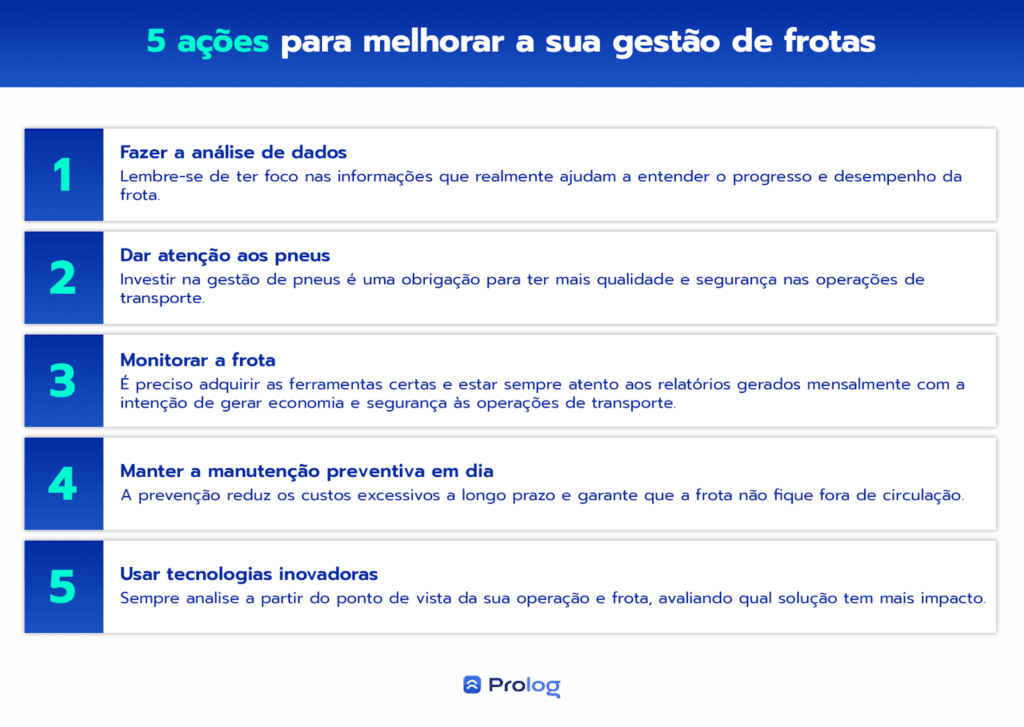
Knowing the ideal steps and the difficulties of the field, you have a better understanding of where to apply “corrections” to your fleet management. Here are some tips to overcome the challenges presented and improve every stage of your management:
Make a plan
Every business strategy, without exception, needs to go through the planning phase. It is unavoidable and you should not skip this stage. It is through planning that it becomes possible to see mistakes and successes, identifying the next steps to achieve the objectives and goals set.
In addition, planning is also essential to be better prepared to face changes and occasional unforeseen events.
At this point, you should plan routes and vehicles, problem prevention, risk analysis and every detail you consider most important.
For more precise planning, put together an overview of what the fleet currently looks like — from which vehicles it includes to how often each one is maintained.
For that, the next item on the list is important:
Analyze data
Real, concrete data analysis is necessary for the fleet manager to structure their planning and steer their strategy. However, this data needs to present information that truly helps in understanding the fleet's progress.
This way, everything that directly affects operations can be used to maximize the fleet's useful life and, likewise, to understand when it is time to “retire” a vehicle.
Some examples of important data include:
- Which vehicles make up the fleet;
- What the current condition of each one is;
- What the monthly spending on each vehicle is;
- How often preventive maintenance is carried out;
- How many times corrective maintenance was needed.
The analysis should also distinguish visible costs from indirect or hidden costs. A decision that seems cheap at first can become expensive once maintenance, downtime, lost productivity and administrative effort come into play.
Pay attention to tires
Vehicle tires can be not only a reason for excessive spending, but also a cause of accidents on the road. For this reason, investing in tire management is a must to have more quality and safety in transport operations.
Correct tire calibration and balancing also help increase the useful life of the assets, contributing to better planning and budgeting for tire replacement.
Monitor the fleet
Fleet monitoring should happen for two main reasons. First, because planned routes cannot always be followed to the letter. So, in these cases, the manager can get in touch with the driver and understand what happened during the operation.
The second reason is to understand drivers' driving patterns. Today there are systems on the market that make it possible to keep track of information such as speed, number of stops, how long the vehicle was stopped and other operational indicators.
So you need to acquire the right tools and always pay close attention to the reports generated each month. The most important thing is to turn monitoring into action: guide drivers, adjust routes, review processes and reduce behaviors that increase risk or cost.
Keep preventive maintenance up to date
Preventive maintenance serves to identify problems before they cause greater damage to the vehicle, leaving the fleet impaired and delaying deliveries.
All the parts in a truck have a useful life and need to be replaced or repaired at some frequency. That is why vehicle inspection becomes an indispensable step in the operation's routine.
And even though there is constant spending on preventive services, such as tire rotation or balancing, prevention reduces excessive costs over the long term.
More importantly: preventive maintenance ensures that the fleet does not go out of service. It also brings predictability to the workshop, purchasing, vehicle scheduling and commitments to customers.
Use innovative technologies
As part of the routine of a successful fleet manager, staying on top of technologies in the logistics field is an important task.
Knowing what the solutions are, how they work, what they are for and what benefits they bring is essential to know what to implement in your fleet.
In many cases, you do not need to adopt a complete system, but rather a few specific solutions for the reality of your business.
If tires are what cause the most problems and generate the most costs over time, you need a tire management system. If maintenance is the biggest problem, a maintenance management system can resolve it.
Always analyze from the point of view of your operation and fleet, evaluating which solution has the most impact. A good technology should deliver enough value to justify its adoption, considering cost, use by the team, operational gains and the ability to improve budget, resources and supplier evaluation.
To learn more about fleet management, download our free e-book on the subject (in Portuguese).
Frequently asked questions
My fleet costs go up every month and I can't predict the expense. What should I do?
How can I reduce fleet costs without harming the operation?
Spreadsheet or system: how do I choose how to manage the fleet?
Do I need to adopt a complete fleet management system, or can I start with individual parts?
I am copying what competitors do to decide what to improve in my fleet. Is that a mistake?
// newsletter
Fleet management content, straight to your inbox
Articles on tires, maintenance and fleet operations. No spam.


