
Importance of the checklist: inspection before every route
 Luiz Felipe 10 min read

Every fleet and/or maintenance manager needs to treat the vehicle checklist as part of the control routine of the transport operation. If you still do not know what the checklist is for and why it matters, this post is for you.
In both passenger transport and freight transport, taking care of the fleet's vehicles is essential. Maintenance is an important part of this process, because it helps organize inspections, record failures and reduce the chance of avoidable issues during the operation.
Buses usually get more attention, since this type of vehicle has particularities of structure, operation and use. At the same time, when we talk about trucks, there are also many makes, models and configurations that may require different check points.
In other words, we are already saying here that part of the importance of the checklist is identifying these differences, and it is advisable to have specific models for each type of fleet inspection, instead of using a generic list for all vehicles.
Below, you will find:
- What is the importance of the checklist;
- When to use the checklist;
- What fleet maintenance is;
- Why it matters;
- What is the importance of the checklist for good maintenance practices?
- How to create the checklist and apply it in the fleet.
What is the importance of the checklist?
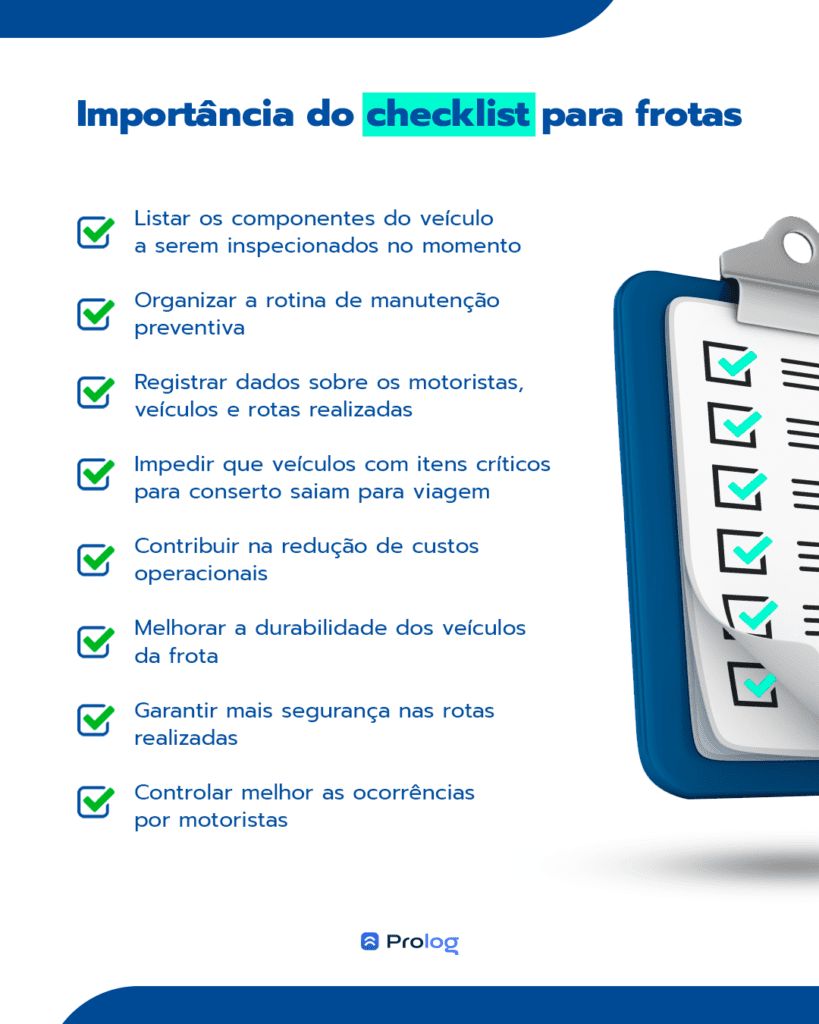
What is the importance of the checklist for fleets?
The importance of the vehicle checklist can be summed up in the practicality of listing the components that must be inspected before setting off on a new trip. It also works as a record base for understanding which issues show up most often in the fleet.
In practice, this makes it possible for vehicles with critical items, which could cause an accident or another serious consequence, to be held back and have the issue fixed before being released to run again. In operations that use criticality criteria, trucks with open critical items can be prevented from going out on the road.
Likewise, preventive actions, such as aligning a truck, can be planned and carried out in a more organized way. This control contributes to reducing operating costs, increasing vehicle durability and safety in transport operations.
The checklist also helps to better control the vehicles and the people responsible for each occurrence. Instead of depending only on conversations or loose notes, the company starts to have records of the inspection, of the item flagged and of the action needed to move the maintenance forward.
When should the vehicle checklist be used?
Whenever a fleet inspection is necessary, the checklist is a practical way to standardize the check. It prevents each person from checking items in a different way and helps keep the same criteria across vehicles, shifts and units.
In addition, in Brazil, before putting the vehicle into circulation on public roads, the driver must check that the mandatory equipment is present and in good working order. That is why a well-designed checklist helps turn this check into a documented routine.
This way, you can have several checklist models in the operation, ranging from the daily vehicle inspection to a more complete checklist, to be carried out every six months or even annually.
Inspection lists can also be differentiated by the part of the vehicle they cover, such as electrical and mechanical, or by type of fleet. The Brazilian Traffic Code has provisions that apply to any vehicle, but the checklist model used in the company needs to respect the real characteristics of the operation.
It is worth remembering that the checklist is a tool that should be present in the fleet's preventive maintenance routine. So, if you do not yet have defined maintenance management, start by planning which inspections are necessary, who performs them and how the records turn into action.
What is preventive fleet maintenance?
A fleet's maintenance can be preventive, corrective or combine actions of both types throughout the routine. In the first case, it aims to anticipate issues, identifying signs of failure and taking the necessary measures to prevent the vehicle from being stopped without planning.
In the second case, corrective maintenance happens when there is already an identified failure that needs to be repaired. It can occur after a breakdown that prevents the trip, but it can also be planned when the issue has been recorded and the vehicle is still operable, as long as the operation handles the risk within safe criteria.
That is why, instead of thinking only about emergency repairs, many managers seek to implement better methods in their fleet, to have control of the items that must be inspected, how often they should be checked and the most productive way to carry out these tasks.
This is exactly where the checklist comes in: it creates a routine of observation and recording. When an item appears as nonconforming over and over, management can see patterns, prioritize resources and decide whether it needs to adjust maintenance, team training or the inspection model itself.
Why does fleet maintenance matter?
Whether it is a truck fleet or a bus fleet, the importance of carrying out maintenance management is undeniable. After all, it is through this management that the company's operations can gain more predictability and safety.
Therefore, gathering and analyzing data related to maintenance, productivity, fuel consumption, tires, among others, is part of creating a broader view, in order to determine positive and negative points.
This is important for vehicle control and reducing operating costs. As well as, of course, for building new strategic plans for the carrier.
There is also a direct link with safety. In Brazil, traffic under safe conditions is treated as everyone's right and a duty of the bodies and entities of the National Traffic System, which must prioritize the protection of life, health and the environment. In the operation, the checklist does not replace these responsibilities, but it helps the company organize a routine compatible with this care.
How do you make a checklist for the maintenance of fleet vehicles?
Although there are several solutions for creating these checklists, you should prioritize a checklist system focused on fleets and transport operations. That way, it is more practical to customize the models, starting from items already relevant to the fleet's vehicles.
That said, the list should include the items that need to be checked before a trip, according to the type of vehicle, route and operation. For example, the condition of the tires, whether they are in good shape, whether calibration is within the specification and whether there are visible signs of wear.
Likewise, engine oil checks should be kept up to date, especially for long-distance trips. When we talk about buses, you can also add electronic modules and other components that make sense for this type of vehicle to the inspection.
Besides creating your own checklist, you can also use ready-made checklist models. These are usually on paper, but they can successfully fulfill the function of listing the vehicle's items to carry out the inspection.
Check out some printable checklist models (in Portuguese):
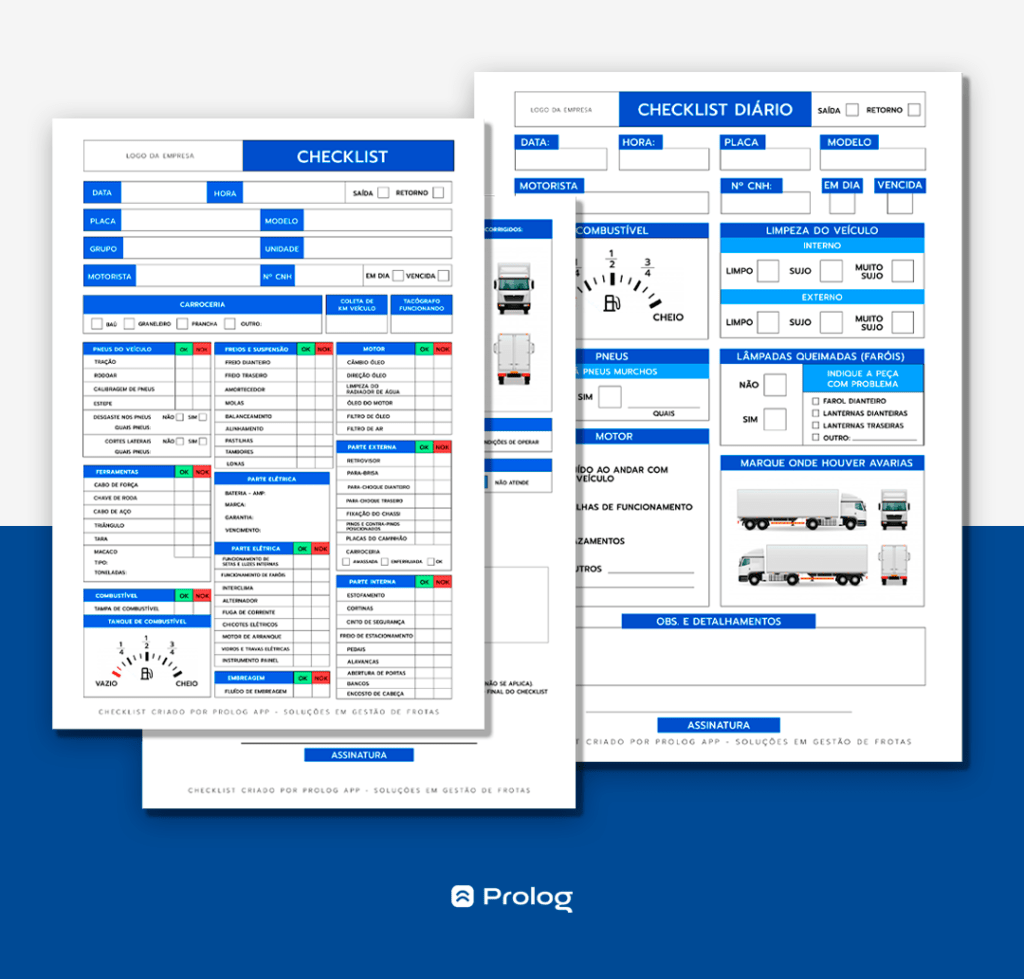
Checklist models for printing.
What is the importance of the checklist for good maintenance practices?
Not only the checklist, but the digital system becomes useful in two fundamental steps: promoting the team's productivity and creating reports for analysis by the operation's fleet and maintenance managers.
Although a vehicle maintenance checklist is a great help in fleet management, it does not do the job on its own. The good maintenance practices the manager should follow include:
- Setting up the inspection schedule as needed;
- Acquiring the tools and determining the best maintenance plan for each type of vehicle in the fleet;
- Training the team to use maintenance tools, such as the checklist itself;
- Using products and original parts and/or high-quality ones;
- Planning maintenance in advance;
- Defining the maintenance metrics and indicators to keep track of.
In these steps, you can understand the importance of the digital checklist by looking at features that help turn inspection into useful information for maintenance:
- Viewing the history of inspections carried out;
- Checklist models customized according to the vehicle type;
- Checklist traffic light, showing the health of each vehicle in the fleet and identifying whether there are open critical items;
- Reports and charts showing nonconforming items and the most common occurrences by license plate.
Among other functions, these already show the importance of the checklist in meeting the manager's needs. When the system reports how many and which nonconforming items were flagged, it becomes easier to prioritize maintenance and keep track of how the issues evolve.
In principle, the most important step is to have regularity in preventive maintenance, carrying out fleet inspections as planned. For this, the checklist system can support the schedule and the record of the inspections carried out, without replacing the manager's analysis.
Moreover, having a trained and competent team is the company's obligation.
The drivers and mechanics responsible for carrying out the maintenance checklist must be professionals and follow exactly the good practices established by the carrier.
How do you apply the checklist in the fleet?
In most transport operations, the paper checklist is already a common practice. To use it, you need to create or have a ready-made model in Excel, Word or PDF so you can print it and distribute it to the operation's drivers.
In this case, you also need to show drivers the importance of correctly filling in the items on the inspection list and of returning the papers to the central office. This way, the manager can move on to the next maintenance step: opening work orders.
So, the application of the paper checklist takes place in these steps:
- Creating models for the vehicles in your fleet;
- Printing the checklists and distributing them to drivers;
- Receiving and reading the completed checklists, opening work orders as needed;
- Repeating the printing and distribution process.
When you opt for a digital checklist, there is no need to print anything, since the driver, the manager — and even the mechanics — access everything through the web system or the mobile app.
In other words, the creation and customization of all checklist models is fully digital, as is the inspection itself. To apply it in your transport operation, you need to acquire a checklist system that meets the fleet's needs.
You should understand, for example, whether the tool supports the size of your fleet and your demand for daily checklists.
After acquiring the platform, you need to go through the step of introducing it to employees and training them to use it. In short, you apply the digital checklist in the following steps:
- Acquiring an electronic checklist system that meets your needs;
- Customizing the checklist models on the platform or creating new models, as needed in your operation;
- Providing a login and password to all users;
- Using the checklist in practice whenever and wherever needed.
Digital checklist for fleet maintenance
Here at Prolog, we have an Electronic Checklist solution for transport operations. Checklists are answered on any mobile phone that has the Prolog app, including in operations that need to carry out checklists even without an internet connection.
When a nonconformity is flagged in the checklist, Work Orders are generated automatically. The platform also lets you include photos taken at the time of the inspection to help describe the nonconformities recorded and offers an electronic signature of the person responsible for the checklist.
In addition, the reports and dashboards help keep track of nonconforming items and the number of Work Orders generated, supporting the managers' later analysis.
Want to know even more about how it works and how to get the checklist for fleet maintenance? Talk to one of our specialists now.
Frequently asked questions
What is the vehicle checklist for?
When should the checklist be used in the fleet?
What is the difference between preventive and corrective maintenance?
How do you put together a maintenance checklist for the fleet?
Does the checklist alone take care of fleet maintenance?
How do you apply the paper and the digital checklist?
// newsletter
Fleet management content, straight to your inbox
Articles on tires, maintenance and fleet operations. No spam.


