Tires and diesel: how to reduce fleet costs
 Diego Paludo 11 min read
The relationship between tires and diesel spending in heavy-duty fleets is directly linked to how the operation is run day to day. From technical decisions, such as correct tire choice, to operational factors, such as cargo transported, calibration and mileage covered, everything influences fuel consumption.
Therefore, when the fleet operates with tires outside ideal conditions, the truck engine needs to work harder to maintain expected performance. This additional effort results in accelerated wear (of tires and mechanical components), increased maintenance needs and, in many cases, higher diesel consumption, quietly and in a way that is hard to notice in the short term.
In road freight transportation operations, this impact is cumulative. Small increases in consumption repeat trip after trip, raising cost per kilometer driven, reducing operational predictability and making fleet financial control harder.
That is why a structured understanding of how tire management affects fuel consumption is essential for managers seeking operational efficiency, cost reduction and greater control over fleet indicators.
In this guide, you will find a clear, practical analysis of how tires and diesel spending in heavy-duty fleets are connected in practice, which factors most influence consumption and which decisions help make the operation more efficient and predictable.
See the topics covered:
- Why do tires affect fuel consumption in fleets?
- Correct calibration: what the fleet needs to know
- Fleet tire management: practices that reduce diesel consumption
- Beware of excess load
- Well-maintained tires consume less diesel
At the end of the article, you can download a free spreadsheet to organize and keep track of your operation's fuel spending.
Enjoy reading.
Why do tires affect fuel consumption in fleets?
Tires affect diesel consumption because they directly influence vehicle movement efficiency. In heavy-duty fleets, factors such as tire wear, pressure outside recommendations, unsuitable model choice and excess load can reduce efficiency per liter.
When tires operate outside ideal conditions, the truck requires more force to maintain speed and performance. This increased effort results in higher diesel consumption throughout the operation, even without immediate signs of mechanical failure.
Relationship between rolling resistance and diesel
Rolling resistance is one of the main factors connecting tires and diesel spending in heavy-duty fleets. The higher this resistance, the more energy is needed to move the vehicle.
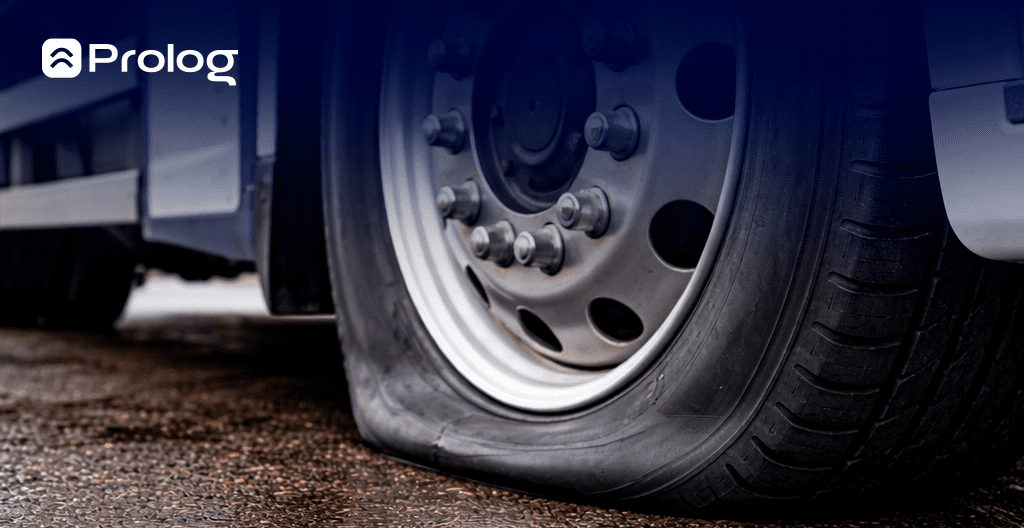
Tires with pressure below recommendations deform more while rolling, causing lost efficiency that needs to be offset by higher diesel consumption. The United States Department of Energy states that correctly inflated tires can improve fuel economy by an average of 0.6%, reaching 3% in some cases, and that underinflated tires can reduce economy by around 0.2% for each 1 psi drop.
Tread wear requires technical interpretation: low tread depth can reduce the mass of rubber flexing and should not be treated as an automatic cause of higher rolling resistance. Even so, a tire at its limit or in irregular condition compromises grip, safety, retreadability and operational predictability, requiring attention before it becomes a risk.
In fleet operations, the impact does not appear in a single trip, but in the total volume. Small increases in consumption per vehicle, accumulated over the month, significantly raise operating costs.
Tires as the main contact point with the ground
All the weight of the truck and cargo, and the forces generated during operation, are transferred to the ground through the tires. Therefore, the condition and correct specification of this component are decisive for vehicle performance.
Tires unsuitable for the cargo type, axle or route reduce efficiency in transferring engine force, increase component wear and raise diesel consumption.
For the fleet manager, this reinforces a practical point: tires should not be treated only as replacement items, but as assets that directly influence fuel costs and operational predictability.
Correct calibration: what the fleet needs to know
Truck tire calibration is one of the simplest factors to control in the fleet and, at the same time, one of those with the greatest impact on diesel consumption. Tires running outside recommended pressure increase resistance to movement and demand more engine effort, raising fuel consumption.
In heavy vehicle operations, small pressure variations, when maintained for long periods, cause continuously higher diesel spending and accelerate tire wear.
Maintaining correct pressure therefore contributes to better efficiency per liter, longer tire useful life and greater vehicle stability, especially on long routes with bulky, heavy loads.
Michelin recommends checking all tires once a month, measuring with cold tires, before driving or at least three hours afterward, and comparing measured pressure with the vehicle manufacturer's indicated specification, rather than the value on the tire sidewall.
Consequences of incorrect calibration
Running tires outside recommended pressure has direct impacts on diesel consumption and fleet costs.
Among the main effects are:
- Increased diesel consumption, caused by higher rolling resistance;
- Reduced efficiency per kilometer driven, especially on long trips;
- Irregular and accelerated tire wear, reducing useful life;
- More frequent retreading or replacements, raising maintenance costs;
- Loss of stability and handling, affecting safety and performance;
- Difficulty standardizing costs, since consumption varies without apparent cause.
In heavy-duty fleets, keeping tires running with incorrect pressure for long periods turns a simple deviation into a recurring fuel and maintenance cost.
Tools to keep track of pressure
To avoid the impacts of incorrect calibration, tire pressure control needs to go beyond sporadic checks. Today, fleets have different tools to support this process, such as:
- manual pressure gauges, used in routine inspections;
- tire pressure monitoring systems (TPMS), with real-time alerts;
- operational checklists linked to preventive maintenance.
Among these solutions, the electronic tire tread probe stands out by bringing greater accuracy and standardization to the process.
Prolog's electronic tread probe, for example, supports 8x faster inspections, works with 99% accuracy and updates data in the Prolog system, helping reduce human errors and keep tires at the correct pressure.
By recording inspections digitally, the fleet gains history, control and traceability, making it easier to correct deviations before they affect diesel consumption and tire useful life.
When pressure measurement stops being manual and becomes controlled, calibration becomes a management factor, rather than just a maintenance factor.
Fleet tire management: practices that reduce diesel consumption
In heavy-duty fleets, poorly managed tires cause continuously higher diesel consumption, raise maintenance costs and reduce operational predictability.
When the fleet adopts clear processes to keep track of the tire life cycle, from selection to disposal, it is possible to keep consumption under control and increase efficiency per kilometer driven.
Below are the main practices that help reduce diesel spending through more efficient tire management.
Indicators that it is time to retread or replace tires
The decision between retreading and replacing a tire should be based on technical indicators, rather than visual perception alone. The main one is tread depth, which indicates the tire's ability to maintain grip and operational safety.
In Brazil, the minimum legal tread depth limit is 1.6 mm. When a tire reaches this level or becomes irregular, the priority shifts from fuel economy to safety, grip, aquaplaning risk, legal compliance and protecting the casing for possible retreading.
Besides tread depth, other indicators should be kept track of:
- irregular wear (shoulders, center or sidewall), which indicates calibration or alignment failures, or incorrect application;
- excessive previous retreadings, which compromise the tire's structure;
- increased diesel consumption without route or load changes, a sign of lost efficiency;
- pressure adjustments more frequent than the expected routine, indicating loss of integrity.
Keeping tires running near or beyond the technical limit generates apparent short-term savings but increases total cost of operation through maintenance, operational risks, unplanned stops and possible casing loss.
Tire and diesel performance indicators
For tire management to effectively contribute to reducing diesel consumption, the manager needs to keep track of clear, comparable indicators.
Some of the main KPIs are:
- Diesel consumption per km driven, by vehicle, axle or tire type;
- Tire useful life in kilometers, from first use to the end of the cycle;
- Tire CPK (cost per kilometer), an essential indicator for comparing the operating cost of different tire makes and models;
- Wear rate by axle, identifying operational deviations;
- Average number of retreadings per tire, assessing asset utilization.
By cross-referencing this data, the manager can answer key operational questions, such as:
- Which tires generate lower diesel consumption per km?
- Which model has the best CPK for a given route?
- Where are efficiency losses occurring in the fleet?
Without these indicators, tire management is based on unit cost rather than total cost of operation.
Technology and data for the fleet
Modern tire management requires reliable, centralized data. Digital solutions allow the entire tire life cycle to be kept track of, from installation to disposal, with a direct impact on diesel consumption control.
Platforms such as Prolog Tire Management make it possible to register each tire in the fleet from purchase to disposal, with inspections performed by the team itself, tread depth and pressure measurements, retreading history and indicators such as CPK and average wear per kilometer. This makes it possible to identify wear patterns, operational deviations and efficiency losses before they become costs.
With consolidated data, the fleet can:
- compare performance between tires, vehicles and routes;
- identify causes of increased diesel consumption;
- standardize inspection and maintenance processes;
- improve the predictability of operating costs.
In this context, technology stops being support and becomes a direct decision-making tool.
Driver training for good practices
The driver directly influences tire useful life and diesel consumption.
Training should therefore go beyond safe driving and cover specific operational practices.
Among the main good practices are:
- avoiding sudden acceleration and unnecessary braking;
- respecting speed limits, especially with heavy loads;
- avoiding potholes, curbs and obstacles whenever possible;
- immediately reporting underinflated tires or abnormal vibrations;
- respecting vehicle and axle load limits.
When drivers understand that their driving affects diesel consumption and tire wear, the fleet reduces consumption variations and improves efficiency per kilometer driven. Training also helps drivers and managers conserve fuel, save money and improve vehicle efficiency.
Choosing the right tires for heavy-duty fleets
Tire choice is another factor that influences diesel spending. Tires should not be standardized across the whole fleet, but selected carefully, depending directly on vehicle type, route, cargo transported and application.
Some practical examples:
- long paved routes require tires with lower rolling resistance, focused on fuel economy;
- mixed operations (paved and dirt roads) demand more robust tires with greater cut resistance;
- drive axles need tires with greater grip;
- heavier loads require tires with a suitable load index to avoid excessive deformation.
Choosing the correct tire for each application reduces wear, improves vehicle performance and directly contributes to reducing diesel consumption throughout the operation, as well as contributing to driver safety along the route.
Beware of excess load
Excess load and poor weight distribution directly affect diesel consumption and tire durability. When a vehicle operates above recommended capacity, the engine needs to work harder, raising fuel consumption along the route.
Even when total weight is within the limit, incorrect load distribution overloads axles and tires, increasing rolling resistance and accelerating wear. This reduces efficiency per kilometer driven and compromises tire useful life.
Besides the operational impact, it is important to consider the legal aspect. In Brazil, the Brazilian Traffic Code provides for an infraction for operating with excess weight; therefore, the operation must respect the applicable Peso Bruto Total (PBT, gross vehicle weight), Peso Bruto Total Combinado (PBTC, gross combined weight), weight per axle and Capacidade Máxima de Tração (CMT, maximum traction capacity) for the vehicle.
In this context, another good operational practice is to redistribute cargo after each unloading. This routine helps maintain vehicle balance along the route, reduces localized axle overloads and facilitates unloading at each stop, contributing to less tire wear and greater stability.
In summary, respecting the vehicle's and tires' load capacity, besides being a legal requirement in Brazil, ensures correct weight distribution, reduces costs and increases safety.
Well-maintained tires consume less diesel
The relationship between tires and diesel spending in heavy-duty fleets is direct and measurable. Tires with correct calibration, controlled pressure, suitable specifications and use within load capacity help reduce operational losses and improve efficiency per kilometer driven.
This guide has shown that diesel consumption does not depend only on the engine or route, but also on how tires are managed. Practices such as pressure control, keeping track of indicators, using technology, driver training and respecting load limits help reduce costs, avoid operational failures and increase fleet predictability.
When tire management moves from reactive to data-based, the fleet gains operational efficiency and greater control over fuel spending.
To support this day-to-day control, download the fuel control spreadsheet for free (in Portuguese) and start organizing your operation's data. With records, it becomes easier to identify deviations, compare results and make decisions that truly affect cost per kilometer driven.
Frequently asked questions
My diesel consumption rose and the route has not changed. What should I investigate first?
How do you choose the right tire for each part of the fleet?
How do you control fleet tire pressure without relying on sporadic checks?
When should a tire be retreaded or replaced?
Does excess load really affect diesel spending and tire life?
Which indicators connect tire management to fuel consumption?
// newsletter
Fleet management content, straight to your inbox
Articles on tires, maintenance and fleet operations. No spam.