
Vehicle inspection guide: what to check on a truck
 Luiz Felipe 7 min read

Vehicle inspection is essential for your fleet's upkeep and durability. Do you know what it is, how to carry out the process and the benefits it brings?
To begin with, you should know that inspection is part of a preventive maintenance routine and that this routine is essential for transport operations.
In fact, this only holds true if you intend to generate savings, safety and productivity in your management. To explore the subject further, read about:
- What vehicle inspection is;
- Why it is so important;
- How to carry out vehicle inspection;
- What needs to be checked during inspection;
- The secrets to a quick and efficient inspection.
What is vehicle inspection?
Vehicle inspection is the act of checking a vehicle's components to identify whether they are functioning perfectly or have faults.
Its main objective is therefore to prevent a vehicle from setting out on the planned route and developing a fault or breaking down along the way, potentially causing a road accident.
This is also part of the answer to the next question:
Why carry out vehicle inspection?
As well as being an essential part of vehicle management for increasing road safety by preventing faults that cause accidents, it has another fundamental role: promoting fleet sustainability.
This is because frequent inspections allow all vehicle parts and components to function properly, particularly when it comes to heavy vehicles such as trucks and buses.
These vehicles tend to pollute more through emissions of gases harmful to the environment, but inspecting them makes it possible to quickly identify problems that increase this effect.
This also makes it possible to correct them and even understand which makes and models perform more appropriately for meeting the goals of building a sustainable fleet in your operation.
How can you carry out fleet vehicle inspection?
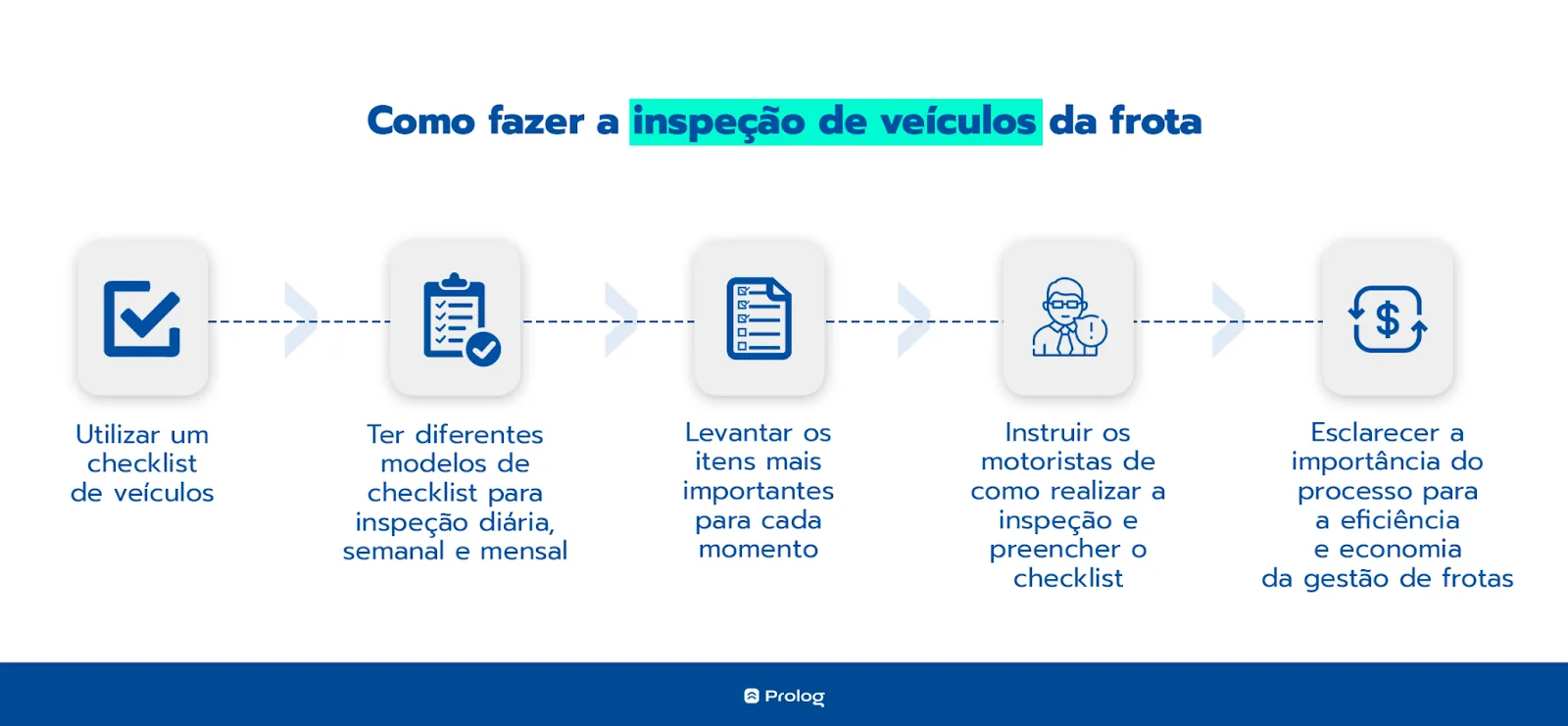
How to carry out fleet vehicle inspection.
The best way to carry out vehicle inspection is with a checklist — a tool that lists all items to assess during a vehicle inspection.
This ensures all aspects are checked, increasing vehicle safety and reducing mechanical problems.
There are different methods for creating the checklist. You can separate items into inspections carried out daily, weekly, every two weeks and so on, up to an annual inspection checklist.
You can also have more specific inspections, covering only the mechanical and electrical systems or checking a specific part of the vehicle, such as the suspension.
What do you need to check during vehicle inspection?
All vehicle items need inspection at some point. You need to identify how often to complete the checklist and then include the corresponding items in the assessment.
For example, the daily checklist before setting out on a route needs to include:
- Headlight operation, separated by headlight location, such as:
| Item | OK | NOK |
| Front right headlight | X | – |
| Front left headlight | – | X |
- Fuel level, identifying whether refueling is needed for the route;
- Horn operation for communication in traffic if necessary;
- Brake testing, preventing the vehicle from setting out on a route without properly functioning brakes;
- Seat belt locking, ensuring the driver has this protection in the event of a collision or other accident.
Among other items you consider important for your fleet's vehicles, these are essential for route safety and efficiency, so they should always be inspected.
For an electronic systems inspection checklist, you need to include items such as:
- Fuse box;
- Sensors;
- Alternator;
- Valves;
- Actuators.
As you can see, vehicle inspection can happen in different ways, and you can create various checklist templates (in Portuguese) for each situation.
The first step to implementing this tool in the fleet is therefore to define which method your operation will use: a checklist by inspection interval, by vehicle system, or more targeted checklists such as a vehicle safety inspection checklist.
When should vehicle inspection be carried out?
It can be carried out daily, weekly, every two weeks, monthly, quarterly, every six months or annually. More than one type of vehicle inspection also takes place in your fleet. The difference largely lies in inspection difficulty and the average time to assess each item.
To understand this better, inspecting truck suspension requires care and attention to detail, assessing its small parts and components. Carrying out this type of vehicle analysis every day is impractical, isn't it?
Especially since suspension does not usually develop problems so frequently, an inspection every two weeks or monthly is sufficient to keep it functioning properly.
Organizing inspection lists and building a schedule is therefore essential to achieve the expected preventive maintenance results — reducing corrections and fleet costs, as well as improving transport operation safety.
What are the secrets of vehicle inspection?
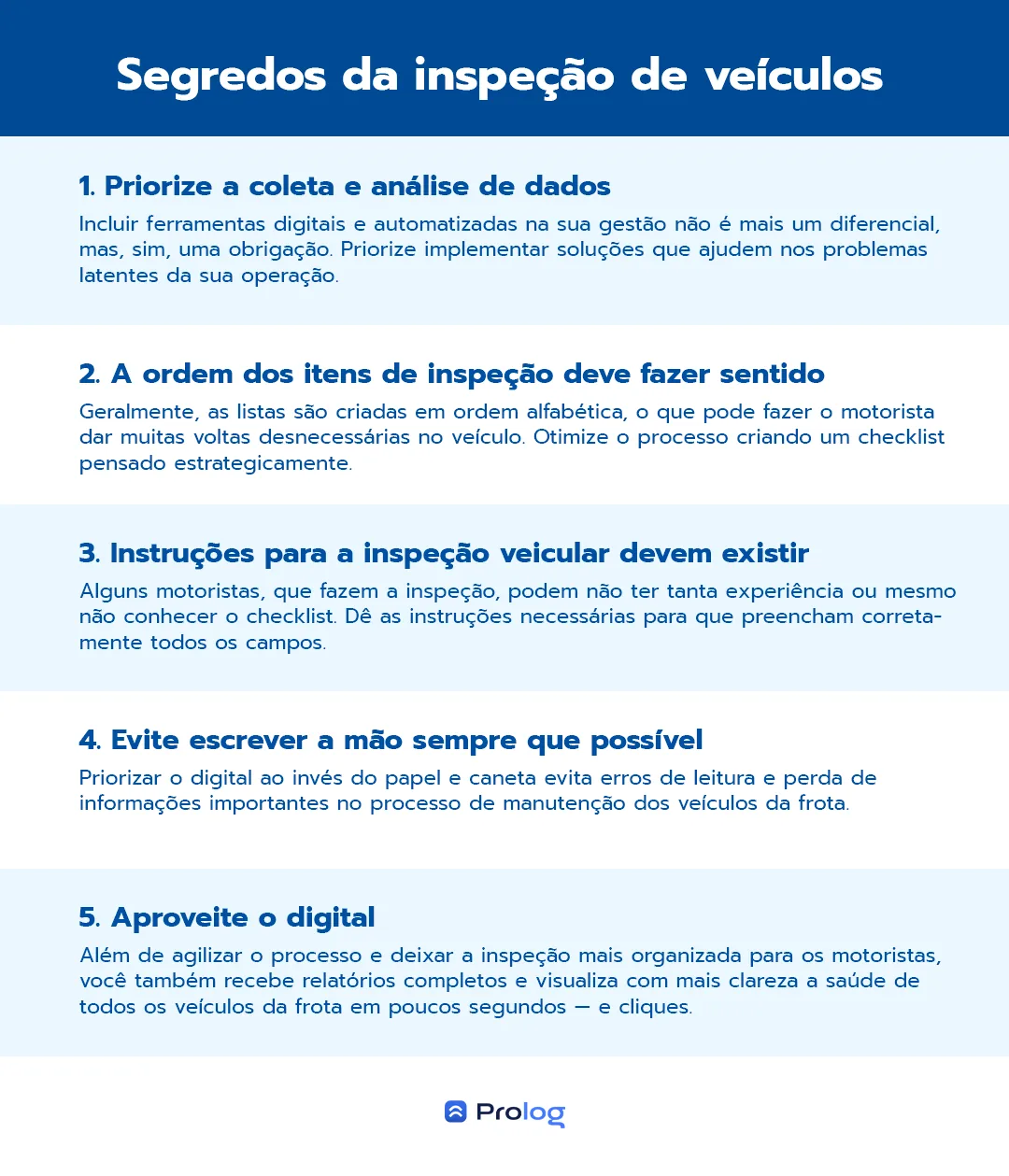
The secrets of vehicle inspection.
1 – Prioritize data collection and analysis
Reports “forgotten in a drawer” do nothing for you or your operation! Especially if the data could transform your management and bring more positive results in fleet savings and productivity.
You should collect this data and also analyze it frequently.
Beyond seeing the importance of vehicle inspection for preventing accidents, mechanical failures and so on, you need to see how valuable the information collected at this point is for your decision-making.
To transform your routine and gain speed and productivity in generating and analyzing this data, you need a digital checklist. Although a tool such as a spreadsheet can meet various inspection needs, it generates reports and analyses automatically, as the digital checklist does.
Keeping a history of problems a vehicle has had (and which vehicle it was) and knowing the validity of each license plate's vehicle inspection are also information you need in management — something digital tools make easy.
To make this even clearer, here is an example:
You want to measure your fleet mechanics' productivity. How can you do this? Well, inspection software gives you access to data that can answer your question.
As work orders are opened and a mechanic becomes responsible for them, an average repair time is calculated for each one.
For each mechanic, you can view the total number of repairs and the average number of hours to resolve problems.
This is just one of many other pieces of information you can extract from the data collected during a vehicle inspection.
2 – Inspection items should follow a sensible order
The main problem with paper checklists is that the checking order can become disorganized, making the task take even longer than it should.
This happens because, in most cases, list items were arranged alphabetically rather than with the practicality of the process in mind.
Inspection needs to be optimized to follow a logical order, preventing inspectors from going back and forth to the same places several times.
Daily inspections in particular, which should be quick and practical, end up taking extra minutes. Even if it does not seem like much, assessing it at the end of the month reveals accumulated hours rather than a few minutes.
The lesson to take away is therefore:
Organize vehicle inspection in an order that makes sense so drivers make fewer trips around the vehicle.
3 – Vehicle inspection instructions must be available
Each vehicle has its own characteristics and particularities, especially newer models that appear with different features every year. Drivers also have different experience and knowledge.
Having a manual of good inspection practices is therefore important. Create instructions and even illustrations for checklist use. This way, whoever performs the task will not encounter difficulties.
4 – Avoid handwriting whenever possible
Handwriting can cause confusion, whether when reading for repairs or for management analysis. A lot of data can even be misinterpreted because of illegible writing.
Worse still, mechanics might fail to correct a serious problem because they cannot understand the writing. This is not a risk to take.
5 – Make use of digital tools
If you have not yet understood all the benefits an electronic checklist brings to your fleet's vehicle inspection, consider this:
As well as speeding up the process and making inspection more organized for drivers, you also receive complete reports and get a clearer view of the health of all fleet vehicles in just a few seconds — and clicks.
The convenience extends further with easy access to systems through a cell phone, allowing managers to take some actions even outside their office. In other words, the benefits extend to all fleet employees.
Want to learn more about the Electronic Checklist and its benefits for your management? Schedule a free demonstration with one of our specialists.
Frequently asked questions
What is vehicle inspection?
Why carry out vehicle inspections in a fleet?
What should be checked on a truck’s daily checklist?
How often should vehicle inspection be carried out?
How can vehicle inspection be made faster and more efficient?
// newsletter
Fleet management content, straight to your inbox
Articles on tires, maintenance and fleet operations. No spam.


