
Bitrem: what it is, capacity, types and legal rules
 Thiago Concado 10 min read

It is common for new fleet managers to have questions about how to tell freight vehicle combinations apart — such as the bitrem, the rodotrem, the tritrem, among others. Beyond the many technical aspects involved in the operation, understanding the difference between these combinations matters for handling cargo well, choosing suitable routes, reducing costs and much more.
The bitrem, in particular, stands out as a very versatile and advantageous solution for road transport. It offers good load capacity, better weight distribution and can bring important operational gains, as long as the configuration respects the legal limits, the capacity stated by the manufacturer and the requirements of the route.
In this post, you will learn everything about the bitrem: its advantages, main features, available models and how to tell it apart from other freight vehicle combinations.
Check out the topics:
- What is a bitrem?
- What are the differences between the bitrem and the rodotrem?
- Why use bitrems? Features and advantages for freight transport
- Meet the 5 types of bitrem and how to choose the right one for your operation
- How do you ensure the fleet's bitrems perform well?
Keep reading and find out how to make more strategic choices for your fleet.
What is a bitrem?
The bitrem truck is one of the most widely used vehicle combinations in road freight transport in Brazil. It is made up of a tractor unit (also called a towing unit) and two semi-trailers, which are connected by a coupling system called a fifth wheel.
The fifth wheel is a plate-shaped metal device mounted at the rear of the tractor unit. It serves as the coupling and articulation point, allowing the trailers to move in a coordinated way when turning and when crossing uneven terrain, ensuring the vehicle's efficiency and safety.
The bitrem's structure distributes the weight of the cargo well, which makes it ideal for long distances and for carrying large volumes of inputs. That is why companies in agribusiness, fuels, cement and other bulk products use this combination widely.
But understanding what a bitrem is goes beyond its physical structure. It is essential to consider its load capacity, legal requirements, weight and dimension limits and even the investment needed to acquire this type of vehicle.
What is the load capacity of a bitrem?
Under the standard rules in Brazil for combinations with more than two units, including the towing unit, a bitrem can reach 57 tonnes of Gross Combined Weight (PBTC), as long as the applicable axle limit and the capacity stated by the manufacturer are respected. In practice, the payload usually varies according to the trailer equipment, the tare weight of the combination, the distribution per axle and the cargo being carried.
Besides cargo volume, another important point is the distribution of weight across the axles, which allows the bitrem to run in good conditions without compromising the vehicle's performance or causing excessive wear.
However, the carrier must strictly follow the limits set by the manufacturer and by the law to avoid penalties and keep operations safe. CONTRAN Resolution No. 882/2021, issued by Brazil's National Traffic Council, covers weight and dimension limits for vehicles on land roads and also establishes that the combination cannot exceed the Maximum Traction Capacity (CMT) of the towing unit.
Want to see this in your fleet? Talk to a Prolog specialist
How much does a bitrem truck cost on average?
The price of a bitrem truck varies according to a few factors, such as the tractor unit model, the type of semi-trailers, the year of manufacture and the level of onboard technology. In general, a new bitrem costs between R$ 700 thousand and R$ 1 million, considering the complete combination (tractor + trailer equipment). Meanwhile, used ones can be found from R$ 400 thousand, depending on their condition.
Despite the high investment, many carriers consider the bitrem a durable asset with good resale value, especially when they carry out preventive maintenance rigorously. In addition, there are good buying opportunities directly from truck dealerships, trailer manufacturers or platforms specialized in selling heavy vehicles.
What does CONTRAN say about bitrem use?
The use of the bitrem on Brazilian highways is regulated by specific rules that ensure safety and standardization. According to CONTRAN Resolution No. 882/2021, issued by Brazil's National Traffic Council, it is forbidden to operate vehicles that exceed the Gross Vehicle Weight (PBT), Gross Combined Weight (PBTC) or per-axle load limits set by the manufacturer. In addition, the tractor unit must respect its Maximum Traction Capacity (CMT).
It is also important to highlight that combinations that do not fit within the weight and dimension limits set by CONTRAN can only operate with a Special Transit Authorization (AET), issued by the authority with jurisdiction over the road. The dimension rule itself sets a limit of 19.80 meters for articulated vehicles with more than two units, and the ordinary framework for combination vehicles (CVC) with more than two units can reach 57 tonnes of PBTC.
Meeting these requirements is essential to avoid traffic fines and protect the integrity of the vehicle, the cargo and the road infrastructure.
What are the differences between the bitrem and the rodotrem?
Although they look alike, the bitrem and the rodotrem have important differences in configuration, legal requirements and the way the semi-trailers are coupled.
The main distinction lies in the system that connects the trailer equipment. In the bitrem, the two semi-trailers are linked to each other by a fifth wheel — an articulated system that ensures stability and maneuverability. In the rodotrem, on the other hand, the second semi-trailer is coupled by a dolly, which is an auxiliary axle with a swivel coupling. This setup requires an extra structure, which increases its overall length.
Another difference concerns the Special Transit Authorization (AET). While bitrems within the ordinary weight, dimension and axle limits can operate without special authorization, combinations that fall outside these limits need an AET. That is why the requirement must be checked according to the configuration of the combination and the road being used.
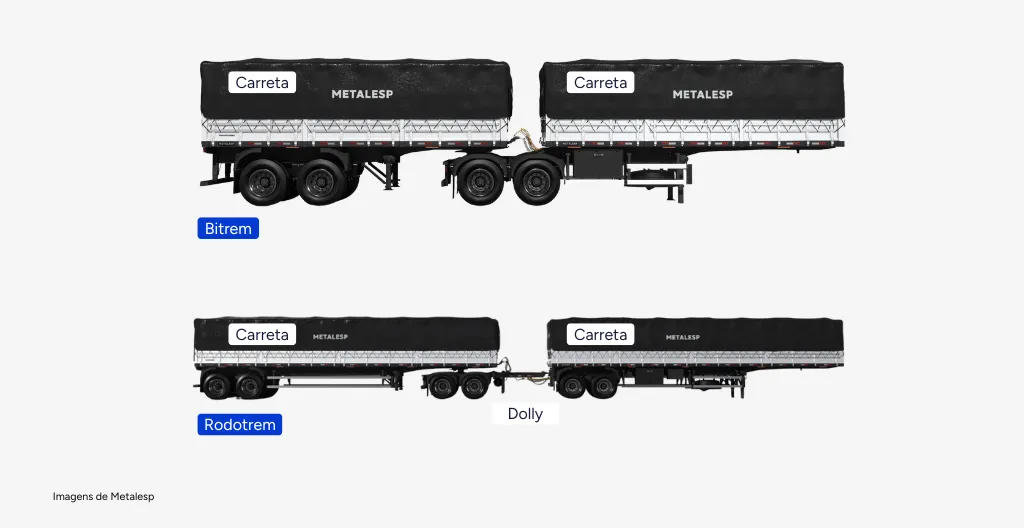
In addition, the maximum PBTC also varies according to the combination and the legal framework. The standard bitrem with more than two units can reach 57 tonnes of PBTC, while the rodotrem is used in higher-capacity operations, usually with more axles and stricter operating requirements.
Put simply, the bitrem is simpler in terms of coupling and requirements, while the rodotrem offers greater capacity and load distribution. However, this brings more legal and operating requirements.
Why use bitrems? Features and advantages for freight transport
Carriers seeking more efficiency in moving cargo over long distances often use the bitrem semi-trailer combination. Its structure was designed to handle large volumes without compromising the safety, performance or durability of the combination, as long as the PBTC, axle, dimension and CMT limits are respected.
Among the main advantages of the bitrem are:
- Good load capacity, with a PBTC of up to 57 tonnes under the standard framework for a CVC with more than two units
- Fewer trips, optimizing time and operating costs
- Lower fuel consumption per tonne transported
- More efficient weight distribution, which reduces component wear and the impact on the pavement
- Versatility in carrying different types of cargo
- Good stability on the road, especially on long-distance highway routes
- Higher resale value, since it is trailer equipment in high demand on the market
With all these benefits, the bitrem becomes a strategic choice for operations that prioritize productivity, savings and safety in freight transport. Opting for this type of combination represents an important competitive advantage for companies in the logistics sector.
Meet the 5 types of bitrem and how to choose the right one for your operation
Not every bitrem truck is the same — and knowing how to identify which configuration best serves your operation can make a difference in productivity and in reducing logistics costs.
Below are the main types and configurations of bitrem used in road freight transport:
- 7-axle bitrem: one of the most common models in domestic transport, it can carry up to 57 tonnes of Gross Combined Weight (PBTC), as long as it respects the other legal and manufacturer limits. It is versatile and suitable for different types of cargo.
- Bitrem in a special configuration: used when the operation needs to assess more capacity, weight distribution or a specific application. In these cases, do not treat the ordinary 57-tonne limit as an automatic rule: the combination must be checked according to weight, dimensions, axles, CMT and any need for an AET.
- Tank bitrem: used to carry liquids — such as fuels, ethanol and other chemical products — it requires extra attention to safety, since these are considered dangerous goods, in addition to following specific signage and documentation rules.
- Grain bitrem: designed specifically for transporting bulk agricultural products, such as grains, meals and seeds. It has high load capacity and is widely used in agribusiness producing regions.
- Dry cargo bitrem: with open or closed bodies, this type is intended for transporting palletized cargo, boxes and packaged products. It also offers flexibility and serves a variety of logistics routes.
How to choose the right bitrem for your operation
Now, among all these types of bitrem, which one should you choose? Which one is ideal for managing your fleet?
Well, to choose the most suitable type of bitrem, it is important to consider three main factors:
Type of cargo carried: each model is designed for a specific type of goods. Liquid cargo requires specialized tanks; grains call for grain trailers; diverse and packaged products benefit from the dry cargo bitrem.
Capacity required by the operation: configurations with greater capacity or more axles can make sense for routes with a high volume of cargo, but they require careful checking of the legal limits, the CMT, the distribution per axle and the need for an AET. Combinations within the ordinary limits, on the other hand, tend to be simpler to operate.
Routes and infrastructure: assess the conditions of the highways and access roads the vehicle will travel. Poorly maintained highways, urban stretches or roads with weight and size restrictions may require a lighter or shorter bitrem.
It is also worth considering aspects such as acquisition cost, maintenance, tire spending and fuel consumption. Having operational data at hand — such as cost per kilometer (CPK) — helps you make better-informed decisions, aligning the vehicle type with the company's goal: carrying more, spending less and doing it safely.
How do you ensure the fleet's bitrems perform well?
To keep bitrem performance at a high level, choosing the right model is not enough — you need to make sure the operation runs with control, maintenance up to date and a focus on indicators.
Here are some good practices to optimize your fleet's performance:
1. Carry out regular, standardized inspections
Inspecting the bitrem's main components, such as brakes, suspension, lighting, tires and couplings, is essential to prevent failures and maintain safety. Standardizing these checks — using an electronic checklist, for example — helps identify failures before they become serious problems.
2. Keep an eye on tire performance
Tires represent one of the largest operating costs of bitrems. That is why keeping a record of pressure, wear, retreads and mileage is essential. Efficient tire management contributes directly to reducing CPK and extending the useful life of components.
3. Train your drivers
Behaviors such as harsh braking, high-speed cornering and excessive acceleration compromise bitrem performance. Training drivers and promoting good driving practices contributes to more safety, fuel savings and, as a result, less mechanical wear.
4. Use data to make decisions
Finally, following indicators such as fuel consumption, cost per kilometer, downtime for maintenance and failure occurrences makes it possible to identify bottlenecks and adjust the fleet strategy. Use operational records, inspections and maintenance logs to compare vehicles, routes and costs before deciding to switch combinations.
Want to make sure the tractor unit of your bitrems is always in good condition? Download the free tractor unit checklist now (in Portuguese) and start doing more complete, faster and standardized inspections today.
Frequently asked questions
What is a bitrem truck?
How much can a bitrem carry?
How much does a bitrem truck cost?
What is the difference between a bitrem and a rodotrem?
What are the types of bitrem?
How do you choose the right bitrem for the operation?
// newsletter
Fleet management content, straight to your inbox
Articles on tires, maintenance and fleet operations. No spam.


