Fleet size: small, medium or large and what changes
 Thiago Concado 7 min read
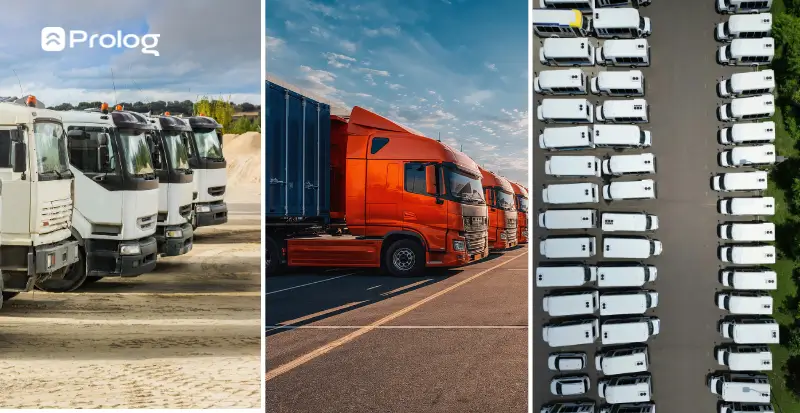
You certainly already understand that managing a fleet of 10 vehicles differs from managing one of 50. But it is not just 5 times harder; it is a completely different model.
With 10 trucks, you know each vehicle even by its engine sound. Control is visual and memory-based, more intuitive, and most of the time it works. With 50, 100 or 200 vehicles, this model simply cannot be sustained. At that stage, things need to work based on data.
Determining fleet size is not a matter of vanity or labels. The right management, maintenance, technology and team structure is the starting point for fleet sizing.
Explore:
- Classification criteria for determining fleet size
- Typical operational challenges of small fleets
- Management complexity in medium and large fleets
- Recommended solutions and technologies for each maturity level
Classification criteria for determining fleet size
There is no official table defining vehicle fleet size as small, medium or large. The definition may vary between markets, segments and even fleet technology suppliers.
But in the context of road freight transport in Brazil (in Portuguese), some parameters are widely accepted and useful for positioning your operation:
Small fleet: up to 20-30 motor vehicles
Lean operations, generally with management centralized in one or two people. The owner or lead manager has direct contact with the operation, knows vehicles individually and makes most operational decisions.
In these cases, the support structure tends to be outsourced (maintenance, tire workshop, tire management).
Medium fleet: 30 to 50 motor vehicles
This is a transition zone. The operation already has enough volume to justify some internal structure (a maintenance supervisor, perhaps the beginnings of an in-house tire workshop), but often still operates with small-fleet processes.
This is the size where the first signs of losing control usually appear.
Large fleet: over 50 motor vehicles
Here we are talking about operations that require a dedicated structure: a maintenance team, in-house tire workshop, someone responsible for tire management, a management system and standardized processes.
Visual control no longer works, and management needs to be based on data, indicators and governance.
It is important to note that these numbers are references, not absolute rules. A fleet of 40 vehicles with complex operations (multiple branches, diverse routes, special loads) may face large-fleet challenges. One of 60 with concentrated, homogeneous operations may be simpler to manage.
What really defines complexity is the combination of volume, operational diversity and support structure.
Typical operational challenges of small fleets
Small fleets have challenges that generally revolve around immediate operational issues, such as a truck that broke down, a punctured tire or a delayed delivery. Vehicle management is more reactive and centered on “repair,” and at this size that works.
The most common challenges include dependence on few professionals, outsourcing most maintenance and tire services (which limits control but reduces fixed cost), difficulty negotiating with suppliers due to low volume, and financial management that mixes operational costs with general business costs.
At this size, manual or spreadsheet control is still viable (not ideal, but viable). The manager knows the operation closely and can compensate for a lack of process through direct attention.
The complexity of managing medium and large fleets
From 50 vehicles onward, fleet management changes. At this level, information volume exceeds direct human processing capacity, and anyone insisting on visual control loses operational visibility.
This has concrete consequences. In small fleets, the focus is on fixing what broke. In large fleets, the focus needs to be on keeping the asset available and optimizing its life cycle cost.
When the operation grows and the model remains reactive, maintenance costs rise because you spend when an issue appears instead of investing to prevent it.
The same applies to tires. Poor calibration in a fleet of 10 vehicles is an inconvenience. The same process failure replicated in 100 vehicles becomes an issue costing hundreds of thousands of reais a year.
Every small inefficiency, whether overdue rotation or a missed inspection, is multiplied by fleet volume.
To resolve this issue in large fleets, implementing a management system is not enough; you need people dedicated to each stage: beyond a fleet manager, someone responsible for tires, a structured maintenance team, operational assistants or support staff, among others.
For this to work, you also need documented processes (SOPs), monitored indicators (CPK, MTBF, MTTR, availability) and auditing mechanisms.
Transition: what happens when you move from small to medium / large?
If you manage a growing fleet (or one that grew quickly in recent years), you have probably felt some of these symptoms:
- Time spent entering data into spreadsheets keeps increasing, while confidence in the data keeps decreasing.
- You cannot calculate actual CPK per tire without spending hours consolidating information.
- Physical inventory never matches what is recorded.
- Preventive maintenance is delayed because no system issues alerts.
- Purchasing decisions are based on price rather than historical performance because the history is simply unreliable.
Recommended solutions and technologies for each maturity level
One of the most frequent mistakes in fleet growth is keeping the same tools used when it was smaller. After all, transport management maturity develops with size, and solutions need to keep pace too. See what makes sense at each stage:
Small fleets (up to 20-30 vehicles)
At this stage, the priority is getting the basics right: tire identification by fire number (the serial number branded on the tire), recording relocations, maintenance control by mileage or time.
Well-structured spreadsheets and paper checklists can work as long as completion is disciplined. Technology investment can be gradual, starting, for example, with an electronic checklist that structures inspections and generates minimum traceability data.
Medium fleets (30 to 50 vehicles)
This is the zone where investment in a system starts to be justified. Data volume already exceeds what spreadsheets manage reliably, and the operation needs automatic indicators to support decisions.
A dedicated maintenance management system becomes the difference between reacting and preventing. Adopting digital tread probes for tire inspections and electronic checklists for vehicle inspections reduces collection errors and generates reliable data with less effort.
Large fleets (50+ vehicles)
Here, having a dedicated system is no longer just an option; it becomes mandatory. The operation needs automated tire management, maintenance management with preventive planning, electronic checklists integrated into operational flow, real-time indicators (CPK, availability, MTBF, MTTR) and, beyond that, integration between systems.
Technology needs to work in the yard and tire workshop (data collection and offline operation) and in the office (dashboard and report analysis). It also needs to connect data originating in the tire technician’s inspection with the manager’s decision-making without intermediate manual steps.
At this size, the physical structure also changes. Service volume justifies an in-house tire workshop and dedicated maintenance team. Fixed cost and gains in control, availability and traceability far outweigh the investment needed initially and even to keep it running over time.
When these services are internal, integration between them also becomes simpler. This is fundamental when, for example, uneven tire wear identified by the tire technician may be a symptom of a suspension issue that maintenance needs to resolve.
When the tire workshop, repair workshop and system operate together, every piece of data collected at one end becomes preventive action at the other.
With all this in mind, it is clear that determining fleet size is not just about numbers; it defines which management model, structure and technology level your operation needs to function efficiently.
If your fleet grew and processes did not keep up, the cost of inefficiency is already present, even if it is not yet clear in the reports. The first step is to recognize where you are. The second is to adapt the structure to where the operation needs to go.
To help with that second step, download our Fleet Planning Guide (in Portuguese) and see how to organize management, maintenance and technology for your operation’s size.
Frequently asked questions
How do you classify the size of a vehicle fleet?
What are the challenges of a small fleet?
What changes in the management of fleets above 50 vehicles?
What signs show that the fleet grew and management did not keep up?
Which technology should be used at each fleet size?
// newsletter
Fleet management content, straight to your inbox
Articles on tires, maintenance and fleet operations. No spam.