Passenger transport: 4 types of service in Brazil
 Jade Zart 7 min read
You are certainly already aware of the importance of keeping vehicle maintenance up to date to ensure safety in road passenger transport. But do you have an in-depth understanding of the main challenges and responsibilities involved in managing a bus fleet?
As well as ensuring passenger safety and comfort, fleet managers deal daily with complex matters such as controlling operating costs, preventive maintenance and efficient route management.
Read on to discover how to optimize your operations and reduce costs with efficient strategies:
- What road passenger transport includes
- The importance of this form of transport in Brazil
- Types of passenger transport services
- Passenger transport vs. freight transport
- Which vehicles are used in road passenger transport?
- Industry challenges
- Technology and innovation in road passenger transport
- Differences between managing freight fleets and bus fleets
- The importance of tire care for transport safety
What does road passenger transport include?
Road passenger transport involves moving people in vehicles that travel along roads and highways. This type of transport is essential to ensure mobility between cities, states and within urban areas, and is one of the main means of passenger travel in Brazil.
The importance of this form of transport in Brazil
In Brazil, road passenger transport is vital, especially because of the country's vast territory and the uneven distribution of other transport modes, such as railways and waterways.
According to Brazil's National Land Transport Agency (ANTT), regular interstate and international public passenger transport is an essential public service, operated on routes with fixed timetables, frequencies and itineraries authorized by the agency. This scope helps explain why regularity, continuity and safety are central to the operation.
Route flexibility, combined with access to remote areas and the extensive coverage of operating companies, makes this an accessible form of transport widely used by the population, especially in regions where other modes do not reach as frequently.
Types of road passenger transport services
Road passenger transport in Brazil comprises the following services:
- Urban transport: operated within cities, using buses and vans that follow specific routes. This service is essential for workers' and students' daily travel.
- Intercity transport: connects cities within the same state. Used for frequent travel between neighboring cities or metropolitan regions.
- Interstate transport: long-distance trips between states, operated by bus companies offering regular services. On routes regulated by Brazil's ANTT, trips follow fixed, authorized timetables, frequencies and itineraries.
- Charter transport: used by companies or groups for specific private journeys, such as employee transport, tourism or events. Brazil's ANTT describes charter transport as a closed-circuit service, hired by a group for a specific trip, without the sale of individual tickets.
Road passenger transport vs. freight transport
Freight transport needs well-maintained vehicles to ensure movement without problems or accidents, just like passenger transport. So what is the difference?
It is actually much more about other procedures, such as boarding and alighting. After all, people get on and off buses by themselves, while freight needs to be loaded.
Another practical difference is the comfort provided. For freight, the vehicle must be appropriate for the goods, whether refrigerated, commercial, technological and so on.
For passengers, the greatest need is to provide comfortable seats, air conditioning and even Wi-Fi internet access.
However, one of the biggest differences is not the vehicle, but the responsibility assumed by the fleet manager. Without a doubt, dealing with people's safety carries much more weight than dealing with cargo safety.
Which vehicles are used in passenger transport?
Several types of vehicles are used in road passenger transport, each with its own characteristics:
- City buses: large vehicles used for transport in urban areas. Their main purpose is to meet high passenger demand on predefined routes.
- Minibuses: used for shorter distances or routes with lower demand, such as municipal or charter transport.
- Vans: with lower capacity, they are used in charter services or areas with low population density.
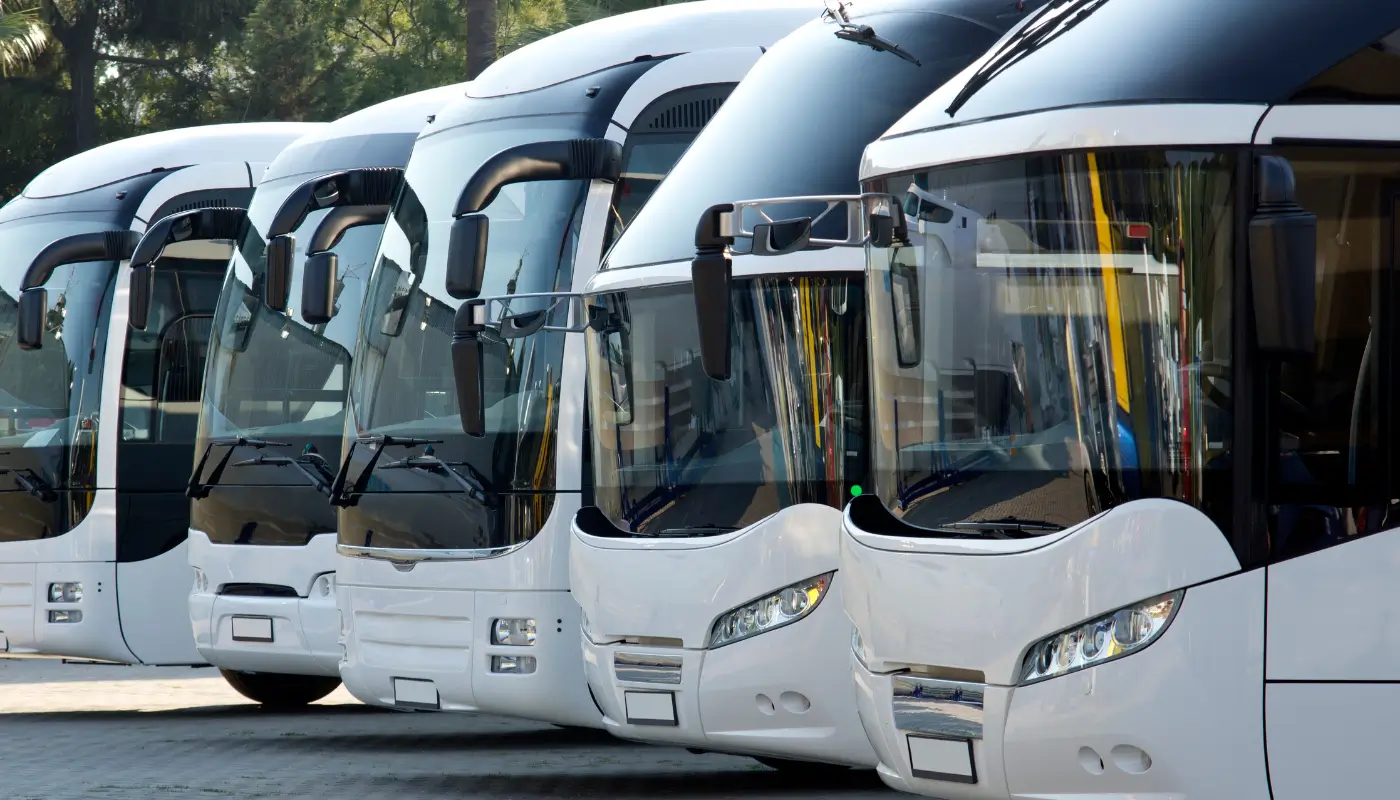
- Coaches: larger, more comfortable vehicles, equipped with reclining seats and other services, such as Wi-Fi, to ensure comfort on long-distance trips.
Industry challenges: costs, safety, vehicle maintenance and route management
Operating costs
Constant increases in fuel prices, a high tax burden and maintenance costs are major challenges.
As a fleet manager, you have probably already noticed how diesel costs and spare parts expenditure directly affect your operation. Keeping costs and profitability in balance is a daily challenge.
Safety
Safety in road passenger transport is a direct responsibility of the fleet manager. Poorly maintained tires, missed maintenance and poorly trained drivers can increase the risk of accidents.
Investing in preventive maintenance programs and defensive driving training for drivers is crucial to ensuring everyone's safety.
Vehicle maintenance
Preventive maintenance is one of the pillars of keeping operations running without failures.
Unexpected stops for emergency repairs can disrupt your operation, delay trips and increase fleet downtime. Lack of control over tire wear or mechanical failures are risks that a good maintenance plan can minimize.
Route management
Efficient route management, while a challenge in itself, also has a direct impact on operating costs. Poorly planned routes can result in increased fuel consumption, vehicle wear and schedule delays.
Using technologies that allow route optimization, taking factors such as traffic and road conditions into account, can reduce these costs and increase operational efficiency.
Technology and innovation in road passenger transport
The road passenger transport industry is constantly evolving thanks to technology. Real-time monitoring systems, tire pressure sensors, telemetry and fleet management software are available on the market as resources that help managers keep closer track of the operation.
With these tools, it is possible to organize information, plan maintenance, improve safety routines and seek to reduce operating costs.
Implementing tracking technologies can also help ensure passenger safety in operations that adopt this type of resource, allowing managers to keep track of journeys and incidents during trips.
Another important innovation is the use of digital platforms for ticket booking and trip monitoring, making both the operation and the passenger experience easier.
Differences between passenger and freight fleet management
Although passenger and freight fleet management share some challenges, such as cost control and maintenance, there are marked differences. In passenger transport, safety and comfort are top priorities, requiring a stricter approach to fleet control.
Another important point is legal liability. While freight management deals with the integrity of goods, passenger operations management involves direct responsibility for people's safety and well-being, making tire management, brakes and maintenance in general even more critical.
Fleet management in road passenger transport
Managing a bus fleet requires a multidisciplinary approach. To ensure efficient and safe operations, here are some tips that can help:
- Driver training: ensure all drivers are trained in defensive driving and know the best safety practices.
- Preventive maintenance schedule: establish regular maintenance schedules to avoid mechanical failures and unexpected stops.
- Efficient tire management: keep track of tire pressure, wear and replacement within a defined routine, preventing accidents and reducing costs.
- Fuel control: monitor each vehicle's fuel consumption, identifying opportunities to save based on driver behavior and route conditions.
- Use of technology: implement fleet management software and, when it makes sense for the operation, industry telemetry resources to optimize the operation, reduce costs and increase safety.
- Route optimization: use tools to plan routes that minimize trip time, avoid congested areas and save fuel.
The importance of tire care for vehicle safety
What does caring for tires mean? The tasks are quite simple: carry out inspections, calibration and other tasks, always following a predefined schedule. This helps avoid unforeseen events and vehicles being out of service as much as possible.
It also means facing a high expense that should nevertheless be incurred to prevent greater losses on trips: retreading and replacing tires when necessary. In other words, when they are reaching the wear limit or are already bald. Brazil's National Institute of Metrology, Quality and Technology (INMETRO) defines retreading as refurbishment by replacing the tread, and the tire must undergo an initial inspection before refurbishment.
What dangers should you expect if tire management is not carried out correctly? You can prepare to deal with broken parts and loose vehicle components. This can result from low tire pressure, which increases the impact of potholes and road debris.
Fuel consumption will also increase considerably because the vehicle will have to work harder to move. Pressure below the recommended level increases rolling resistance, and ideal pressure can vary according to tire size and the axle on which it is used.
Overinflated tires, meanwhile, can reduce the vehicle's balance, making it bounce more when it encounters stones and other small obstacles on the road. Cornering with pressure above the recommended level is also more dangerous because the contact area with the ground becomes smaller and uneven.
Want to learn more about how Prolog can help optimize your passenger fleet management? Discover our solutions here.
Frequently asked questions
What are the types of road passenger transport in Brazil?
What is the difference between managing a bus fleet and a freight fleet?
Which vehicles are used in passenger transport?
Why is tire calibration so critical on a bus?
What are the industry's main cost challenges?
What can you do to reduce unexpected stops in a bus fleet?
// newsletter
Fleet management content, straight to your inbox
Articles on tires, maintenance and fleet operations. No spam.