
Types of fleet maintenance: which to use and when
 Luiz Felipe 11 min read

There are three main types of maintenance that take place in a fleet: preventive, corrective and predictive.
Although their names are self-explanatory, they need to be understood in detail to know when to use each type in your operation.
In everyday maintenance vocabulary, what separates one from another is not the service performed — replacing a shock absorber is the same task in all three cases — but the criterion that decides when to intervene: preventive maintenance acts on a planned interval (time, mileage or hours of use); predictive maintenance acts on the measured condition of the component; and corrective maintenance acts after the failure or defect has already appeared. Keeping this criterion in mind avoids confusion between the three terms.
For example, to meet fleets' constant need for updates and logistics optimization, it is necessary to implement predictive and/or preventive maintenance processes. Through them, you can make the most of the vehicles' useful life, as well as reduce corrective maintenance and the purchase of new parts and components.
Learn more about predictive, preventive and corrective maintenance below, as well as:
What is fleet maintenance?
Fleet maintenance is the main means of diagnosing and determining solutions to the issues found in vehicles used for freight transport or passenger transport. It covers both what is done to prevent failure and what is done after it — and, in a fleet with several vehicles, the two usually happen at the same time, on different assets.
In addition, with the growth of analytical fleet management in transport operations, which needs data for analysis, maintenance becomes one of the fundamental paths for recording valuable information.
Such as, for example, the number of failures that happen in a given vehicle, which driver has the most incidents, average fuel consumption figures by vehicle type and vehicle model, among others.
All of which help build reports, charts and comparison tables for strategic decision-making. It is worth noting that this record is not an automatic by-product of the workshop: it only exists if someone records the service, the part replaced and the reason. Maintenance that is done but not recorded fixes the vehicle that day and teaches the fleet nothing.
Why do fleet maintenance?
Fleet maintenance is important to increase control over the vehicles, meet accident reduction and operating cost targets, and avoid the premature loss of assets.
There is also a reason that does not depend on internal targets. In Brazil, art. 230, XVIII, of the Brazilian Traffic Code (in Portuguese) defines as an infraction driving the vehicle "in a poor state of repair, compromising safety, or having failed the safety and pollutant and noise emission inspection provided for in art. 104". In other words: the state of repair of a vehicle in circulation is also addressed in regulations, and not only in the company's internal policy.
Depending on the needs of each company and transport operation, there are different benefits it will receive. But, in general, planning and controlling maintenance is closely tied to giving vehicles a longer useful life, as well as keeping them at high performance.
When all these advantages come together, another one also emerges: increased team productivity. After all, if the vehicles are well cared for and show no issues, the driver can drive without running into setbacks and unplanned stops, besides saving fuel.
What are the types of fleet maintenance?
Preventive maintenance
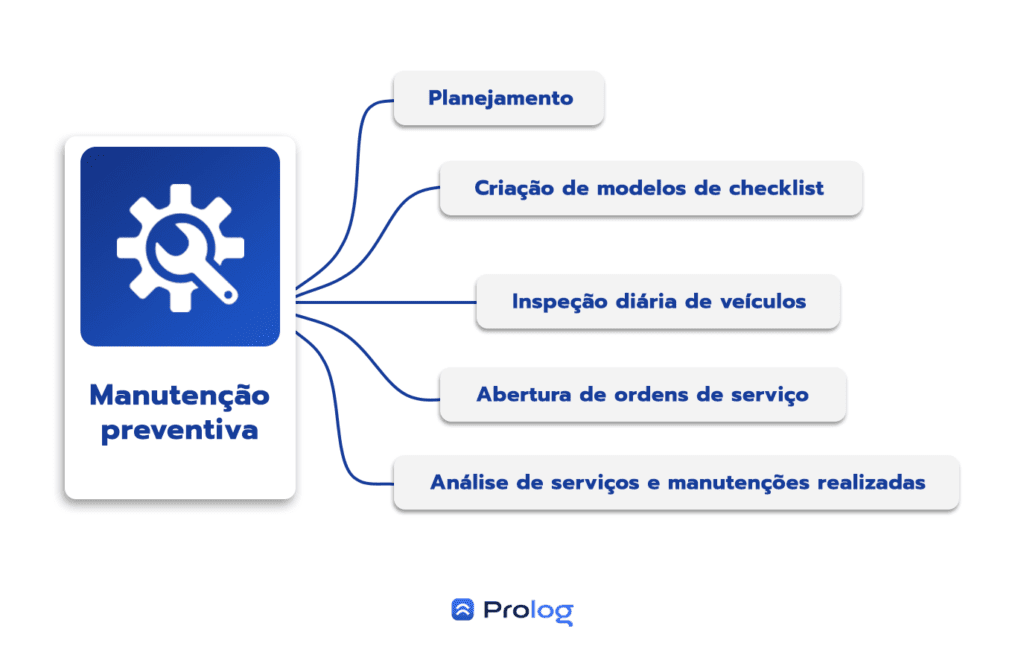
Preventive maintenance is always planned, with a predefined schedule of what must be done within each time interval. The plan needs to be followed to obtain the desired results.
The criterion here is the interval: the intervention is triggered because the time, mileage or number of hours scheduled for that component has been reached — and not because some measurement indicated that it is about to fail.
In some cases, an inspection or service may be brought forward or postponed, as identified when assessing the condition of each vehicle and whether it is showing problematic symptoms.
In general, preventive maintenance helps prevent vehicle issues through routine care, such as lubrication, oil changes, filter cleaning, vehicle alignment and balancing, etc.
Among the types of maintenance, preventive maintenance is the one that most seeks to establish a routine. In this case, the main point is carrying out fleet inspections through the checklist.
It is worth noting what the regulations say about checking before driving. In Brazil, art. 27 of the Brazilian Traffic Code determines that, "before putting the vehicle into circulation on public roads, the driver must check that the mandatory equipment is present and in good working order, as well as make sure there is enough fuel to reach the destination". The provision addresses this check to the driver; the checklist is one of the ways of recording it and turning it into data, which makes it possible to keep track of it and analyze it later.
For each moment, there are different checklist models, such as the daily one or the vehicle safety inspection one. The goal of this activity is to have the driver look for possible failures and wear that must be fixed to avoid idle vehicles and, in more serious cases, the premature loss of the vehicle.
You have frequent expenses involved, but smaller than in the other types of maintenance and, in the long term, there is a reduction in operating costs due to the reduction, as well, of breakdowns and corrective maintenance.
Corrective maintenance
Among the types of maintenance, this is the one that most often happens without planning, after a vehicle breaks down on the road and needs urgent service to complete the trip or, at the very least, to return the asset to the operation's base.
Even so, it can indeed be planned, and it is preferable that it only happens this way. That is, after identifying the need for a correction during the vehicle inspection in the preventive maintenance routine — or based on the measured condition of the component, when the operation keeps predictive condition monitoring in place. In both cases, the issue is identified before it becomes a breakdown, and the service enters the queue with the part, workshop and date chosen.
Corrective maintenance includes activities such as replacing parts or components that broke or failed in the vehicle. That is why it usually involves a high investment, both for purchasing these materials and for the greater labor involved in the service.
In cases where it happens due to a lack of prevention and planning, it delays departures for routes and the meeting of delivery deadlines.
Predictive maintenance
Predictive maintenance is also planned maintenance, similar to preventive maintenance. The difference is that the trigger for the intervention is no longer a fixed schedule and becomes the measured condition of the component.
It happens through specific technologies installed in the vehicles, such as tags and sensors. These measure the vehicle's temperature, vibrations, pressure and even noise to identify, through the analysis of the data collected, the vehicle's condition and predict its useful life. They are condition monitoring equipment and systems supplied by companies specialized in this type of solution, contracted separately by the operation.
This is what distinguishes predictive from preventive maintenance: here the trigger for the intervention is not the calendar, but the reading of a physical quantity that has gone outside the expected range. In practice, the decision about when to work on the component starts to consider its measured condition, and not only the deadline set in the schedule.
Because of the technology needed to carry out this control, the initial investment in predictive maintenance is higher than in preventive maintenance. However, the return on this investment can pay off in the long term, when the number of vehicles and the criticality of the components justify the instrumentation. This is because it prevents damage from increasing and reduces spending on corrections, anticipating the appearance of issues.
Which is the best type of maintenance?
Most managers work more with preventive maintenance, as it is the best alternative to reduce maintenance costs. Even though it is necessary to create and follow a schedule for vehicle inspection, it is an efficient alternative.
For companies that are able to make a higher investment, predictive maintenance is excellent.
You need to analyze your fleet's goals, the results presented so far, and the targets and budgets of each area of the fleet to understand which is the best option for the moment.
If you are interested in implementing predictive processes, create a plan that illustrates the need for and advantages of this type of maintenance and present it to the company's directors.
This way, you can get it included in the business's long-term planning so that everyone is aligned on intentions and budget allocation.
But remember that the main goal should be to work in a way that avoids unplanned corrective maintenance.
Do you need to do all types of maintenance or choose just one?
To generate the best results, you need to combine at least two types of maintenance: corrective and preventive. And there is a simple reason for this: no matter how well planned preventive maintenance is, unexpected failure does not disappear — what preventive maintenance usually does is reduce its frequency and the size of the bill when it does appear.
Predictive maintenance, because it requires a higher implementation cost and, in many operations, delivers gains close to those of preventive maintenance, is usually not the main choice in transport operations. But, as you saw above, it can be quite advantageous.
If you can include all three types in your fleet, even better. This way, you would have:
- Preventive maintenance: following the schedule of services at the planned interval and identifying damage and necessary services according to early symptoms of the issue that are noticeable to the driver at the time of the inspection.
- Planned corrective maintenance: carrying out the services needed to keep the vehicle running well, avoiding accidents and breakdowns that lead to emergency services and a high amount invested.
- Predictive maintenance: keeping track of the measured condition of components to anticipate failure and recording data for analysis, which adds to the data from the other types of maintenance and builds a knowledge base on the vehicle types, models and makes that offer the best cost-benefit for your operations.
The final decision belongs to the manager and depends on the resources available in their fleet.
To better visualize the characteristics and understand which type of maintenance you should apply in your business, check out the main differences between the types of fleet maintenance:
| PREDICTIVE | PREVENTIVE | CORRECTIVE | |
| PLANNING | YES | YES | CAN BE PLANNED OR UNPLANNED |
| ROI | MEDIUM | HIGH | DEPENDS ON THE CASE |
| IMPLEMENTATION DIFFICULTY | HIGH | MEDIUM | MEDIUM |
| OVERALL COSTS | HIGH | LOW | HIGH IN EMERGENCIES |
| PRODUCTIVITY INCREASE | HIGH | HIGH | DEPENDS ON PLANNING |
| TIME OPTIMIZATION | HIGH | HIGH | DEPENDS ON PLANNING |
| SERVICE TYPE | ANTICIPATING ISSUES THAT HAVE NOT YET OCCURRED | PREVENTING ISSUES THAT MAY OCCUR | CORRECTING ISSUES THAT HAVE ALREADY OCCURRED |
Comparison between the types of fleet maintenance. The values in the table are qualitative and serve as a reading reference, not as a measurement: in a specific fleet, cost, ROI, productivity, time and implementation difficulty depend on the size, the criticality of the components, the workshop's planning and how much of the maintenance is already done in-house.
How do you control fleet maintenance?
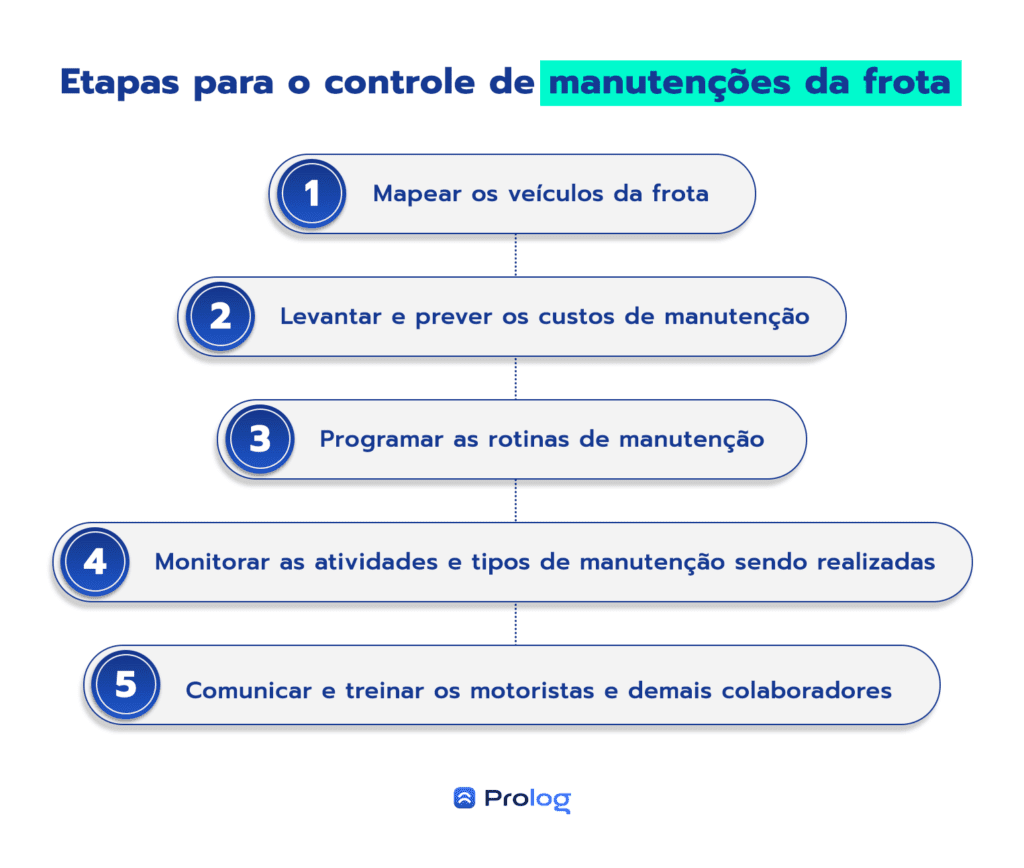
For this, you need maintenance management. Whether by manual control, spreadsheets or by acquiring a technology system, the processes of fleet maintenance control must be included in the routine of transport operations.
These processes go through five main steps:
- Map the fleet's vehicles: identify the vehicles, models and makes, as well as information on mileage driven, vehicle year, time in use, etc. Without this registry, no maintenance interval can be calculated, because there is nothing to count from.
- Survey and forecast maintenance costs: checking invoices and services carried out in the previous period will help forecast the average amount that will be spent on the next maintenance, in the same period.
- Schedule the maintenance routines: define inspection tasks and the completion of checklists, who will be responsible for each activity and how often it should happen.
- Keep track of the activities and types of maintenance being carried out: check whether the defined activities are being carried out correctly, the results they are generating, whether they need improvements and what those improvements are. Also, see whether corrective maintenance is under control — keeping track of the ratio between corrective and preventive maintenance over the months helps you see whether the plan is working.
- Communicate with and train drivers and other employees: bring in training and development so that employees understand the importance of maintenance processes and how fundamental their contribution to the activities is.
To learn more about the tasks and the importance of maintenance management in your fleet, download our complete free guide on the subject (in Portuguese).
You can also watch the video we prepared on the subject (video in Portuguese). Click and watch!
Frequently asked questions
What are the types of fleet maintenance?
What is the difference between preventive and predictive maintenance?
What is corrective maintenance?
What is the best type of maintenance for the fleet?
Do you need to do all types of maintenance?
How do you control fleet maintenance?
// newsletter
Fleet management content, straight to your inbox
Articles on tires, maintenance and fleet operations. No spam.


