Types of truck tires: 5 options and when to use them
 Luiz Felipe 8 min read
Different types of truck tires can be used in your operation to meet different objectives. You do not need, and should not choose, just one tire type for all your transport operations.
Each situation requires specific tire characteristics. For example, a long trip on state highways calls for a tire with less resistance to the road, while an urban delivery route requires more reinforced tires.
Through tasks such as tire inspection, you collect data and make decisions that bring fleet improvements. Knowing tire types, consulting manufacturer specifications and understanding when to use each is essential to keep the fleet fully operational.
See below:
- What types of truck tires are there?
- Comparison of truck tire types
- New truck tire models
- Factors influencing truck tire types
- How to choose between different truck tire types
- What is the best truck tire type?
- How to manage truck tires
What types of truck tires are there?
High severity
These are the hardest and heaviest truck tires, meaning they have greater resistance to damage than other types.
They are designed to withstand intense acceleration and braking, as well as temperature increases, providing greater stability during maneuvers.
While they have basic ground grip, they require more engine effort to roll.
When to use: Ideal for urban routes with multiple stops. They are widely used in urban distribution and passenger transport vehicles.
Medium severity
Medium-severity tires suit vehicles operating on both paved and dirt roads, or on routes with many bends and slopes.
Before fitting them, check whether one road type predominates, whether the stretches have similar distances and whether the selected model makes sense for the operation.
In general, they provide a balance between resistance and speed, as an intermediate option between high- and low-severity tires.
When to use: On regional trips. Since the category can overlap with mixed use on some routes, consider the predominant surface, actual vehicle operation and manufacturer recommendations.
Low severity
With a lighter structure, these tires offer advantages and disadvantages.
They are designed for better grip on pavement, resulting in greater acceleration efficiency and fuel savings, as well as easier maneuverability.
On the other hand, they withstand less weight and heat and are more susceptible to damage on damaged or rocky roads.
When to use: On long trips over straight paved roads and expressways, provided the model suits route conditions.
Off-road
Designed to cross aggressive terrain, off-road tires have reinforced construction, with a wider, taller tread. They differ from ordinary road tires and are made to withstand extreme terrain conditions.
When to use: They should not be the first choice for paved roads. They are ideal for rough locations with extensive rocks and dirt, such as mining operations.
Mixed-use
Mixed-use tires combine characteristics of road and off-road tires.
They are ideal for routes alternating paved and dirt roads, offering a versatile solution to avoid risking premature tire loss.
When to use: On routes alternating paved and dirt roads. They are commonly used on garbage trucks and agricultural vehicles. Consider which road type predominates and compare actual route use with manufacturer specifications, because medium-severity, mixed-use and off-road tires serve different situations.
Want to see this in your fleet? Talk to a Prolog specialist
Truck tire type comparison table
| Tire Type | Main Application |
| High Severity | Urban routes |
| Medium Severity | Regional trips or routes with varying surfaces |
| Low Severity | Highway routes |
| Off-Road | Dirt roads and aggressive terrain |
| Mixed-Use | Routes alternating paved and dirt roads |
New tire models emerging
Technological advances have also reached truck tires, bringing new models for different operating conditions and even sustainability needs. See the main ones:
Green tires
Green tires are designed to be more environmentally friendly, using low rolling resistance materials that help reduce fuel consumption and CO₂ emissions.
They are manufactured with high-tech rubber compounds that provide less wear and greater durability.
They are therefore ideal for fleets seeking to reduce operating costs and adopt more sustainable practices, provided the selected model is compatible with the operation.
Self-sealing tires
Self-sealing tires contain an internal layer of sealant that automatically seals punctures and small cuts in the tread. This reduces the need for repairs and minimizes vehicle downtime.
Their main advantage is a lower risk of unexpected stops, working very well for urban and rural operations where puncture risk is high.
Factors influencing truck tire types
Terrain type
The terrain where a truck operates is one of the main factors influencing tire choice. Rough terrain, dirt roads and paved surfaces require different tire characteristics.
Rough and off-road terrain, for example, requires reinforced tires with high resistance to damage. Paved roads, in turn, require good grip and low rolling resistance to save fuel.
Distance traveled
In addition to road type, consider the distance to be traveled on the route. For long distances, it is better to use tires offering durability and low fuel consumption.
On shorter routes, tires should provide good traction and maneuverability — especially on urban routes.
Load carried
The amount and type of load a truck carries can determine tire choice. Unsuitable tires can wear more quickly or even fail under heavy loads.
Heavy loads generally require tires with higher load capacity and wear resistance, while light loads allow lighter, more efficient tires. In every case, manufacturer specifications should guide the decision.
Weather conditions
Tires designed for specific conditions offer better performance and safety. In cold, wet climates, it is essential to use tires with good traction on wet surfaces and the ability to operate at low temperatures.
For hot climates, on the other hand, choose tires that resist heat and provide durability at high temperatures.
How do you choose between different types of truck tires?
Assess operating conditions
The first consideration is the conditions in which trucks regularly operate. As discussed, terrain type, distance traveled, stop frequency and whether pavement or dirt predominates are determining factors.
For example, if a route is mostly paved, medium- or low-severity tires are preferable, depending on route conditions and the selected model. If dirt roads and aggressive terrain predominate, assess off-road tires.
On routes alternating paved and dirt roads, mixed-use tires are the best choice, always comparing the tire type with actual route conditions.
Consult manufacturer specifications
Each tire manufacturer provides detailed specifications for the types it produces. Consult them to ensure the selected tires meet your fleet’s specific needs.
In addition to the tire’s commercial category, check the recommended pressure for the vehicle. Using exactly the manufacturer’s recommended pressure helps avoid decisions based only on habit or a fleet average.
Check availability, quality and cost
Tires from renowned makes generally offer better performance and durability, but may have a higher initial cost. However, tire cost-effectiveness should be assessed over the long term.
Tire availability is important to ensure you can replace tires quickly when needed.
What is the best type of truck tire?
Although some tires adapt to different situations, no single tire type is ideal for all of them.
There is therefore no single answer to this question: assess conditions of use, load type, climate, each route’s specific requirements and manufacturer guidance.
Even so, carrying out the necessary analyses and making an informed decision is essential, as this brings more benefits to your operation, such as fuel savings, less tire wear, greater safety and more vehicle uptime.
How do you manage truck tires?
Effective truck tire management requires a suitable maintenance routine, keeping track of records and performance analysis. This includes:
Maintain a preventive maintenance schedule
A preventive maintenance schedule helps avoid unexpected failures and extends tire useful life. This covers activities such as tire rotation, alignment and balancing.
In addition, include periodic tire pressure checks and visual inspections to detect possible cuts, bulges or uneven wear. Pressure must follow manufacturer recommendations exactly and be checked every two to four weeks, always before longer trips or when carrying additional loads.
Perform regular tire inspections
Checking pressure and tread depth and looking for visible tire damage helps ensure tires are always in ideal conditions for use.
Drivers can perform surface-level inspections before each trip, and maintenance technicians at intervals scheduled by the fleet according to operation type, route criticality and applicable recommendations. The routine thus stops depending on a generic timeframe and reflects each operation’s actual risk.
Using precise measuring tools, such as an electronic tread probe, helps make the process faster and achieve better results in managing different truck tire types.
Establish tire policies
Defining clear tire replacement policies based on criteria such as minimum tread depth, tire age and conditions of use helps maintain safety and operational efficiency.
Implement a tire management system
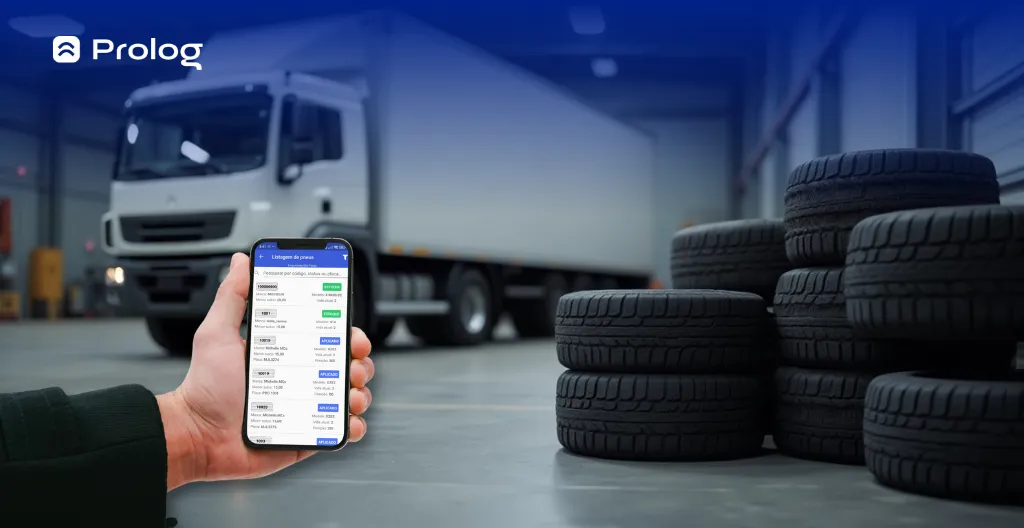
A tire management system, such as Prolog App, makes it easier to keep track of and analyze tire records, centralizing information entered during inspections about pressure, tread depth and other important metrics.
This data is fundamental to making informed tire maintenance and replacement decisions.
Integrate tire management with fleet management
Integrating tire management with other aspects of fleet management, such as vehicle maintenance and fuel control, provides a more complete view of the operation and allows resources to be optimized more effectively.
Want to see how Prolog App can transform fleet tire management? Schedule a free demonstration of our solution.
Frequently asked questions
Which truck tire type is most widely used in Brazil?
Can I use off-road tires on paved roads?
How often should fleet tires be inspected?
What are green tires and self-sealing tires?
Is there a tire that suits the entire operation?
What should I consider before buying a batch of tires?
// newsletter
Fleet management content, straight to your inbox
Articles on tires, maintenance and fleet operations. No spam.