Bus maintenance: essential inspection items
 Jade Zart 10 min read

Buses are essential vehicles for the daily transport of passengers, whether on urban, intercity or interstate lines, charter services or tourism. In any operation, they need to run safely, regularly and comfortably, and the best way to sustain that standard is through well-planned bus maintenance.
The good condition of a passenger transport vehicle is indispensable. It protects drivers and passengers, helps reduce unexpected stops and also shapes how travelers perceive the company.
Below, you will learn:
- The importance of bus maintenance;
- How to do efficient bus maintenance;
- The most important items in a bus inspection;
- How to prepare for servicing in periods of high demand;
- Tips for carrying out bus maintenance;
- Tools that can help with bus maintenance.
The importance of bus maintenance
It is essential for buses to work properly to avoid accidents, delays and losses in passenger transport.
Regardless of the distance they travel, these vehicles need to offer comfort and reduce the risk of people getting hurt or harmed along the way. Cases of buses breaking down on the highway are not rare and, to a large extent, can be prevented when maintenance is done correctly.
In addition, for the company, good maintenance control contributes to benefits that every operation pursues: lower costs, higher productivity, greater fleet availability and longer vehicle useful life.
How to do efficient bus maintenance
Bus maintenance becomes efficient when it is well planned and then carried out according to that plan. The foundation of a maintenance plan for bus fleets is preventive routines, such as vehicle inspections, tire checks, keeping track of safety items, servicing critical components and recording what was found.
Once this plan is ready, everyone needs to know which tasks they must perform when carrying it out, and the importance of each role in keeping the vehicles and the operations running needs to be reinforced.
Drivers, fleet assistants, supervisors and the maintenance team must know their duties and perform them as planned. Whenever there are doubts or disagreements, the fleet policy should be available to clarify the procedures, responsibilities, deadlines and release criteria for each vehicle.
All these factors combined bring the productivity and efficiency that fleets need to deliver better results to the company. In passenger operations, this care is also directly tied to the regularity, continuity and safety expected of those who transport people every day.
Want to see this in your fleet? Talk to a Prolog specialist
What are the most important items in a bus inspection?
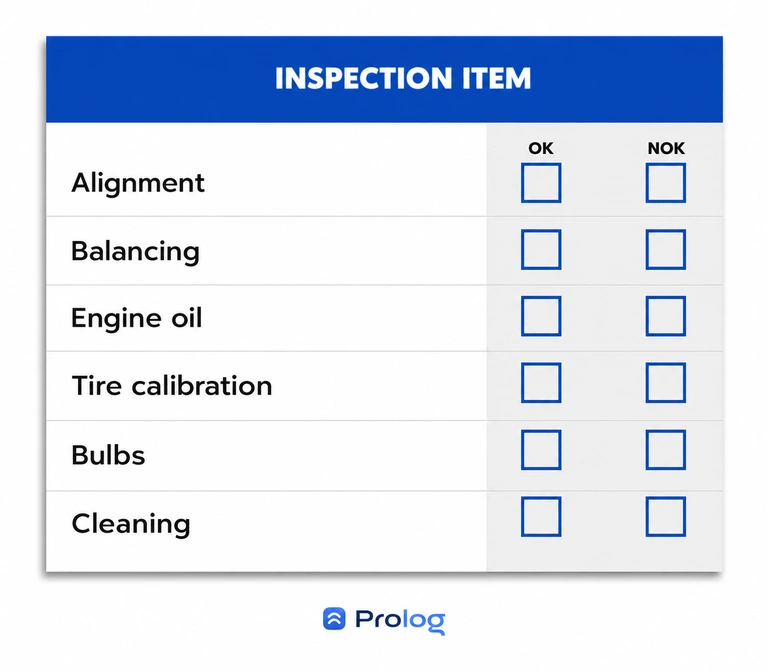
In a bus maintenance plan, the vehicle inspection checklist is indispensable. Make sure to create different templates for each routine: quick inspections before and after trips, daily safety checks and more complete checklists for periodic servicing, monthly or yearly, depending on the operation, the vehicle type and the technical recommendations adopted by the fleet.
Some items that cannot be left out of a bus checklist are:
Alignment and balancing
These are two processes to keep vibration to a minimum and to increase the safety and economy of the vehicles. On buses, they also help preserve tires and suspension components, which suffer heavily from weight, constant running and road irregularities.
They should be done when the bus shows symptoms of imbalance or “sway” on the road, especially in curves. They also deserve attention after hard impacts in potholes, when there is irregular tire wear and/or when tire rotation is carried out.
During alignment, it is important to check whether the vehicle's parts are worn and whether the springs and shock absorbers are working properly. If the fleet records occurrences in a checklist, it becomes easier to notice repeated symptoms and decide whether the vehicle should go to maintenance before returning to the route.
Engine oil
Do you know what engine oil does? It is an essential item for lubricating the metal parts and allowing them to work properly. If the engine runs dry or works with the wrong oil, its structure can be damaged and the vehicle's performance can even be affected, causing premature wear.
That is why oil control should not depend only on a casual reminder or on mileage written down without a standard. Ideally, keep track of the change history, follow the maintenance plan defined for the bus model and include checking the level and possible leaks in the vehicle release inspections. Before making the bus available for a route, check in the history when the last change was, whether there is a pending reported issue and whether a new inspection is needed before departure.
Tire calibration
Tires are one of the most important parts of transport: they are in direct contact with the ground and need to support the vehicle's total weight while absorbing impacts from the road surface and facing constant friction.
In other words, they need to be at the correct pressure to increase their efficiency, performance and useful life. Calibration is a mandatory inspection item in the maintenance of buses and of any vehicle, but it should be handled together with other checks, such as the analysis of wear, cuts, bulges, objects stuck in the tread and the condition of the valves.
Lights
All the lights, inside and outside the vehicle, must be working for safe transport. The maintenance checklist should include the inspection of headlights, reverse lights, turn signals, position lights, interior lights, brake lights and other signaling items.
Besides affecting safety, lighting failures can delay the bus's departure, create rework and damage the operation's image. When the driver records the nonconformity before the trip, the maintenance team can prioritize the repair and keep the problem from being noticed only during the journey.
Cleaning
Since this is passenger transport, cleaning is a crucial factor. Instead of depending on occasional care, cleaning needs to be part of the operation's routine, with defined people in charge, items to check and a record of what was done before the vehicle returns to service.
Some of the cleaning measures include:
- Complete interior cleaning of the vehicle;
- Seats, corners, curtains and upholstery are places of possible contamination by viruses and bacteria and should be prioritized;
- The air-conditioning filters must always be clean;
- The restroom needs to be completely sanitized before and after each trip.
For an even deeper and more efficient cleaning, the appropriate equipment and products should be chosen for each moment. It is also worth keeping a checking standard so the team knows what must be verified, in what order and with what approval criteria.
How to prepare for bus inspections in periods of high demand
An essential step to be well prepared for periods of high demand, such as holidays, summer vacations and special dates, is to anticipate demand. That is, analyze what the volume of demand was in previous years in each of these periods, what the increase was each year and which vehicles needed more interventions before, during and after these peaks.
This way, you can find an average of the expected demand forecast and cross-check that expectation with the fleet's actual availability, the teams' schedules and the repair shop's capacity.
Some other ways to be prepared are:
- Implementing process standardization in the fleet;
- Having the fleet and maintenance planning defined for the entire period;
- Identifying weak points in the management of previous periods and the appropriate solutions for each one;
- Testing, also in advance, the planned solutions and analyzing whether they really bring results in the day-to-day of transport operations.
Another good practice is to bring forward the servicing of the most heavily used vehicles, organize the maintenance queue by criticality and confirm that fast-moving parts will be available. This way, inspection stops being just a last-minute check and starts supporting the operation throughout the busiest period.
Tips for bus maintenance
Some tips to make the maintenance of your bus fleet easier and more practical:
Set a maintenance frequency
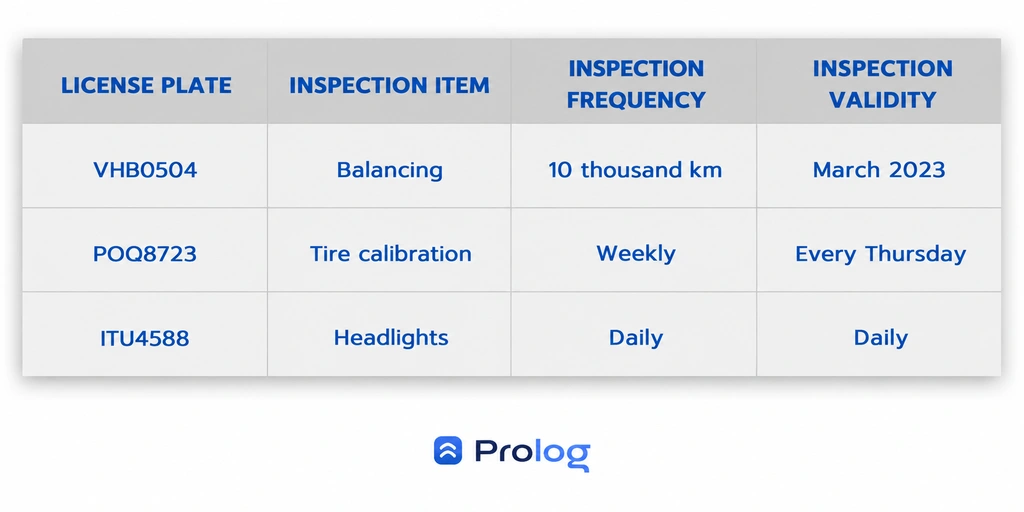
The two most common ways to plan your maintenance schedule are by time or by mileage. For example, every two weeks or every 10,000 km driven. What matters is that this criterion is recorded, tracked and revised when the reality of the operation changes.
Each item of the vehicle has different intervals for inspection, so identify which ones should happen together, more or less often. Also consider how the bus is used, how demanding the routes are, the age of the fleet and the failure history. Maintenance management can work with work orders by mileage or by date, which helps turn the plan into an executable routine.
Use technology for maintenance management
Turning to technology is a decision you will be glad you made every day. These tools are developed to increase fleet productivity, speeding up and standardizing all the processes of the routine.
With the electronic checklist, for example, preventive maintenance is made easier, because it makes the vehicle inspection task the same for all the drivers and/or mechanics who will carry it out. In a bus operation, the electronic checklist can be customized by vehicle and by routine, helping detect failures more quickly and open work orders when a nonconformity is recorded.
Another advantage is keeping records more organized. When inspections, reported issues and work orders are centralized, management can see more clearly what is pending, what has been resolved, which buses show recurring problems and which maintenance costs need to be watched more closely.
Hire qualified professionals, but also offer training
When hiring someone for your team, it is important that they have at least the theoretical knowledge of how a fleet works and understand the responsibility of working with passenger transport vehicles.
But even if hiring is based on each person's experience and knowledge, training should be planned and provided regularly. Train drivers to record failures clearly, mechanics to handle work orders to a standard and supervisors to keep track of indicators, deadlines and recurrences.
Control the parts inventory
Always keep an inventory of parts available to prevent vehicles from sitting longer in the repair shop.
Survey the main parts and which ones need to be replaced most often. Just like the forecast for periods of high demand, this survey helps you forecast monthly purchases of inventory parts.
Besides listing the parts, record incoming and outgoing items to keep track of the quantity available in the operation. This control reduces emergency purchases, prevents shortages of basic items and helps identify consumption that is out of line with expectations in certain vehicles or systems.
Tools that can help with bus maintenance
The spreadsheet is one of these tools, even though it is less practical and efficient. If you still have no form of control in the operation, it can meet the initial need to collect data and have more concrete information for analysis and decision-making.
However, you should prioritize acquiring technologies such as an electronic checklist and a maintenance management system.
In these systems, several tasks are automated, such as opening work orders, organizing data, creating reports and the maintenance history. The visibility and agility they bring to the routine help take maintenance out of improvisation and put it into a flow that management keeps track of.
For bus fleets, look for tools that let you create specific checklists by vehicle type, track plans by date or mileage, control maintenance costs and record the parts inventory from incoming and outgoing items. That way, the daily inspection, the repair shop and management start working from the same information base.
Start managing the maintenance of your fleet's buses with our checklist made specifically for this — download it for free now (in Portuguese).
Frequently asked questions
Which items cannot be left out of a bus checklist?
When should a bus get alignment and balancing?
How often should the engine oil be checked?
How do you prepare for periods of high demand?
Spreadsheet or system: what should you use to control maintenance?
Why keep a parts inventory?
// newsletter
Fleet management content, straight to your inbox
Articles on tires, maintenance and fleet operations. No spam.