How to choose fleet tires: 10 criteria
 Jean Zart 12 min read

Every fleet manager should know how to choose tires for the operations they oversee. However, many managers still struggle to find the model offering the best value for money for each vehicle type, route and condition of use.
Knowing the differences between tire types is essential at purchase time, both to select a model better suited to urban roads or long-distance trips and to understand which design, load capacity and grip best match each operation.
With that in mind, we have brought together ten criteria you should consider when choosing tires for your fleet:
- Manufacturing date
- Tire classification
- Type of route traveled
- Tire load and speed rating
- Traction classification
- Tread type
- Tread depth and TWI
- Impact on fuel consumption
- Weather and road conditions
- Long-term value for money
How to choose fleet tires: assessment criteria
1. Manufacturing date: what should you look at?
It may seem like a detail, but the tire’s manufacturing date is a factor you should consider. It helps you understand how long ago that tire left the factory and should be analyzed alongside its overall condition, intended application and your operation’s purchasing guidelines.
The main point is not to treat the date as an isolated, absolute criterion. In tire management practice, a more confident purchasing decision considers the manufacturing date alongside the other criteria in this guide, such as classification, route, load, speed, traction, tread, tread depth, consumption and value for money.
Tires stored for long periods deserve attention before joining the fleet. So, however strong and durable the tire and all its constituent materials are, the best option is to know when it was manufactured and assess whether the purchase makes sense for the operation.
This way, you avoid buying a tire that has been in inventory for a long time without considering whether it suits the vehicle type, route, load and expected performance.
Therefore, when choosing tires, check the manufacturing date on the sidewall, assess the overall condition and do not base the decision only on a fixed age rule. The date matters, but should be part of the same analysis as the fleet’s other technical and economic factors.
2. Tire classification: what is the right category for your vehicle?
Each tire has a specific classification according to vehicle type. Knowing how to choose truck tires means paying attention to these classifications before comparing price, make or availability in inventory.
On the sidewall of tires there is a code whose first item is a letter. The 4 letters you may find represent a vehicle category:
- P: Indicates that the tire is for passenger cars.
- LT: Means the tire is for light trucks and sports and large cars.
- ST: Tires recommended for trailers and motorhomes.
- C: These tires are used on trucks, vans and large pickups.
It is important to know this classification to ensure you are using the correct tire for each fleet vehicle, avoiding excessive wear, loss of performance and a purchase that looks economical initially but does not suit the operation’s actual profile.
3. Choosing tires by route type
Route type should be one of the first factors considered when choosing tires for the truck fleet. Road conditions directly influence tire wear and performance.
There is no mystery here:
- Highway tires: for medium and long distances, with good resistance to heat and wear.
- Urban tires: ideal for short distances and urban journeys, which require greater durability.
- Mixed-use tires: suitable for both paved and dirt roads.
- Light-vehicle tires: recommended for small trucks, vans and minibuses.
Combining this information with tread types allows you to determine which tires should be purchased for the fleet, aiming both to optimize tire performance and reduce operating costs. On severe routes, for example, real savings do not come only from a lower purchase price, but from the ability to withstand the surface, preserve the casing and maintain good vehicle availability.
4. Load and speed rating: are you paying attention to these details?
Trucks carry large loads, so knowing how to choose tires with the correct load rating is essential. This information, found on the tire sidewall, helps ensure that the chosen tire can support the load the truck carries, avoiding premature wear.
Since different tires support different loads, you should know the tire load index table:
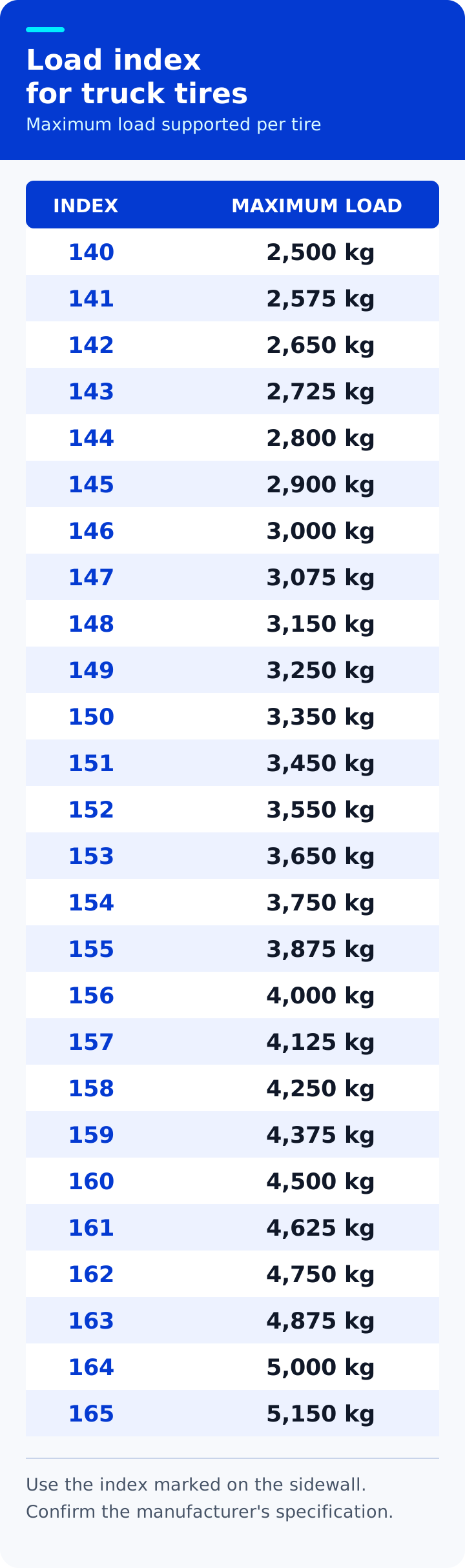
Consult the same values in a text table.
Find out the maximum supported load by analyzing the tire sidewall and this table.
The same applies to speed, represented on the tire sidewall by a letter. To identify its value in km/h, we also use a table:
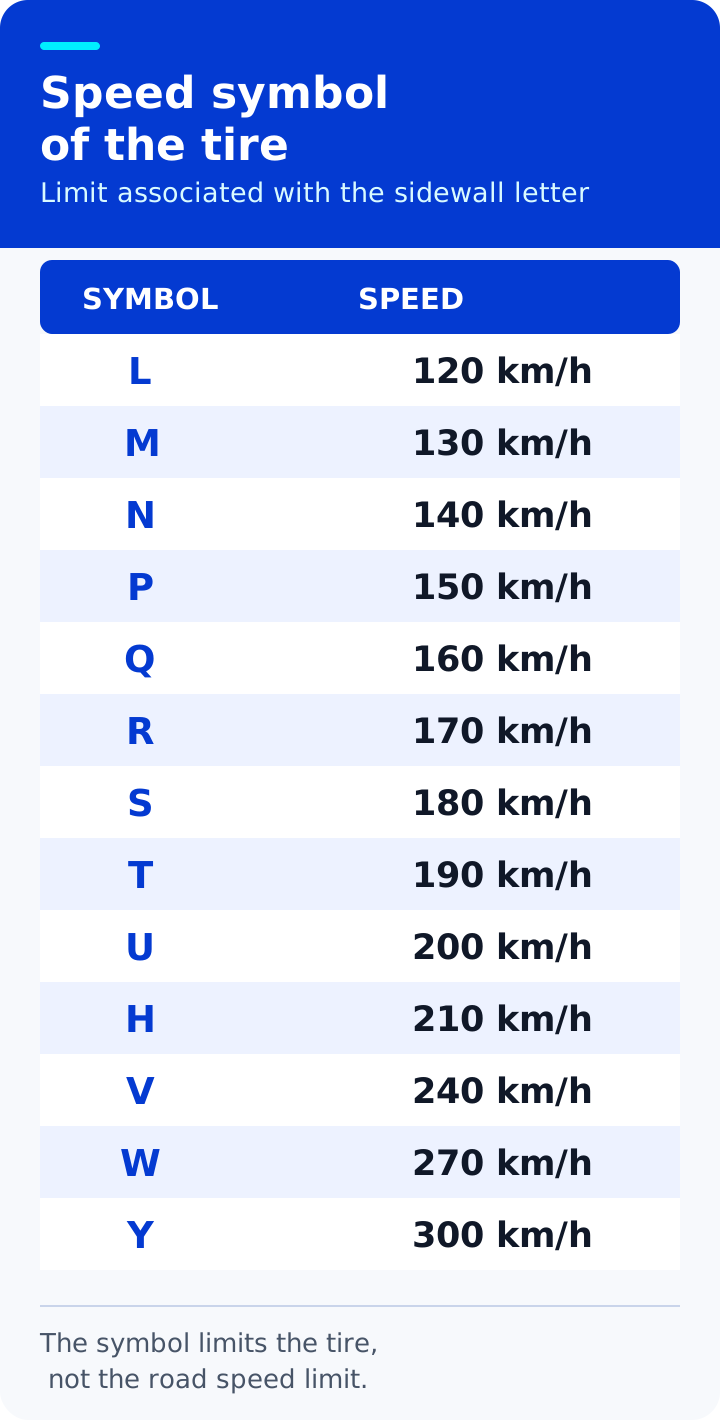
Consult the same values in a text table.
Check the tire sidewall and interpret the letter to find its maximum rolling speed.
Note: the tire speed limit is unrelated to highway limits, so drivers must pay attention to and respect the limits of each route.
5. Traction and rolling resistance
Tire traction determines its grip on the ground, which is fundamental when choosing tires for long-distance trucks or adverse driving conditions.
Tires with good traction offer greater safety, especially on wet roads. Rolling resistance, in turn, directly influences fuel consumption.
This data is found on the INMETRO (Brazil’s metrology institute) label on new tires, which provides rolling resistance and wet-road grip information.
Rolling resistance is rated from A to F: the closer to A, the better its energy efficiency and the lower its fuel consumption.
Wet-road grip is represented on the label by letters from A to E, with “A” again providing the most grip.
Tires with lower rolling resistance are more energy-efficient, which may generate savings over the long term. When choosing fleet tires, always seek models with the best combination of traction and energy efficiency, without losing sight of the route, load, mounting position and safety.
6. Tread: what is the ideal type for your operation?
The tread is responsible for traction and water dispersion, ensuring safety and performance under different road conditions. There are various tread types, such as:
- Directional or unidirectional: these have arrows on the rubber indicating the correct tire mounting direction. This design offers high protection against hydroplaning, good behavior on snow and mud, and good stability at higher speeds.
- Bidirectional: the groove patterns of these tires point in two different directions, aiming to generate more traction with the ground.
- Symmetrical: the patterns are identical on both sides of the tire in this tread, and it is the model most used on vehicles because it provides smooth driving, directional stability and low rolling resistance.
- Asymmetrical: this tread model combines different patterns on the inside and outside of the tire. The aim is to favor handling, cornering stability and wet-surface grip.
- Off-road: this tire type focuses on vehicles that encounter roads with dirt, mud and debris. To that end, its grooves are deeper.
The tread is also directly related to tire tread depth, which brings us to the next topic. In practice, pattern, depth and application need to be analyzed together to prevent a technically good tire from being used in conditions it was not designed for.
7. Tread depth and TWI: avoid driving with bald tires
Grooves are the standardized patterns found in the tread. Generally, the deeper the groove, the greater the tire’s ability to handle certain surface conditions, although correct application also depends on the pattern, position and route type.
Most commonly, trucks use tires with an average tread depth of between 10 and 20 mm when new. Some can reach up to 23.5 mm to reduce damage to the rubber and be even more resistant.
Vehicles traveling longer distances, with non-driven or steering axles, may have tires with an average tread depth of 14 mm.
Tread depth also indicates the tire’s wear level and, under Brazilian law, the minimum depth limit is 1.6 mm; below this, the tire must be replaced.
This is because that measurement indicates a tire is about to become “bald” and completely lose its grip on the ground. Even though that value is mandatory in Brazil, our recommendation is: do not drive with a tire whose tread depth is below 3 mm.
This measurement is ideal for removing the tire from operation and retreading it to use it longer in operations, preserving the casing for a new useful life when it is in suitable condition.
More modern tires come equipped with the TWI (Tread Wear Indicator), a marking on the tread indicating when the tire has reached its wear limit. When the indicator is level with the tread, it is a sign that the tire should be replaced.
However, there are other ways to measure its depth, such as an electronic tread probe. This is a device that helps measure how many millimeters of tread depth the tire still has; with this record, management can keep track of wear progression more accurately.
Through these measurements, the data entered into the system, together with other information such as acquisition cost, age and the vehicle on which it is installed, is also analyzed to understand the tire’s performance throughout its useful life.
This provides the most valuable information that brought you here: the tire offering the best value for money for your transport operation.
8. The impact of tire choice on fuel consumption
Tire choice directly influences your fleet’s fuel consumption. Tires with low rolling resistance, for example, are designed to reduce the amount of energy needed to move the vehicle, reducing friction with the road and consequently saving fuel.
Low-rolling-resistance tires have harder rubber compounds and designs that minimize deformation during use, reducing the effort needed to keep the truck moving.
As a bonus, tires with low rolling resistance also contribute to operational sustainability, since less fuel means fewer carbon emissions.
When choosing fleet tires, consider opting for models with good rolling resistance ratings without compromising grip and safety. Selection also needs to take account of expected casing durability and the possibility of refurbishment, because these factors contribute to the tire’s total cost over time.
9. Weather and road conditions: how they affect tire choice
Weather and road conditions play a fundamental role in choosing suitable tires for your fleet. Operations in rainy climates, on dirt roads or in regions of extreme heat require specific tires offering greater safety and durability.
For routes through regions with frequent rain, choosing tires with good wet-road grip is essential, as this improves braking and vehicle stability, reducing accident risk. Asymmetrical patterns, for example, can offer good grip in wet conditions, while directional patterns help protect against hydroplaning.
If the fleet operates in rural areas or on unpaved roads, tires with off-road treads and deeper grooves are more suitable because they offer better traction and resistance to damage from stones and mud.
In regions of extreme heat, tires should have greater heat resistance to avoid accelerated wear and performance problems.
When planning tire purchases for your fleet, consider the weather conditions and the most common terrain on the routes traveled, ensuring the ideal tires are chosen for each scenario. It is also worth recording performance by route and application, because this comparison helps distinguish a genuinely efficient choice from a decision based only on impressions.
10. Long-term value for money: savings or safety?
When choosing fleet tires, many managers focus only on the purchase price, but it is crucial also to consider long-term costs and benefits in terms of safety and performance.
Cheaper tires may seem an economical solution, but they generally have lower durability and may require more frequent replacement, as well as not offering the same safety level. Higher-quality tires, in turn, tend to last longer and provide better performance, reducing operating costs over the long term.
When comparing tires, assess not only the purchase price but also durability, performance under different road conditions and fuel consumption, maintenance and refurbishment costs. Retreading can help reduce tire costs and extend the casing’s useful life when the tire is in suitable condition for it.
This is also one of the aspects reinforcing the importance of keeping track of data for each tire type and tire model. Over time, you will gather enough information to understand which perform better under the conditions your operation faces.
How can you convince management to buy the best tires?
Convincing management to invest in the best fleet tires requires balancing the presentation of technical data with the ability to translate those figures into practical and financial results.
One of the first steps is gathering clear, straightforward information about tire performance, focusing on cost per kilometer driven and cost per hour worked. These figures should be well supported by comparisons between different models and makes, tested in similar conditions to ensure a fair and impartial analysis.
Presenting this data clearly allows purchasing managers, who are usually more focused on cost reduction, to see the benefits of opting for better-quality tires.
Besides direct costs, it is crucial to highlight the impact of factors such as retreadability rate, damage rate and loss-due-to-damage rate.
These KPIs provide a view of tire performance over time, allowing management to understand that higher-quality tires can generate savings through greater durability and less frequent replacement.
Another strategic approach is highlighting how tire retreading can be a viable economical alternative, comparing the cost of retreading with new tires. When well managed, retreading can extend the casing’s useful life, maintain quality standards and reduce the financial impact on fleet operations. Refurbished tires can also reduce resource use and waste generation, strengthening the discussion of cost and sustainability.
To prepare adequately for a meeting with management, the tire controller should be able to communicate findings clearly and demonstrate command of the subject, supporting all arguments with the data found.
During the presentation, it is essential to remember that the purchasing decision-maker is usually not directly involved in fleet operations, so the focus can also be directed toward the tires’ total cost of ownership (TCO).
This concept helps clarify that investing in quality tires results in long-term savings, not only in the initial acquisition but also in operating and maintenance costs.
Want to use the tool from the company that became a benchmark for tire management in Brazil? Explore how it works and the complete system in a free online demonstration.
Frequently asked questions
What criteria should be used to choose fleet tires?
What do the P, LT, ST and C tire classifications mean?
Why does tread depth matter when choosing a tire?
How does the chosen tire influence fuel consumption?
How can management be convinced to invest in better tires?
// newsletter
Fleet management content, straight to your inbox
Articles on tires, maintenance and fleet operations. No spam.