
8 tips for smart tire management in your fleet
 Luiz Felipe 5 min read

Tire management tips involve changes to the routine, and adding new strategies can optimize the way you manage the fleet's tires.
These assets directly affect operational safety, productivity and savings, which is why you should focus your efforts on ensuring you are making smart, informed decisions in this area of fleet management.
Here are some tire management tips:
- Use an electronic measuring device for tread depth and pressure inspection;
- Calculate the tire replacement forecast;
- Identify the CPK of each tire make and model;
- Establish a driver training and incentive program;
- Monitor the conditions of the routes traveled;
- Store tires properly;
- Adjust the preventive inspection schedule;
- Manage tires through a tire control system.
1 – Use an electronic measuring device for tread depth and pressure inspection
An electronic measuring device makes the tire inspection routine much faster and more agile. With 99% accuracy, the depth of each groove is checked in a few minutes.
In other words, this technology also halves the time spent on this activity and ensures a positive increase in your fleet's productivity indicators.
Among the tire management tips, this is one that will bring major benefits and results for your fleet. After all, measuring tread depth is one of the most important activities in this area of management.
It is possible to adapt an electronic measuring device to measure tire pressure, because the device kit comes with the hose needed to make this adaptation.
This provides measurements that are also highly accurate and indicate how far tires are above or below the ideal calibration pressure. This information makes it possible to make adjustments to achieve the ideal performance of each tire make and model.
2 – Calculate the tire replacement forecast
Choosing to remove tires while they still have 3mm of tread depth is an action many managers have already adopted, and if that is not your case, it is time to implement it too.
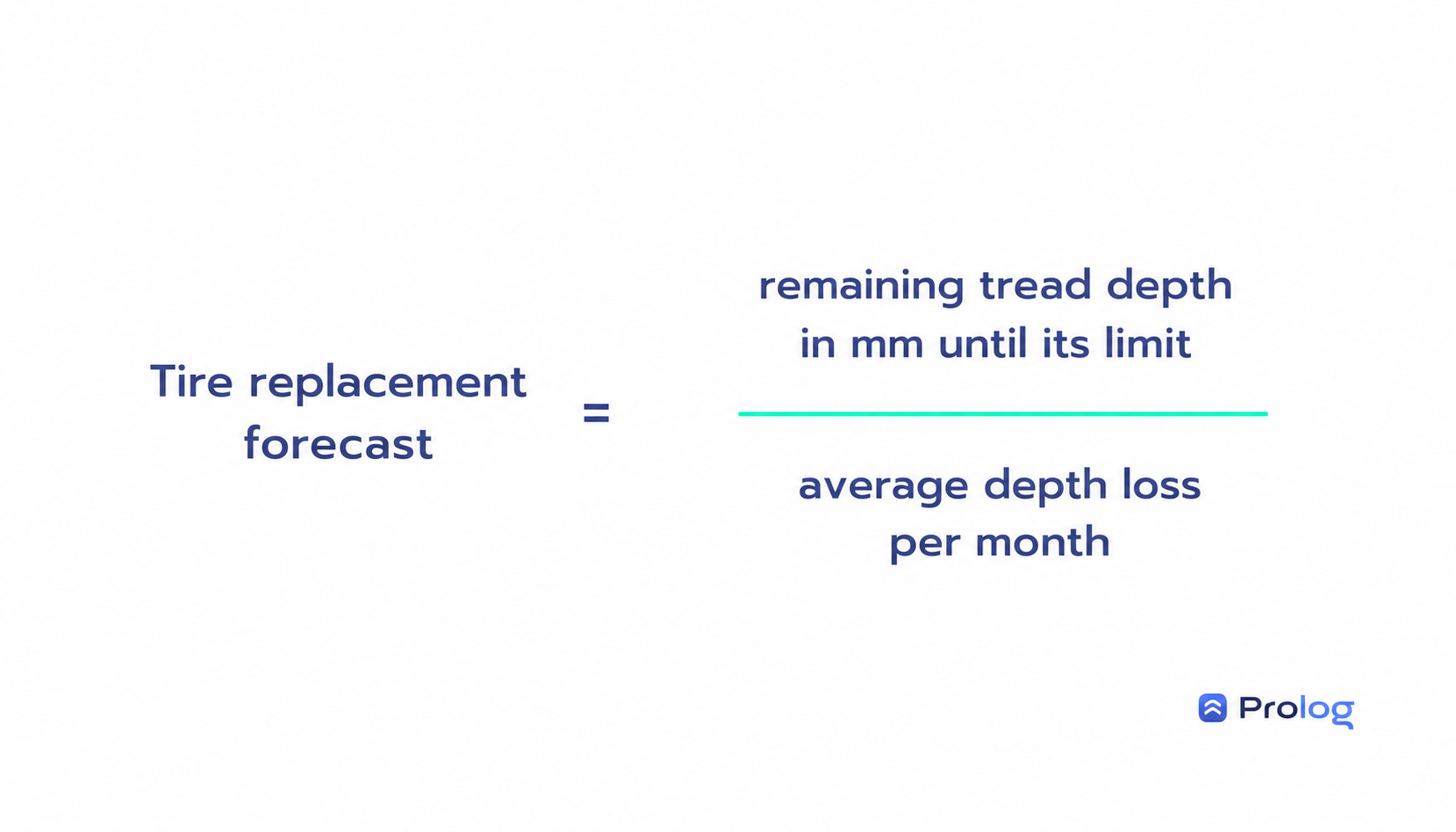
To know when this will happen and plan both the tire demounting service and retreading of the asset to be removed, you need the replacement forecast calculation.
This average is calculated from the tread depth measurement remaining before its limit and the average loss of depth over the months of use:
3 – Identify the CPK of each tire make and model
Understanding the Cost per Kilometer (CPK) of each tire is one tire management tip you cannot ignore. When buying a new tire, the focus should not be on the lowest price, but on the value for money that tire model provides for your operation.
That is why identifying which make and model performs best in terms of durability and savings helps you make more well-grounded decisions—and ones that are actually reducing your operating costs.
4 – Establish a driver training and incentive program
Encouraging and training drivers to adopt proper vehicle driving practices is fundamental to tire management.
Acceleration and braking while driving affect tire performance and can lead to irregular wear. In addition, driving at high speed on roads with potholes and debris (such as dirt roads) causes other types of damage, such as cuts, punctures and even bulges.
That is why providing driver training and encouraging good driving practices can contribute to tire durability and preservation.
Through an incentive program, you can reward drivers who achieve better results both in this respect and in others, such as completing the daily vehicle checklist.
5 – Monitor the conditions of the routes traveled
Brazilian road conditions greatly affect tires, as most of these roads are in poor condition. Monitoring the routes traveled and their conditions is a task that can help anticipate wear and adopt preventive measures.
One possible action when you notice excessive tire wear on a particular route is to use more resistant tire models. This is an option for reaching a destination with no alternative route.
Although it is not directly related to looking after fleet assets, this is one tire management tip that will make a difference to the organization and control of your operation.
6 – Store tires properly
Proper tire storage may not seem so important, but it contributes to tire preservation, preventing premature wear and damage. So provide a suitable, safe environment, away from heat sources and exposure to weather conditions.
Also, plan tire use to decide on vertical or horizontal storage.
Tires that will be installed soon can be positioned horizontally without a problem. If storage time exceeds 4 weeks, the best course is to move the tire upright and, preferably, about 1 meter off the ground.
7 – Adjust the preventive inspection schedule
The preventive inspection schedule should be adjusted according to changes in the results you are obtaining. If a very drastic change is noticed, you need to shorten the inspection interval and investigate the cause of that result more closely.
On the other hand, if results prove stable, you can space inspections further apart and optimize your team's time.
8 – Manage tires through a tire management system
Tire management technology provides control from the operational stage of data collection through to strategic, decision-oriented management in data analysis and action planning.
This system is a differentiator for your fleet and should be used as a strategy to reduce costs and increase tire durability.
Here is another entry on the list of tire management tips, with details on how to determine the ideal time to perform each task and identify the tools needed:
Get our Tire Management Map. This model follows the Prolog methodology and identifies all the actions and requirements for carrying them out and getting the best results for your fleet. Click here to download it (in Portuguese)!
Frequently asked questions
What should you look at when choosing a fleet tire?
How can you know in advance when each tire will need replacing?
What changes when you use an electronic measuring device in tire inspections?
The fleet's tires have irregular wear. What could be behind it?
How should tires that are sitting in inventory be stored?
How often should tires be inspected?
// newsletter
Fleet management content, straight to your inbox
Articles on tires, maintenance and fleet operations. No spam.


