
Tire pressure gauge: models and prices
 Luiz Felipe 7 min read

For tires to better reach their useful life, some specific care is needed. One of these steps is using a tire pressure gauge in the fleet's routine to keep track of pressure. A good reference is to do this check every week or, at the very least, once a month and before long trips, always with the tires cold whenever possible.
Actions like this are what give clearer answers about what to do to reduce operating costs. In addition, correctly calibrated tires contribute to more safety, better durability and lower fuel consumption.
By following the practice of tire pressure control, you can raise or lower the tire calibration in PSI as needed, but, in this case, it is also important to analyze the tread depth measurement and other signs of wear.
In fact, there is a way to measure both pressure and depth at the same time, which helps make the inspection more complete.
What is a tire pressure gauge?
(video in Portuguese)
View this post on Instagram
(video in Portuguese)
It is a tool, manual or digital, used to check a tire's calibration pressure at the moment of measurement. This pressure is usually read in PSI, and it can also appear in bar depending on the equipment used. The product may also be called a pressure meter, a manometer or a tire gauge.
How does a tire pressure gauge work?
We can find different gauge models on the market, and some variations may occur. On the most common ones, the measurement is taken by connecting the instrument's hose or fitting to the tire valve. Then the person in charge reads the result on the display, on the dial or in the system used by the fleet.
Why do you need to use a tire pressure gauge?
Tire calibration is essential to prevent irregular and/or accelerated wear, as well as to define a wear limit the tire can reach. It also helps avoid fatigue, excessive heating and internal damage caused by low pressure. Incorrect pressure can even affect the durability of the vehicles.
The tire helps cushion the impact on other components of trucks and buses. So, if the tire is underinflated, the chances of damage to the vehicle's structure also increase.
In addition, low pressure increases rolling resistance and can lead to higher fuel consumption. A lack of adequate pressure also hurts the tire's grip, especially on wet roads.
Running with low pressure is usually a sign that tire control is not being done correctly. However, there are other reasons for pressure to drop even when measuring and calibrating as needed:
- Due to climatic changes in temperature;
- Due to calibration with the tire hot;
- Due to a puncture in the tire or air leaking through the valve.
With high pressure, on the other hand, the risks lean more toward safety and tire preservation. Excess pressure can increase the chance of cuts, punctures or damage when going over obstacles, in addition to concentrating wear in the center of the tread and compromising retreading opportunities.
In this case, the best prevention is for drivers to respect the measurements set by the fleet's tire manager and for the reading to be taken with a reliable instrument, within a clear inspection routine.
Is it worth having a tire pressure gauge in the fleet?
Yes, it is. It is a practical way to control tire pressure while building a knowledge base for the fleet.
The analytical approach in fleet management is growing more and more and, for it to deliver the expected results, there needs to be reliable data to analyze. For tires, this base starts with consistent records of pressure, tread depth, wear and corrective actions.
That way, the tire pressure gauge is not only worth it, but becomes essential for operations that want to move away from informal control and make decisions based on what was measured in the field.
What are the models of tire pressure gauge?
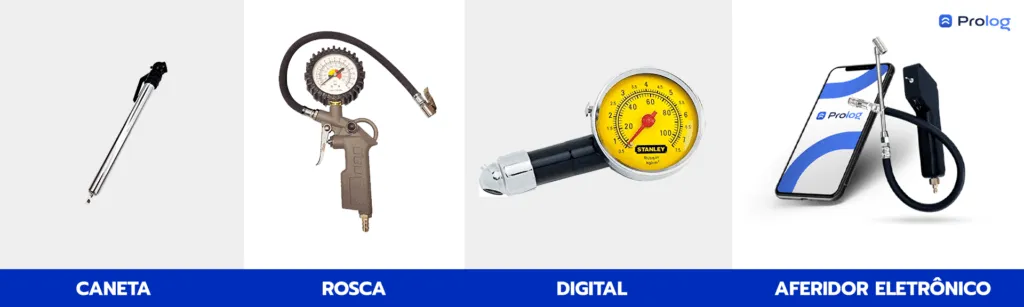
Types of tire pressure gauge.
Pen-type
The pen-style gauge is an analog model, which means you have to take the reading yourself, without automation.
It usually stands out for its low price and good performance, although it is not practical when it comes to use in large fleets or in routines that require a history of the measurements on record.
Screw-on
Another model in which tire pressure measurement is done manually. The driver or employee in charge needs to screw the gauge's hose onto the tire valve and read the pressure on the “dial”.
Most of these models also work as a tire inflator, but they tend to be more common in simple applications and light vehicles.
Digital gauge
The digital gauge is a more attractive alternative for vehicle fleets. It needs to be fitted manually onto the tire valve, but the reading appears on the digital display and tends to reduce interpretation errors compared with some analog models.
Electronic tread probe
(video in Portuguese)
The electronic tread probe model is one of the trends in tire management and should gain ground in fleets that need more productivity, an inspection history and standardized control.
Here at Prolog, the tool is developed by our own team. It is a tire pressure gauge used by a person during the inspection to collect pressure and tread depth data with high accuracy.
For the pressure inspection, you use the hose you receive in the inspection kit sent after purchase.
After attaching it to the inspection gun, the person in charge connects the equipment to the tire valve and takes the measurement. The inspection record can be sent to the system through the app used in the inspection, without relying on paper notes.
Then, once you finish measuring all the tires, you can access the system and analyze which tires are below or above the recommended pressure. That way, you can open work orders to fix this issue.
What is the price of a tire pressure gauge?
Prices range from 20 reais, like the pen-type model, up to the hundreds.
What you should evaluate, more than the price, is cost-effectiveness. An electronic tread probe has many more features and benefits for the fleet than an analog manometer, especially when the operation needs to record measurements, keep track of history and reduce rework.
However, if your fleet has only about 10 vehicles, for example, there may not yet be a need to invest in a digital or electronic model. The decision should take into account the inspection routine, the number of tires, the desired level of control and how much the lack of records weighs on operating costs.
What is the best tire pressure gauge?
Generally speaking, the technological alternative tends to be the most complete. But the answer depends on what already happens in your fleet, whether you need to start tire pressure control or want to improve what you do today.
Also consider, as we mentioned, the size of your fleet and the cost-effectiveness the tool can bring to the operation. A small fleet can start with a simple gauge and a well-defined routine; larger operations, on the other hand, usually need more standardization and traceability of inspections.
With the electronic tread probe, the advantages it brings carry great weight when deciding whether or not to purchase the instrument:
- Accuracy;
- Practicality;
- Productivity;
- Fewer errors;
- Lower operating costs;
- Inspection time cut in half;
- Elimination of rework;
- Greater fleet visibility and action planning.
When you use a manual tire pressure gauge, errors can occur both in reading the measurement and in writing it down on paper or entering the data into a spreadsheet.
This is where another important point of the electronic tread probe comes in: eliminating the use of paper in the fleet. It can also be considered a wireless tire pressure gauge, that is, without wires, because the operation no longer depends on physical forms to record each inspection.
By choosing a model like Prolog App's, you also get complete tire management software.
With the data recorded during inspections, the system helps organize analyses and reports on tire condition. With that, you can keep track of wear, pressure, tread depth, life cycle and costs per tire, as well as plan maintenance actions more clearly.
To learn even more about our tool, download our free e-book: Prolog App Guide – Learn all about our tire management product.
Frequently asked questions
What is a tire pressure gauge?
How much does a tire pressure gauge cost?
What is the best tire pressure gauge?
How often should the tire pressure gauge be used?
What does low or high pressure do to a tire?
What are the models of tire pressure gauge?
// newsletter
Fleet management content, straight to your inbox
Articles on tires, maintenance and fleet operations. No spam.


