
How many km does a tire last? An average of 60,000
 Luiz Felipe 9 min read

A few years ago, a tire’s useful life was a problem for fleet managers. It was generally shortened by a lack of appropriate care and even a lack of alternatives for controlling rubber wear.
Today, however, we have technological solutions developed exclusively for tire management in transport operations.
These combine a modern tool for pressure and tread depth measurements with a complete system that receives, stores and organizes data collected during inspections.
We also have greater access to in-depth knowledge about increasing the durability of fleet tires. Start now by learning:
- What is a tire’s useful life?
- How many km can a tire cover?
- How long does a tire last?
- How can you determine a tire’s useful life?
- Causes of reduced tire useful life;
- Care to increase a tire’s useful life.
What is a tire’s useful life?
On average, a tire’s useful life is 60,000 km of driving, but with good tire management it can reach up to 80,000.
It is worth emphasizing that this is difficult information to provide, as useful life also depends on the roads encountered and tire models and makes used in the fleet.
So you should not form expectations about your operation’s tires, but rather keep track of them and discover the answer to an even more interesting, relevant question: how long do tires last in your fleet?
How many km can a tire cover?
A truck tire can cover around 500 km before needing recalibration.
But mileage is not the only factor affecting calibration. If the vehicle has been driven for a week without completing 500 km, it should still be calibrated.
This is also a way to keep tire calibration up to date and prevent a reduction in useful life.
How long does a tire last?
Tire age needs to be tracked from the manufacturing date, but it should not be treated as the only replacement deadline. In many operations, tires cover enough distance to require replacement before age becomes the main factor.
From the moment it enters use, its durability is affected by factors such as pressure, load, speed, temperature, impacts, road conditions, driving time, weather conditions and damage along the way.
The care taken will also reduce or increase a tire’s useful life.
The tire life cycle in a well-managed fleet may last around 2 to 3 years, with the possibility of another 2 with each retreading performed.
How can you determine a tire’s useful life?
To know exactly what a tire’s useful life is in your fleet, you need to manage them.
Controlling tire wear, calibrating correctly and using the right tires for each situation are actions that both provide the answer you seek and increase tire durability.
To help you understand even better:
By controlling wear through tread depth measurement, you can identify the rate at which the tire is wearing.
This reading should not become an automatic, linear projection of the future. If a tire lost 1 mm of depth in two months of use, the data serves as a warning to keep track of the trend, compare similar applications and investigate wear causes, rather than guaranteeing it will lose the same amount in subsequent months.
Measuring and recording this data provides predictability when the fleet keeps track of the history over a longer period, cross-references pressure with tread depth and compares tires on similar routes, loads and vehicles. This makes it easier to identify how much usage time remains for each asset and how much each tire is delivering in your operation.
You can also compare which ones wear faster and perform a cost per kilometer (CPK) calculation to understand which makes and models are best for your fleet. This enables more efficient, economical purchases.
Causes of tire wear
High or low pressure
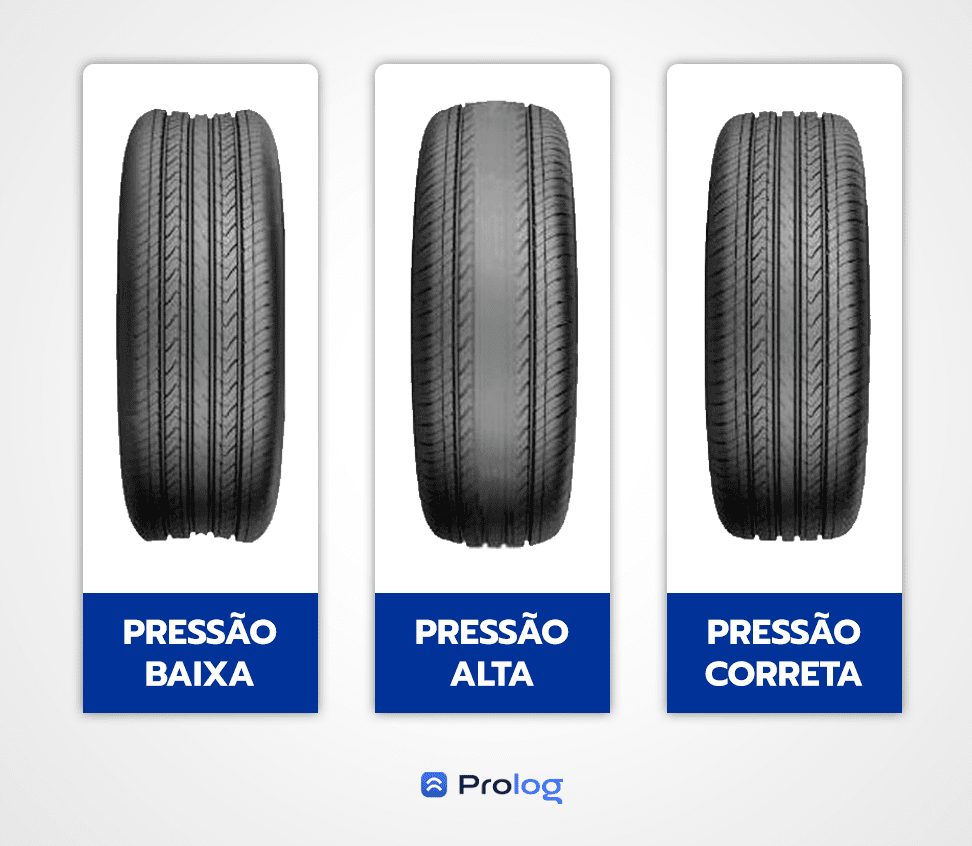
The difference between correct and incorrect tire calibration.
When underinflated, the tire tread has greater contact with the ground and the rubber becomes “softer”. This increases wear on the tire shoulders and makes it more susceptible to cuts, punctures, cracks, overheating and internal damage.
Conversely, when calibration is above the ideal pressure, the tire becomes “bulging”. In other words, less of the tread touches the ground. In this case, wear is uneven and concentrated in the tire’s central strip.
An overinflated tire also poses risks to transport safety, giving the vehicle less stability and balance. Also, the likelihood of cuts, punctures or damage when passing over stones, debris, potholes and other road obstacles increases.
Poor driving
Drivers need to drive defensively, economically and sustainably, prioritizing preservation of the vehicle and its components.
Any poorly timed braking or pressing the accelerator harder can cause unnecessary tire wear. This comes in addition to other consequences, such as engine overheating, higher fuel spending and loss of braking system efficiency.
Poor road conditions
Brazil is known for the great difficulty of traveling on its roads and highways, given their poor conditions. Many have potholes and cracks that should be avoided.
However, it is not always possible to avoid driving on them. So it is the manager’s job to assess routes to match the best roads with vehicles and determine the most suitable tire type for each situation.
After all, some tires perform better on long-distance trips, while others perform better because they withstand urban roads better.
Wheel misalignment
When the steering wheel “pulls” to one side, it means there is an alignment problem. Besides unbalancing the vehicle and increasing rollover and accident risks, it also causes rapid, uneven tire wear.
If alignment is not corrected, wear increases and leads to casing fatigue, preventing subsequent tire reconditioning. In other words, besides losing a tire’s useful life, you lose the chance to use it longer and save fleet resources.
Lack of balancing
When the vehicle shakes and there are “vibrations” in the steering wheel, it indicates a balancing problem. Generally performed alongside wheel alignment, it is a type of preventive service that corrects the distribution of the vehicle’s weight over the wheels.
This gives vehicles better stability and balance.
Shock absorber and brake problems
Shock absorbers play an important role in tire grip on the ground, and brakes can make tires exert greater force to stop, increasing wear.
On the other hand, if the brake is stronger or “heavier” than it should be, it may wear out due to the excess force applied and the friction generated.
Overloading
Weight increases the tire’s contact area with the ground and the vehicle needs more force to move. Trying to compensate for weight by increasing tire calibration is a common “solution” in these cases, but it is something you need to avoid.
The risks and consequences are wasted money and premature loss of your fleet’s tires.
To extend tires’ useful life, you should:
Inspect the tires
A complete maintenance check should take place every 10,000 km, performing alignment and balancing services to prevent vehicle damage. In other words, it is an activity within the preventive maintenance routine.
However, also create a routine with tire management processes in your fleet, inspecting pressure with the electronic tread probe every week and tire tread depth every month.
Besides pressure and tread depth, a good routine checks for uneven wear, very smooth areas, high and low spots and other signs of damage. Pressure, tread depth, rotation and alignment are among the central care measures for keeping tires in use longer.
Check vehicle suspension and geometry
You do not need to wait for the vehicle to develop serious problems or break down to look for the cause. The preventive routine aims to anticipate these problems and bring small solutions to prevent a more serious case.
So vehicle suspension and geometry should be checked frequently, whether based on mileage or time since the last service.
A predefined schedule and the use of an inspection checklist make it easier to identify the need for services like these.
Use the appropriate pressure for each tire
Keeping tire calibration up to date is simple: just perform the calibration process every week. But do you know the ideal pressure for each tire?
This is one of the things you discover through fleet tire management. Pressure should be checked with a suitable gauge, in PSI, and compared against the recommendation applicable to the vehicle, load and operation.
Keep track of tires to understand whether wear is uneven and whether incorrect tire calibration is the cause. If you identify a problem, adjust the assets’ pressure measurement and assess the results in analyses over the coming weeks.
Remember that pronounced shoulder wear represents low pressure, while wear in the center of the tread indicates high pressure.
Rotate tires when necessary
You certainly already know tire rotation is a common practice for increasing asset durability. It contributes to even wear on all tires, both front and rear.
The right time for rotation depends on how far tires have traveled and whether wear is even across all assets. Generally, the service is performed at 10,000 km, as are alignment and balancing.
One tip is to check each vehicle’s Owner’s Manual, which indicates when to rotate and the best rotation pattern. When there is no more specific internal rule, the reference recommendation should respect the vehicle manual and may use regular intervals defined by maintenance.
Check the tire’s TWI
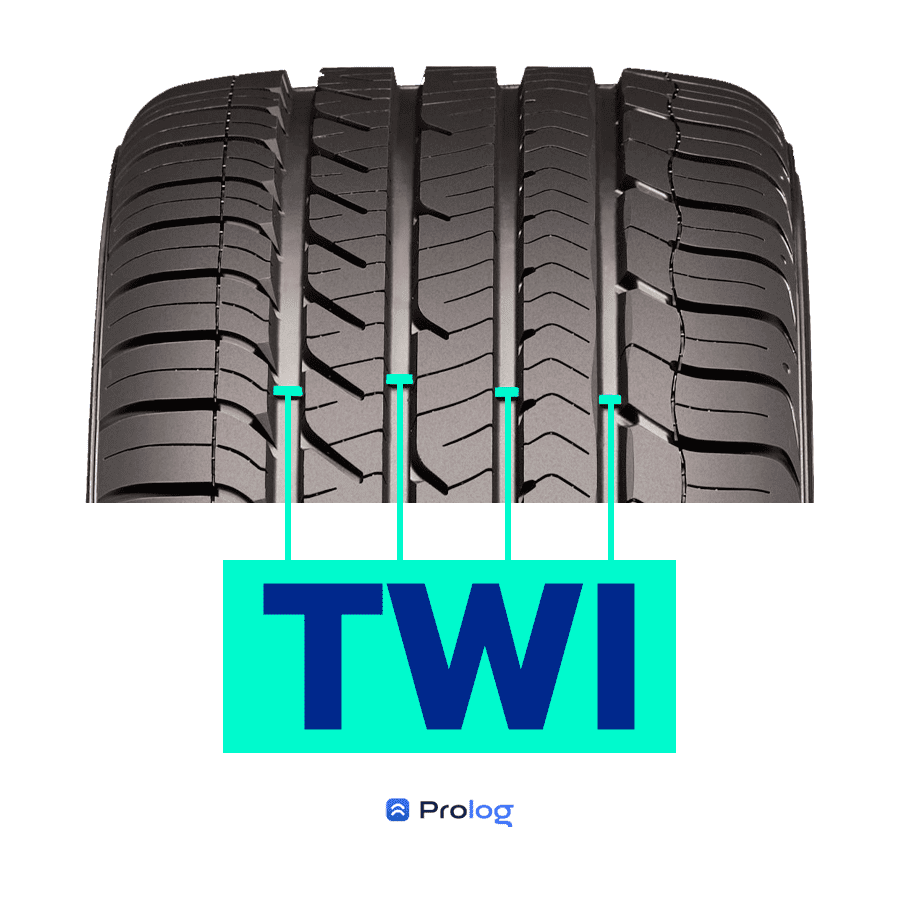
Check the tire’s TWI to identify whether wear is normal or excessive.
The abbreviation “TWI” stands for “Tread Wear Indicator”. It is a raised section at the bottom of each tire groove and indicates exactly what the name suggests: its wear level.
When the tread reaches the tire’s TWI, it is time for replacement. If you can no longer see or identify the tire’s TWI, the tire is probably bald.
Clean tires to remove residue and debris
Every bit of dirt stuck to the rubber makes the tire more susceptible to damage, and cleaning assets is one way to increase a tire’s useful life.
In some cases, it can destabilize the vehicle and make steering harder for the driver. A tire driven on a rainy day retains a sandy, muddy layer even after drying, making tires “slicker” when braking, for example.
In other words, it is fundamental to keep fleet tires clean at all times.
To learn even more about tire care that brings savings and safety to transport operations, download our free e-book (in Portuguese).
Frequently asked questions
How many km does a tire last?
What is a tire’s expiration period?
How often should you calibrate truck tires?
What most shortens a tire’s useful life?
What is a tire’s TWI and how do you use it?
Which routines help tires last longer?
// newsletter
Fleet management content, straight to your inbox
Articles on tires, maintenance and fleet operations. No spam.


