
Tire history: from solid rubber to radial tires
 Luiz Felipe 16 min read

Tire history passes through several important milestones and evolves from something nobody imagined possible at the time into an essential item today. Especially in the daily lives of everyone who needs transport, whether freight or passenger transport.
Now explore the entire journey of tire creation and development, through to the care practices developed so that these tools could be put to the best possible use. Enjoy!
What are the main milestones in tire history?
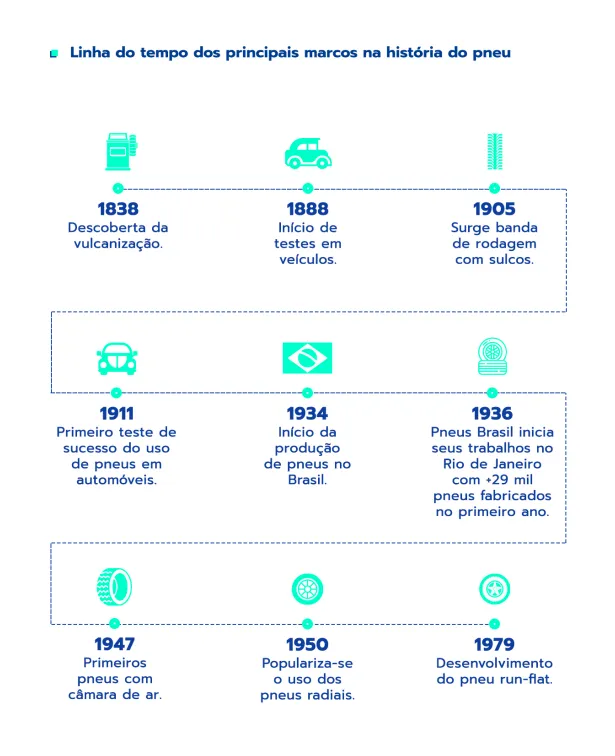
Tire history timeline.
1844 – Charles Goodyear patented vulcanization, which strengthened rubber and opened the way for new uses of the material.
1888 – John Boyd Dunlop developed the first practical pneumatic tire and patented the invention in Great Britain.
1895 – The Michelin brothers pioneered the use of rubber tires on cars.
1905 – Tire grooves appeared in treads, invented by Frank Seiberling, founder of Goodyear, as an alternative to make tires more resistant.
1909 – The first patent for synthetic rubber production was granted to German Fritz Hoffmann.
1911 – Philip Strauss was the first to succeed in using tires on automobiles.
1934 – Brazil's Plano Geral de Viação Nacional, the national transport plan, was implemented. Tire production began in Brazil.
1936 – Companhia Brasileira de Artefatos de Borracha — better known as Pneus Brasil — was established in Rio de Janeiro, producing more than 29 thousand tires in its first year.
1947 – Tires began to feature an air-filled tube combined with the solid rubber surface, making the assembly lighter.
1950 – The decade in which radial tires began to become popular, with casing cords and plies arranged vertically in the direction of travel, following Michelin's launch of a model in 1948.
1979 – The run-flat tire was developed, designed to allow continued driving after a puncture while respecting usage limits such as a maximum speed of 80 km/h and maximum distance of 80 km.
Many other tire types have been developed since then, and tire technology is far more extensive today.
Tread types, rubber types and rubber “thickness” all influence tire performance. This is also why tires have specific purposes according to their construction/production.
Want to see this in your fleet? Talk to a Prolog specialist
How did tires originate?
The wheel had existed for a long time when rubber began to be used to cover it. The first tire prototype was solid, was not filled with air and was used by low-speed vehicles.
Charles Goodyear was responsible for solving one of rubber's biggest issues:
Hardening in the cold and melting in heat.
After his experiments, he arrived at the process now known as vulcanization. That is, cooking rubber at high temperature, adding sulfur during the process.
A supposedly accidental discovery. At least, tire history says the sulfur mixture happened after Goodyear stumbled in his kitchen while experimenting with rubber.
After this discovery, he performed new experiments and measured the ideal temperature and quantity of sulfur for vulcanization. The process was patented in 1844 and revolutionized the rubber industry.
With this “new” rubber, air-filled tires became possible.
How did tires develop over the years?
In 1845, a few years after Goodyear's discovery, vulcanized rubber inflated with air was used to cover carriage wheels.
But only in 1895 did the first air-filled car tires begin to be used in France, intended to cushion the journey and make it more comfortable. Until then, only solid rubber tires were used.
Later, tires acquired an inner tube, making them lighter. Changes in the 50s, with radial tire development, brought steering stability as one of the greatest benefits, along with even greater fuel savings.
As years pass, new technologies emerge and tire manufacturing follows some trends. Today, there are high-, medium- and low-severity tires, each more suited to a specific road type.
Likewise, there are tires with 3, 4 or 5 grooves, which can affect tire efficiency and road grip. Various details indicate their evolution.
In fact, synthetic rubber was a major milestone in producing these components. Natural rubber is a scarce raw material and could never meet today's demand.
What are the main tire characteristics?
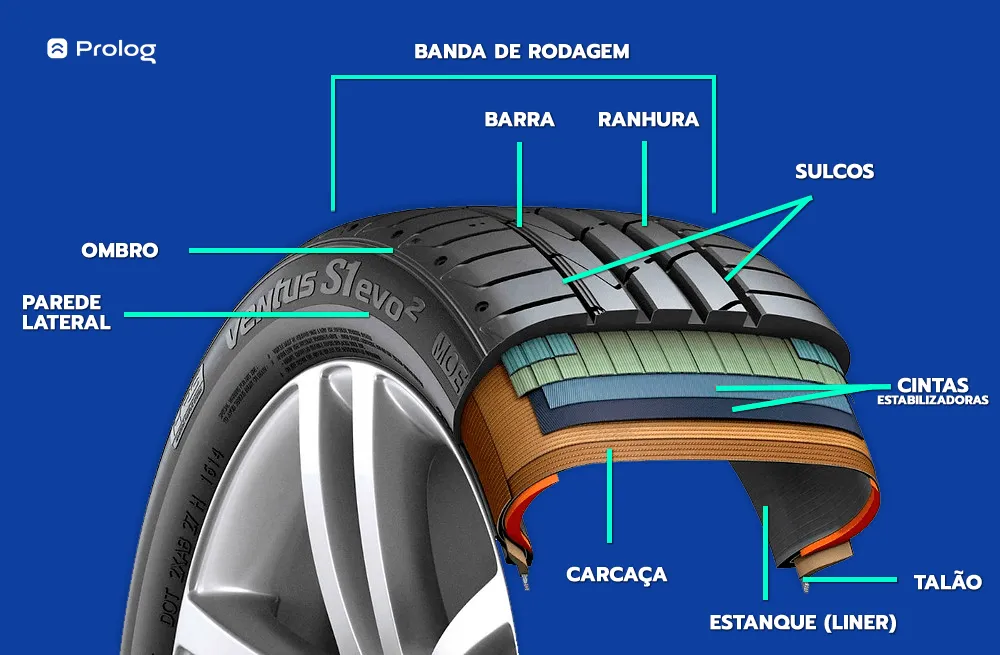
Elements of tire structure.
Tires are made up of the tread, sidewall, casing, stabilizing belts, bead and inner liner.
The tread is the tire's outer part, the one actually in contact with the ground. It consists of grooves, shoulders and blocks. Their respective functions are to drain water and allow air passage; support cargo weight and weight transfer in corners; and generate traction.
The other parts are made with rubber and materials such as nylon, steel and polyester.
Sidewall information
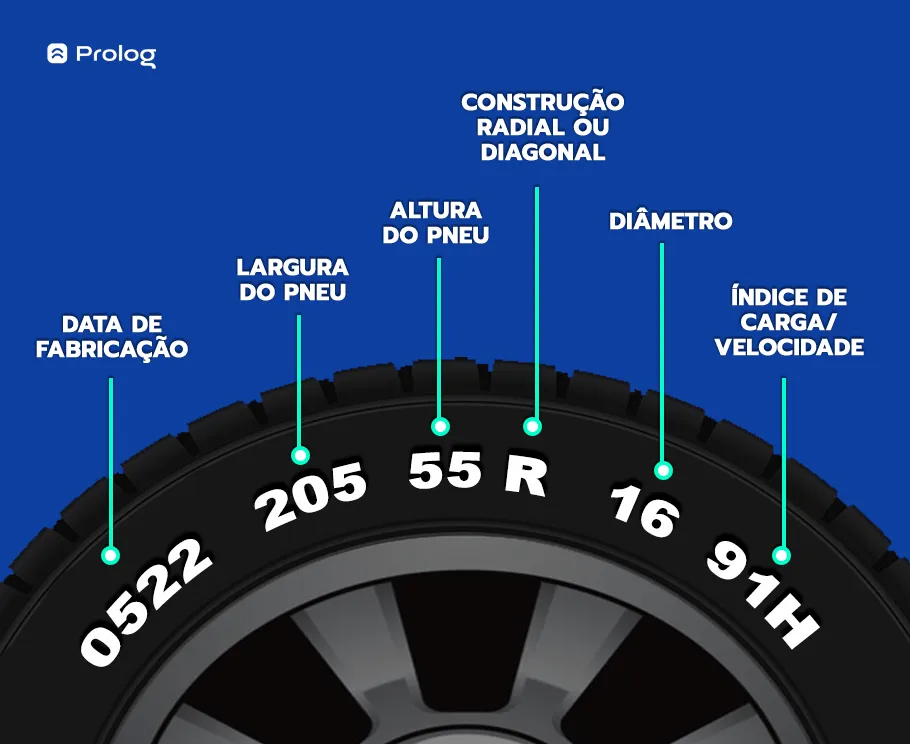
Information on the tire's sidewall.
This information describes some tire characteristics, including, in this order:
- Manufacture date;
- Width and height;
- Whether the tire is radial or bias-ply;
- Diameter;
- Load and speed ratings.
There is normally also a spare space intended for fire-number branding, so transport companies can record each tire's identity after purchasing the component.
Sizes
A tire's size is defined by width, height and diameter. As you can see above, all the data are included on the tire's sidewall.
The values are normally in inches, so in many cases you need to convert them to centimeters. Confirm the size needed for the operation's vehicles and make the right purchases.
A wrong choice can cause early casing damage and even lead to a tire blowout during a trip.
Tire load index
The number indicating the load supported by the tire is the last number written on the sidewall. It is followed by a letter indicating the tire's maximum speed rating, which we discuss in the next section.
Respecting the maximum supported load is important to avoid accelerated tire wear. Excess weight also harms vehicle performance and fuel consumption — since the engine needs to work harder to get the tires turning at the necessary speed.
See the table with the index number and corresponding weight in kilograms:

Tire maximum load index table.
Tire maximum speed rating
Immediately after the maximum supported load number comes a letter, completing the tire's sidewall information. It represents the component's speed rating.
The letters from L to Y translate, as shown in the table below, into speeds from 120 to 300 km/h. This is something you can save and print for your fleet noticeboard, keeping the material available for reference.
In any case, heavy vehicles are not recommended to exceed 80 km/h on their trips. But it is still important to know each tire's ratings and establish rules for fleet use.

Table with the maximum speed rating for each tire.
Number of grooves and tread depth
As we have seen through tire history, their structure has evolved greatly since the first assets were used — when they were all the same.
Today, some tires may have only 1 groove, while others have up to 12. However, the most common number is between 3 and 8 grooves. What determines how many grooves tires should have is the item's size and function.
Some tire models are even developed with both 3 and 4 grooves, potentially producing better results on long-distance trips or urban roads.
However, it is up to the manager to analyze both options' performance and understand which is the best alternative for the fleet's trips.
Grooves are necessary for traction and water drainage, and their number can be crucial to making tires as efficient as possible.
In this respect, tread depth is also very important. New tires range between 10 and 20 mm, but may be deeper. Their intended purpose helps determine initial tread depth.
For example, off-road tires (for dirt roads and rough terrain) are usually deeper, up to 25 mm. Tires focused on greater efficiency on highways and long-distance trips have shallower grooves — around 15 mm.
Tread types
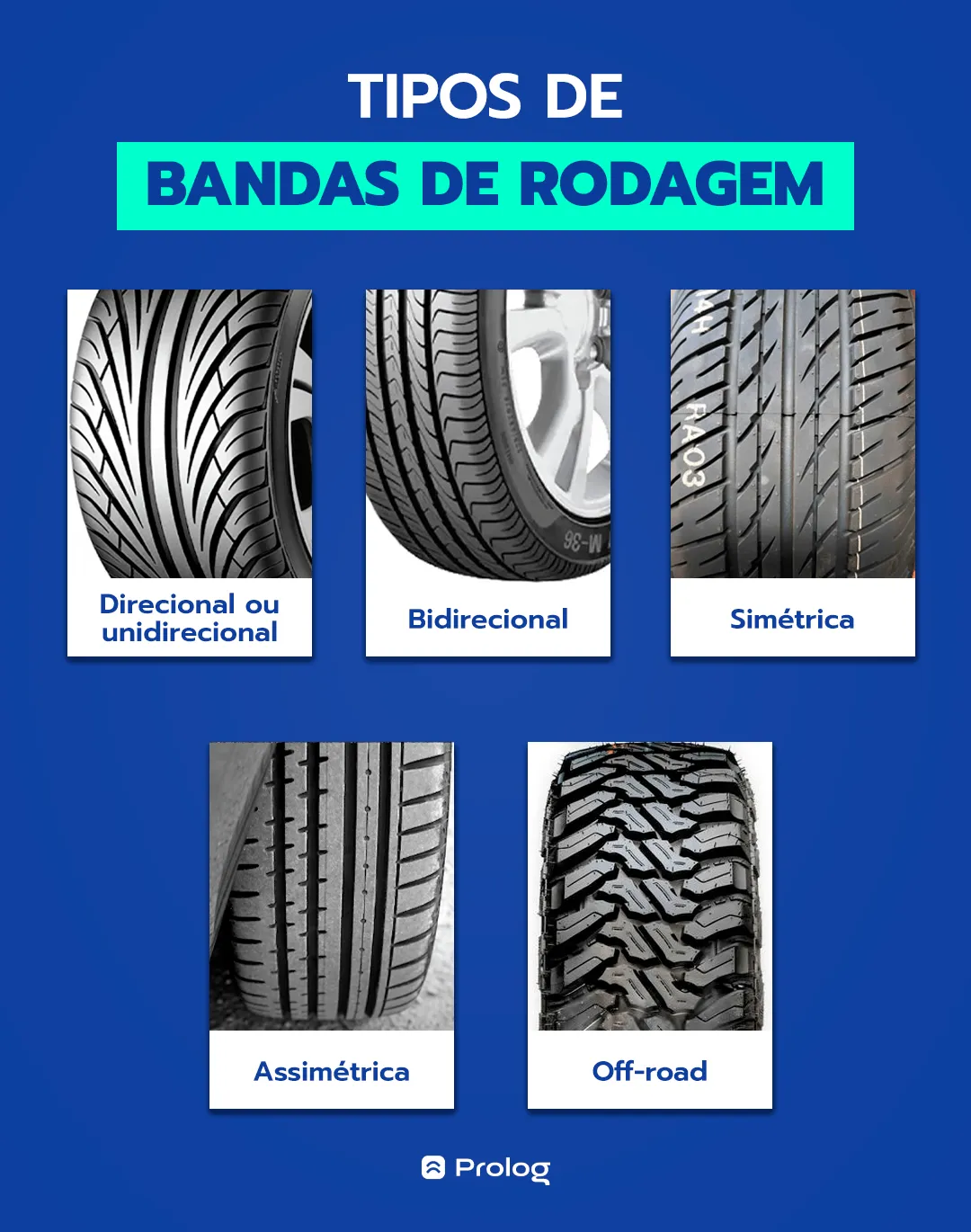
The 5 tread types.
Tread types differ by groove patterns, their depth, tire types and functions. They are:
Directional or unidirectional: Generally have arrows in the rubber indicating the correct mounting direction. This tread type aims to provide greater vehicle stability, especially in corners. It also aims for better performance on high-speed trips.
Bidirectional: Similar to asymmetrical tires, the groove patterns point in two different directions. This construction is intended to generate a little more traction with the ground.
Symmetrical: Patterns on this tread are identical on both sides of the tire. It is also the model most commonly used in transport operations.
Asymmetrical: This tire tread is usually wider than the others because its grooves have patterns alternating in all directions. The downside is that the component wears more unevenly than the others and may have a shorter useful life.
Off-road: These tires have the deepest tread grooves. After all, they are intended to face clay, mud and plenty of debris.
What are the tire types?
By vehicle
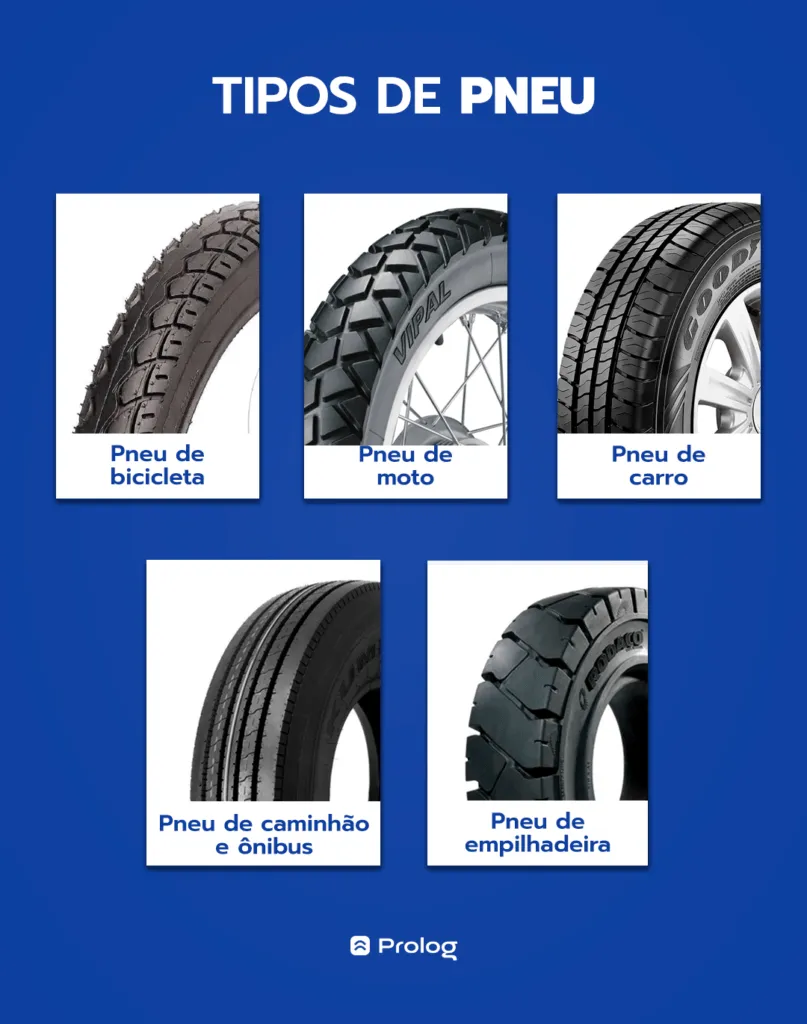
Tire types by vehicle.
Various vehicles now use rubber tires in their structure, from leisure bicycles to industrial forklifts. And what distinguishes each tire type by vehicle?
That is easy:
The vehicle itself! Bicycles require two thin tires, narrower but with a larger rim, that is, its outer diameter. Motorcycle tires are similar but have greater width and larger grooves, since they face different roads and need more resistant rubber.
Then there are cars. Whether used for leisure or as freight or passenger transport, they must use the most suitable tires — with more or fewer grooves, for example.
There may be some confusion about bus and truck tires, but the truth is: there is no difference between them. The same tires used for a long-distance truck trip can be used by a bus for passenger transport within a state.
The only consideration is that specific tires exist for each situation. That is, some tires are more suitable for driving within the city, on dirt roads or on the long-distance trips mentioned above.
Forklifts, meanwhile, have specific tires for driving in warehouses with smooth floors or on rough terrain. In other words, there are also some specific tire types just for these machines.
By severity
(video in Portuguese)
When we talk about severity, we mean tire tread depth. In other words, the higher the severity, the greater the tread depth.
We can divide truck and bus tire types into 3 severity types:
High: These are the most resistant tires, handling the impacts of acceleration, braking and temperature increases well. They therefore perform very well on urban distribution trips.
Medium: Medium-severity tires offer both good resistance and good performance when gaining speed. They strike a good balance between high and low severity, as you may have imagined. They are usually used on regional trips.
Low: Low severity is more susceptible to damage, being quite sensitive to temperature increases and braking friction. It is therefore used only on long-distance trips, with long paved sections and/or expressways.
Then, we can also find tires that are:
- Off-road: Off-road tires also have high severity, but differ through their reinforced structure and may be wider and taller. Used only on roads with plenty of dirt or stones.
- Mixed-service: Combines off-road and highway tire characteristics, performing well on all terrain types. However, it should only be used when the route combines paved and dirt roads in equal proportions. On routes where one road type predominates, prefer tires specific to each situation.
How long do tires last?
From tire history, we do not know exactly what average longevity was when tires first appeared and for many years afterward. Analysis of performance, materials, structure and so on did not begin that long ago.
Today, there is already a great deal of tire information, with various models, sizes and rubber heights aimed at serving the diversity of existing roads and vehicles.
That said, even today, determining how long a tire lasts is complicated. What we can analyze is:
Expiry date vs. average longevity
Every tire has an estimated validity of 5 years from manufacture — the only date marked at the factory on tires. So, if a tire was produced in 2022, it can be purchased and used without issues until 2027.
However, this does not guarantee longevity, since care practices affect how long tires last. This means:
If you do not calibrate them or perform vehicle maintenance such as balancing and alignment, you may lose the asset much sooner than those expected 5 years.
With defensive, economical driving, a tire can reach around 70 thousand km traveled. However, this depends on its shape, groove number and depth, roads faced, etc. Besides these, see other factors:
Issues affecting fleet tire longevity
Besides expiry date and driving style, tire useful life is determined by several other factors. These include weather conditions during the trip, the roads themselves and factors such as calibration, rotation and irregular tread wear.
If we look closely, both above- and below-recommended calibration can cause tire issues.
When pressure is too high, there is greater wear in the tread's center, causing the vehicle to lose stability and creating a risk of tire blowout if it suffers a heavier impact.
Low pressure, meanwhile, causes greater wear on tire shoulders and sometimes sidewalls. This is because the tire runs with uneven ground contact.
In both cases, tire and vehicle performance is affected, increasing trip time and fuel consumption.
There are not many measures to prevent damage from weather and poor roads. Weather is uncontrollable, and drivers are often surprised by rain and/or strong winds mid-trip.
Roads in general are also a factor you cannot control. But you can always keep tires calibrated and at the ideal tread depth to avoid issues. You can also seek alternative routes that maintain average delivery time and overall performance.
What increases tire useful life?

Actions that increase tire useful life.
Ideal calibration
(video in Portuguese)
In freight transport, unlike light fleets, ideal tire calibration is defined mainly by the weight the vehicle will carry. It is therefore important to consider the truck's gross weight, attached equipment and total cargo.
Contrary to what many imagine, there is no fixed pressure determined by the tire manufacturer, but rather a recommendation based on the maximum load it can safely support.
With all that said, these recommendations will not always be 100% precise. The best approach is to perform tire pressure control, along with tread depth control, checking weekly or every two weeks and analyzing the wear level the tire shows.
If wear is above normal, adjust calibration and analyze again. As you notice wear is stable (minimal), you will have the ideal pressure for tires to achieve maximum longevity.
Tread depth control
This control, as mentioned above, is also directly linked to finding ideal tire pressure. After all, tread depth indicates wear level.
How does this happen?
By establishing normal wear of up to 0.5 mm every 5 thousand km traveled, you can check through tire inspections whether the tire met that expectation, exceeded that wear or even outperformed expectations with less wear than predicted.
Both these forecasts, made using tread depth tables, and the view of results can only be built through regular control of groove wear.
So, each month, schedule specific days in your calendar for this measurement.
If the carrier has not yet implemented a method, it needs to acquire a manual tread probe and a control spreadsheet, or a digital tread probe that sends data to a system that is also digital.
Tire rotation
Rotation ensures all tires wear naturally at the same level. This way, when replacement time comes, all installed tires are replaced together. Much better and more practical for planning replacements and new component purchases.
Normally, the most suitable tire rotation practice is described and illustrated in each vehicle's manual. The best approach, even if you have these instructions, is to leave the work to a trained professional.
This ensures tires are installed correctly.
Like other fleet tire care, rotation helps generate savings, increase safety and make vehicle fuel consumption more efficient. Besides, of course, increasing tire useful life.
Defensive driving
The way vehicles are driven largely affects fleet fuel consumption. However, tires also suffer, as they receive all the impacts of improper practices such as excessive acceleration, which quickly raises tire temperature.
That is why defensive driving is so recommended for those working in freight transport and, fundamentally, passenger transport.
What does it involve?
First, it has some basic principles, such as:
- Knowing traffic laws;
- Knowing how to drive the assigned vehicle;
- Understanding precautions for possible obstacles or unexpected road events;
- Knowing how to drive in unfavorable weather.
Then it is defined by practices promoting traffic safety to avoid accidents, and the longevity of vehicles and components (including tires). For example:
- Paying attention to other vehicles on the road;
- Keeping a safe distance from the vehicle ahead;
- Always keeping both hands on the steering wheel;
- Performing vehicle maintenance;
- Respecting signs and weight limits;
- Overtaking safely;
- Handling truck dimensions well;
- Etc.
Avoiding excess load
The vehicle's and cargo's weight rests entirely on the tires. So, when there is excess load, tires are pressed harder against the ground and have more difficulty rotating.
This practice also harms overall trip performance, even causing increased fuel consumption.
Each tire has its maximum load index, right? Each vehicle has this indication too. So respect the limits to achieve a longer-lasting fleet.
Performing periodic vehicle maintenance
Keeping maintenance up to date should be a fleet objective regardless, but for tires, certain tasks are essential to avoid premature component disposal.
These include vehicle balancing and alignment, brake care and suspension care in general. These components are directly related to tires.
Balancing adjustment, for example, ensures wear is regular instead of occurring on tire shoulders. Brake adjustments allow minimal, consistent wear across the rubber as a whole, instead of excessive localized wear.
Did you know that tire evolution also brings specific care needs?
Among the items you saw for increasing tire useful life, pressure and tread depth control fall under what we call “tire management”.
And what is tire management?
This practice is becoming increasingly common in Brazilian fleets, given the high cost of these assets. It consists of including processes in the fleet's routine to care for tires.
This ranges from washing them to pressure and tread depth measurements. Each step is important to ensure component longevity.
In fact, making better use of tire useful life also increases the chances of retreading. Retreading can extend casing useful life and help reduce tire costs.
And retreading is the process of replacing the tread so the tire gains a new life. Following these tire care best practices can increase the chances of more than one retread, provided the casing is in good condition.
Have you imagined having a tire that lasts that long? Nobody in tire history is likely to have imagined it!
You can also keep up with our content on our YouTube channel.
Watch one of the most-viewed videos (video in Portuguese):
Frequently asked questions
How long does a truck tire last?
How did tires originate?
What is the ideal truck tire calibration?
Is there a difference between bus and truck tires?
How many grooves does a tire have and how deep are they?
What increases tire useful life?
// newsletter
Fleet management content, straight to your inbox
Articles on tires, maintenance and fleet operations. No spam.


